|
TRANSLATE THIS ARTICLE
Integral World: Exploring Theories of Everything
An independent forum for a critical discussion of the integral philosophy of Ken Wilber
 Dr. Joseph Dillard is a psychotherapist with over forty year's clinical experience treating individual, couple, and family issues. Dr. Dillard also has extensive experience with pain management and meditation training. The creator of Integral Deep Listening (IDL), Dr. Dillard is the author of over ten books on IDL, dreaming, nightmares, and meditation. He lives in Berlin, Germany. See: integraldeeplistening.com and his YouTube channel. He can be contacted at: joseph.dillard@gmail.com Dr. Joseph Dillard is a psychotherapist with over forty year's clinical experience treating individual, couple, and family issues. Dr. Dillard also has extensive experience with pain management and meditation training. The creator of Integral Deep Listening (IDL), Dr. Dillard is the author of over ten books on IDL, dreaming, nightmares, and meditation. He lives in Berlin, Germany. See: integraldeeplistening.com and his YouTube channel. He can be contacted at: joseph.dillard@gmail.com
SEE MORE ESSAYS WRITTEN BY JOSEPH DILLARD
THE DREAMING KOSMOS
A Naturalistic Approach to Emergence and Transformation through Transpersonal Dream Yoga Harnessing Negentropy, Chaos Theory, and the Attractor Informational network to Unlock Emerging Potentials Chapters 01 | 02 | 03 | 04 | 05 | 06 | 07 | 08 | 09 | 10 11 | 12 | 13 | 14 | 15 | 16 | 17 | 18 | 19 | 20 21 | 22 Contains AI-generated content. The Noun-King and the Three Great Engines of TeleologyThe Dreaming Kosmos, Chapter 14Joseph Dillard
Before the first stories were spoken, before language congealed the flowing world into categories, the Dreaming Kosmos moved in pure relation. Everything was verb. Everything was becoming. Rivers didn't flow, they were flowing. Stars didn't shine, they were shining. Creatures didn't grow, they were growing. But from within this shimmering field of motion rose a peculiar tribe: The Nouns. The Rise of the Noun Tribe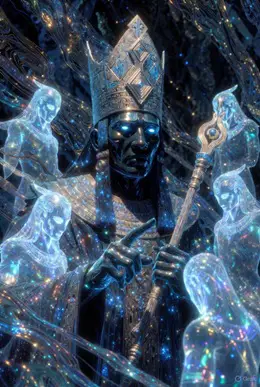
The Noun Tribe were the beings who grew weary of flux. They hungered for stability, names, boundaries, and permanence. While the Verbs danced in ceaseless transformation, the Nouns hammered stakes into the ground, insisting, “This is what it is. Here it stays.” The Noun Tribe favored adaptation, structure, stability, and security over selfless organization, process, emergence, and creativity. At their center ruled a figure known as the Noun King, a sovereign of stillness who believed the world could only be understood by freezing its motion. He wore a crown of carved definitions and carried a scepter shaped like a pointing finger. Yet the Noun-King was neither cruel nor ignorant. He knew that naming made cooperation possible. He understood that mapping the ever-shifting terrain required anchors. Without nouns, there would be no memory, no shared meaning, no stable identity around which a community might gather. But as the ages passed, the Noun-King grew too powerful. His tribe multiplied, building fortresses of certainty. They feared ambiguity, distrusted emergence, and suspected anything that refused to hold still. To enforce his rule over the Dreaming Kosmos, the Noun-King relied on three servants, each powerful, subtle, and indispensable. These were the Scouts of Agency, the Priests of Essence, and the Royal Bard of Story. Their combined influence shaped the human mind long before language, and even now they operate behind perception, as the built-in, hard-wired, genetically inherited cognitive biases of agency, essentialism, and narrative. Together their job is to generate the irresistible feeling that everything has intention, identity, and purpose. These servants are not villains. They are cognitive tools, prehistoric software for survival, still running beneath the modern mind. Yet when their power goes unchecked, they generate teleology, the sense that the universe seeks ends, embodies intention, or unfolds according to destiny.[1] Serving the Noun King, their purpose is to capture and entrain human thinking to create language that validates stability, structure, and security in the name of adaptation. Nouns are welcomed into the tribe. At best, verbs are viewed as servants of the King and his loyal subjects. How can we recognize these servants without banishing them? How can we honor their function while loosening their grip? This is a function of IDL Dream Yoga, a mythopoetic process epistemology disguised as practical psychology. Even the most sophisticated scientific frameworks are not immune to the subtle enchantments of the Noun Tribe. Their King whispers into laboratories and lecture halls just as easily as into myths. His three great servants, the Scouts, the Priests, and the Bards, dress the impersonal logic of systems in the costumes of intention, essence, and story. Let us meet these three faithful servants of the Noun King in turn. The Scouts of AgencyThe Scouts are the Noun-King's swiftest servants. They race ahead of perception, painting intention onto every flicker of uncertainty. They whisper: “Something is behind this. Someone meant this. You are being watched.” In the Dreaming Kosmos, the Scouts are tireless. They animate the inert, personalize the impersonal, spiritualize the random: a falling acorn becomes a sign from ancestors, a sudden illness becomes punishment or cosmic pedagogy; a strange noise in an empty room becomes a lurking presence; a coincidence becomes a message addressed to you; a malfunctioning appliance becomes a mischievous house-spirit; a fluctuation in finance becomes the will of an invisible hand; dream figures become emissaries of the unconscious gods. Even in evolutionary, systems, and chaos theoretical sciences, the Scouts of the Noun King sneak agents into descriptions of process. They make scientists utter magical ritualistic formulas like, “Natural selection chooses the best solutions,” implying that there is a selecting mind rather than stochastic filtering across reproductive variance. They proclaim, “Cells decide whether to differentiate,” signaling gene-regulatory dynamics as deliberation and intention, something Nouns do. They smuggle in a teleological “guide” by proclaiming that “Constraint-based causation guides the evolution of new forms.” They tell us that “The ecosystem wants to return to equilibrium,” suggesting desire where there is only feedback regulation. They attribute goals to dissipative structures by announcing that “Self-organizing systems seek stability.” They confuse random variation with purposeful correction by proclaiming that “The mutation tries to compensate for the breakdown of the pathway.” They anthropomorphize mathematical basins by stating, “The attractor pulls the system toward order.” These biases appear whenever scientists, educators, or communicators inadvertently animate processes or treat distributed causal networks as if they harbor intentions.[2] All of these successful fossilizations of process by the Scouts of Agency are received with great pleasure by the Noun King. In each case, the language of agency papers over the absence of a self, a will, or an intention. The Scouts have done their job. The Noun King knights his Scouts for successfully making impersonal mechanisms seem intentional. The Priests of Hidden EssenceThe job of the Noun King's priests is to declare hidden essences inside fluid systems. If the Scouts animate, the Priests of Essence sanctify. They carry urns filled with golden resin, the substance of identity. Wherever they pour it, motion freezes into meaning. The Priests whisper: “Beneath every appearance lies a hidden core, immutable, defining, eternal.” They proclaim with certitude language that implies that complex, emergent, multi-causal phenomena are produced by internal “core identities” or quasi-substances. Their creed spreads through the Dreaming Kosmos, encouraging beings to believe that: “A lion is a lion, even if it grows up among sheep.” “A nation has an unchanging character.” “A gene houses destiny.” “A diagnosis speaks the truth of a soul.” “A spiritual glimpse reveals the 'true self.'” “Humanity is essentially different from all other life.” Instructed to spread this creed, the Priests wandered the lands of the Verbs, pouring resin over rivers mid-meander, flames mid-dance, and creatures mid-becoming. The resin hardened everything it touched. Categories proliferated; boundaries sharpened; gradients dissolved. Essentialism embalmed the world with definitions, convincing humanity that identities are inherent rather than relational, internal rather than emergent, and fixed rather than provisional. This is the High Priesthood of the Noun-King, making permanence appear fundamental. Not content to conquer culture and society, the Noun King sent his priests out to pour their resin over science. In a very short time people in lab coats were proclaiming that there are genes for altruism, aggression, and intelligence, implying that there is a stable essence contained in DNA rather than polygenic, context-dependent expression. They started affirming that stem cells contain an intrinsic capacity to become anything, suggesting a magical internal essence rather than regulatory openness to environmental cues. They announced that “Chaos systems have an underlying order,” vesting reification by turning an abstract concept concrete. They pronounced that “Organisms express their true evolutionary potential under stress,” thereby framing evolutionary novelty as the unfolding of a pre-set inner nature. They told us that “Every species has an adaptive essence that defines its niche,” ignoring niche construction, co-evolution, and plasticity. By stating that developmental pathways embody ancestral programs, they used the metaphor of a program to turn process into a blueprint with fixed content. Such is the slight-of-hand of the Priests of the Noun King, as they utter their incantations while pouring their resin over the dancing Verb Tribes.[3] The Priests of the Noun Tribe adore these formulations. They turn relational dynamics into inner substances, souls by another name. The world becomes alive with shamanistic nouns, the spirits of rocks, rivers, and lightening. The Noun King built temples for his Priests, in gratitude for their success in making fluid systems seem to contain fixed essences.[4] The Royal Bards of the Noun KingThe Bards are the most beloved of the Noun-King's servants. They are the teller of tales, the weavers of coherence, the spinners of fate. They carry looms with which they stitch events into stories. On their silver looms a setback becomes a heroic trial and a heartbreak becomes moral instruction. Evolution becomes progress and history becomes ascent. Random suffering becomes “part of a plan” and coincidence becomes destiny. In the old myth, the Bards carried brushes dipped in living ink. Wherever they passed, they painted eyes on clouds, carved expressions into mountains, and fashioned whispers in the wind. They believed they improved the world by making it legible, animated, alive. They are the Noun-King's vanguard, converting verbs into characters and processes into personalities. They humanize what does not think, animate what does not live, and imbue the swirling flux of process with imagined fingerprints. The Bards were not content to transform collective culture and society into groupthink pleasing to the Noun King. They silently invaded the laboratories and universities of the most revered scientific minds of the world. Their influence is found wherever and whenever scholars and researchers describe open-ended evolution, system dynamics, or chaotic behavior as if unfolding along a pre-written plot arc or moral trajectory. The Bards smile and the Noun King applauds their work when the scientists proclaim “Evolution moves toward increasing complexity,” proliferating a teleological storyline imposed on contingent historical branching. When they tell us that “Major transitions represent the great chapters of life's progress,” the Bards shake hands and congratulate one another. They have succeeded in imposing a historical structure on top of biological events. When scientists proclaim that “Systems learn to organize themselves more efficiently,” the Bards know that they have succeeded in implanting the belief in development toward a goal instead of iterative environmental interaction. When they hear “The evolutionary process solves the problem of cooperation,” they know they have successfully framed distributed selection pressures as a dramatic resolution. When a scientist states, “The population climbed out of the adaptive valley and found a higher peak.” They know they have succeeded in portraying landscapes as quests and peaks as destinies. When a chaos theorist states that “Chaos is nature's way of exploring the space of possibilities,” they grin, knowing they have succeeded in assigning adventurous purpose to stochastic exploration. The Bards are the most seductive of the King's servants because stories are how the human mind, even the dreaming mind, naturally tames the wildness of nonlinear processes. The narrative bias the Royal Bards stitch upon their looms refuses a world without plot. Their mandate is to organize chaos into meaning. The Bards follow the Scouts and Priests, stitching their work together. While the Scouts animated and the Priests essentialized, the Royal Bards narrated. The result was a world that felt intentional, purposeful, moral, and coherent, pleasing the Noun king and turning the Verb tribe into loyal servants. The Noun King gifted his Bards with priceless silver gowns for making life's open-ended processes seem like plotted progress. Even the most rigorous models of EES (Extended Evolutionary Synthesis) and systems science, fields explicitly committed to multi-causality, emergent behavior, and dynamic feedback, find that these biases still infiltrate, shaping how results are explained and how research is imagined. These fields must pass through the gatekeeping metaphors of ordinary language. But there was a problem unrecognized by the Noun King. This tapestry was a projection, not the fabric of the Dreaming Kosmos itself. This is precisely why IDL Dream Yoga's de-reification, de-centering, and perspective-shifting practices are so potent: they reveal how easily the Noun Tribe's spells seep into perception, understanding, and interpretation, even in the most technical disciplines. When the Noun and Verb Kings Met on the Plain of PerceptionAs the Noun Tribe grew stronger, the world of the Verbs grew restless. Rivers resented being frozen into “river-things.” Clouds resisted being assigned meaning. Creatures tired of being trapped in categories that never evolved. Consciousness itself got tired of being locked in a metaphysical purgatory. On the Plain of Perception, the Verbs appeared: flowing, spiraling, transforming. The Scouts tried to animate them, but the Verbs slipped through every attempt to personify them. The Priests poured resin, but the Verbs danced between the drops. The Bard cast narrative threads, but the Verbs spiraled beyond linearity. The Noun-King shouted, “Meaning must be fixed!” The Verbs replied by becoming storms. The Noun Tribe insisted, “Identity must endure!” The Verbs dissolved into mist. The Noun-King proclaimed, “Purpose guides everything!” The Verbs laughed and became wind. The stalemate stretched across an age of the world. The Arrival of a Mediator: IDL Dream YogaFrom this tension emerged a new figure: the Human, a creature who dreamt in Verbs as well as Nouns, but spoke in Nouns. Humans felt the pull of both realms, yet were enslaved by the Noun-King's servants. They mistook Scouts for spirits, Priests for metaphysical truths, and the Bard for cosmic law. And so the Dreaming Kosmos birthed a discipline to heal the rift: Integral Deep Listening Dream Yoga. IDL moved between Nouns and Verbs, teaching humans de-reification, unfreezing the rivers of groupthink to allow them to flow again, loosening the Priests' resin. It taught humans to de-teleologize, to quiet the groupthink babble of the Bard's compulsive stories. It dissolved the Scout's projections by de-centering the self through practicing empathetic multi-perspectivalism. By returning perception to process it restored the forgotten Verbs so that they could dance freely, generating higher order selfless organization. Every interviewed dream figure, transpersonal experience, or personification of a life issue became a process, a relational pattern, a system-perspective, and an attractor making a recommendation. Nothing in IDL carried intrinsic essence. Nothing acted with fixed identity. Everything emerged from context, relation, and ongoing becoming. Through IDL, the Verbs rose again, not to overthrow the Noun-King, but to balance him. Humans learned once more to see the Dreaming Kosmos not as a story with a plot, nor a machine with a plan, nor a hierarchy of essences, but as a living improvisation, a weaving of relationships in motion. IDL restored the Verbs. NOTES
Widget is loading comments...
|