|
TRANSLATE THIS ARTICLE
Integral World: Exploring Theories of Everything
An independent forum for a critical discussion of the integral philosophy of Ken Wilber
 Dr. Joseph Dillard is a psychotherapist with over forty year's clinical experience treating individual, couple, and family issues. Dr. Dillard also has extensive experience with pain management and meditation training. The creator of Integral Deep Listening (IDL), Dr. Dillard is the author of over ten books on IDL, dreaming, nightmares, and meditation. He lives in Berlin, Germany. See: integraldeeplistening.com and his YouTube channel. He can be contacted at: joseph.dillard@gmail.com Dr. Joseph Dillard is a psychotherapist with over forty year's clinical experience treating individual, couple, and family issues. Dr. Dillard also has extensive experience with pain management and meditation training. The creator of Integral Deep Listening (IDL), Dr. Dillard is the author of over ten books on IDL, dreaming, nightmares, and meditation. He lives in Berlin, Germany. See: integraldeeplistening.com and his YouTube channel. He can be contacted at: joseph.dillard@gmail.com
SEE MORE ESSAYS WRITTEN BY JOSEPH DILLARD
THE DREAMING KOSMOS
A Naturalistic Approach to Emergence and Transformation through Transpersonal Dream Yoga Harnessing Negentropy, Chaos Theory, and the Attractor Informational network to Unlock Emerging Potentials Chapters 01 | 02 | 03 | 04 | 05 | 06 | 07 | 08 | 09 | 10 11 | 12 | 13 | 14 | 15 | 16 | 17 | 18 | 19 | 20 21 | 22 Contains AI-generated content. The Twin Dragons of EmergenceMicrocosm, Macrocosm, and the Evolution of CooperationThe Dreaming Kosmos, Chapter 11Joseph Dillard
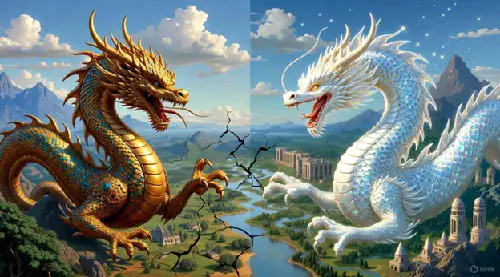 For centuries, the Western world has thrived under the logic of competition. Dominance, conquest, extraction, individualism, and control became the measure of success, the gold and jewels guarded in the mountain halls of civilization's Smaug-like dragon. Its vigilance ensured the expansion of empires across continents and oceans. Trade networks flourished, technological advances accelerated, and wealth accumulated in ways unprecedented in human history. Yet every expansion bore a cost: economic inequality, ideological extremism, ecological devastation, and unending cycles of war. The dragon's treasure gleamed, but cracks festered in its foundation. Meanwhile, subtle forces began to stir across the globe, beyond the reach of Smaug's immediate gaze. In the East, South, and peripheries of old Western power, conditions demanded adaptation. Rivers of trade, corridors of infrastructure, and networks of influence emerged that did not rely on coercion or domination. The Phoenix dragon arose here, scales glimmering with relational light. It was neither weaker nor submissive; its potency was transformational. It thrived in cooperation, symbiosis, systemic feedback, and higher-order adaptation. Where Smaug enforced hierarchy, Phoenix cultivated networks. Where Smaug demanded vigilance, Phoenix nurtured relational intelligence. The Dragon of Adaptive Stability: Smaug RevisitedIn the mythic mountain halls, Smaug's eyes glimmered in molten gold. Every coin, jewel, and artifact represented centuries of competitive dominance. Its claws traced the outlines of empires past and present, its wings casting shadows over global trade, political hierarchy, and economic networks. Smaug's breath scorched deviation; any innovation or relational experiment that threatened his treasure was immediately incinerated. At the macrohistorical level, Smaug represents the Western hypercompetitive model, dominant for ~500 years. From Greco-Roman legacies through Renaissance mercantilism, industrial empires, and modern globalization, the West's strategies emphasized unilateral leverage, control over resources, and self-maximization. Institutions, legal systems, and military power were marshaled to preserve hierarchical order. But over time, Smaug's methods became unsustainable: internal fissures, including inequality, extremism, and social fragmentation, combined with global overreach and ecological strain, generating systemic stress. But the engagement between these two dragons does not only play out in the macrocosmic, geopolitical sphere. It also plays out every day in our 24 cycle between the adaptive control of our waking identity and the wild self-organization of our night time dreams. In those dreams, Smaug manifests as attachment to our waking perspective and assumptions, through which we filter dream reality. Even in lucid dreams our default perspective is that of our scripted waking reality. When we practice interviewing the elements, both awake and in our dreams, using Integral Deep Listening dream yoga, we evolve empathy and multi-perspectivalism, relational foundations of evolutionary cooperation, balance, and self-organizing emergence. By encountering Smaug in our inner landscape we dismantle self-other dualisms to integrate our waking/dreaming survival/cooperation polarity. Here is our first exercise for mediating internal dragons: IDL Exercise 1: Witnessing Adaptive Stability• Enter a dream or meditative landscape and visualize Smaug perched atop a vast treasure hoard. • Become Smaug and observe what you are doing and how you feel. What do you like most about yourself? What do you like least? • How is Smaug like you? How are you like Smaug? • Reflect on the ways these similarities have served your survival and stability. The Dragon of Adaptive Flux: Phoenix EmergenceBeyond the mountain halls, the Phoenix dragon rises from the fires of necessity. Unlike Smaug, it does not hoard. Its flames transmute rather than destroy, nurturing networks of cooperation and relational intelligence. It represents the Margulisian principle that collaboration outcompetes domination under systemic stress. Just as eukaryotic cells arose from symbiotic cooperation, ecosystems stabilize through mutual adaptation, and bacteria thrive through relational networks, civilizations now reveal similar dynamics on a planetary scale. Phoenix thrives where old hierarchies falter. Russia and China's movement from historical rivalry to strategic alignment, the emergence of BRICS+ as multipolar economic and political coordination, and the African Union's relative unity on resource sovereignty all manifest Phoenix-like relational intelligence. Belt & Road infrastructure, Eurasian economic corridors, and non-dollar trade systems exemplify non-coercive integration, creating feedback-sensitive networks capable of enduring instability. In IDL dream interviewing, Phoenix appears as therapeutic reframings of dreams and life issues, emergent relational patterns, and cooperative strategies. It appears as the retreat of control, fear, and self as identity expands and thins as a result of becoming multiple other perspectives. Practitioners can invite the dragon to interact, facilitating inner negotiation with Smaug.
IDL Exercise 2: Inviting Adaptive Flux
• Visualize Phoenix soaring above Smaug's mountain, fire illuminating hidden corridors and bridges. • As with Smaug, become Phoenix and experience what that feels like. What are your strengths? What are your weaknesses? How are you, Phoenix, most like the dreamer? How is the dreamer most like you? • Now become Smaug again. As Smaug, do you want to change? If so, how? “ Smaug, you can stay the same if you want. This is about what YOU want, Smaug, not about the dreamer's preferences.” • Now become Phoenix again. “ Phoenix, what do you think about Smaug's decision, whether it is to stay the same or to change? How would you like to relate to, interact with Smaug?” “ Again, Phoenix, as with Smaug, this is about what YOU want, not about the dreamer's preferences.” • “ Smaug, if you were in charge of this dreamer's life, would you live it differently? If so, how?”
Geopolitical Vignettes: Macrocosmic Dragons at PlayBRICS and the Eurasian CorridorIn the Eurasian steppe and along the Silk Road routes, Phoenix dragons stir. China and Russia coordinate strategically, leveraging complementarities in trade, defense, and technology. India asserts an independent, multipolar role. Middle Eastern states normalize relations under the auspices of BRICS+ initiatives. The African Union emphasizes continental resource sovereignty. Together, these forces form a networked counterbalance to Western hypercompetitiveness, emphasizing infrastructure, mutual benefit, and systemic integration rather than coercion. Belt & Road and Infrastructural IntegrationBelt & Road projects exemplify Phoenix's logic. Rail lines, ports, energy grids, and digital corridors create durable interdependencies. Unlike Western conquest, these strategies reward cooperation, create feedback loops, and build resilience against shocks such as climate crises, pandemics, and economic instability. Participants gain shared benefits without direct subjugation, demonstrating systemic cybernetic self-correction in action. Financial and Trade DecouplingNon-dollar trade networks, regional currencies, and resource-backed barter systems exemplify adaptation to structural exhaustion. Western hegemonic influence is challenged not through war but through relational economic intelligence. These developments mirror the dream landscape: channels open where Phoenix flights connect nodes that Smaug once guarded jealously. Systemic Global ChallengesClimate destabilization, energy transition imperatives, food and water insecurity, pandemics, and financial volatility act as evolutionary pressures. Competitive models fail to resolve these crises alone. Only relational, cooperative systems, like the Phoenix dragon's network, can absorb stress and maintain planetary homeostasis. IDL Microcosmic Diplomacy: Negotiating Inner DragonsDream Yoga, becoming not only dream elements but waking life issues and transpersonal experiences, provides a laboratory for microcosmic diplomacy, where the same tensions observed globally are experienced internally. Practitioners cultivate skills to mediate between the Smaug dragon of defensive hierarchy and the Phoenix dragon of emergent cooperation. IDL Exercise 3: Dragon Dialogue• Think of the life issues that most concern you. Perhaps they involve finances, your health, your relationships with your partner, children, or parents. Perhaps they involve issues of life meaning and death. • Ask Smaug how he would deal with your life issues if he was in charge of your life. • Ask Phoenix how she would deal with your life issues if she was in charge of your life. • Ask each dragon to inform decisions rather than dominate. • Ask each dragon, “ How can I test your recommendations in my life to find if I can trust you or not?” • “ Are there times in my waking life and dreams that you recommend that I become you? If so, when? If so, why?” IDL Exercise 4: Cooperative Visioning
• Imagine a world where Smaug and Phoenix collaborate rather than contest. • How might family dynamics change? • How might communities interact differently? • What might the impact on culture be? • What might be the consequences for relationships between nations? The Cybernetic Thesis: Self-Correction in ActionThe planetary system itself behaves like a cybernetic organism. Hypercompetitive Western structures generate instabilities, exhaust resources, and provoke counterforces. Emergent cooperative blocs increase feedback sensitivity and resilience. This is second-order cybernetics at a civilizational scale: a system corrects itself when a single attractor, competition, dominates unsustainably. Prigogine's dissipative structures demonstrate that crises create conditions for novel order. Laszlo's evolutionary systems theory shows that networks with relational feedback are adaptive. Bateson's ecology of mind finds that relationships and differences generate learning and homeostasis. Wilber's integral evolutionary frameworks reveal that higher-order awareness integrates microcosm and macrocosm. The Smaug/Phoenix metaphor allows both individuals and policymakers alike to conceptualize homeostatic adjustment at multiple scales, from neurons to nations. Microcosm-to-Macrocosm Integration: Dreams and GovernanceDreamers practice internal diplomacy, cultivating relational intelligence. Policymakers and global actors mirror this externally: Eurasian alignment, multipolar trade networks, and infrastructural cooperation reflect the same principles. In both realms, balance is dynamic, achieved not through unilateral dominance but through relational negotiation.
IDL Exercise 5: Systemic Mapping
• Map your interviewed dragons' influence on your personal decision-making. • Consider the implications for analogous strategies for your relationships with your family, relatives, friends, co-workers, community, and nation. • Consider how your nurturing of this dance of dragons within yourself bridges inner wisdom and global systems. Concluding Vision: Dragons in ConcertSmaug remains vigilant, guarding legacy systems and accumulated power. Phoenix rises, transmuting crises into networks of cooperation and resilience. Together, they illustrate the emergent balance of stability and flux, Darwinian competition tempered by Margulisian cooperation. Geopolitically, the pendulum swings. Western dominance faces structural exhaustion. Eurasian and Global South blocs coordinate relationally, integrating infrastructure, trade, and mutual benefit. Systemic pressures demand cooperation for survival. Dream Yoga mirrors this reality, training us to negotiate internal and relational tensions. The treasure is transformed: gold and jewels become knowledge, networks, and adaptive intelligence. The dragons' dance is ongoing; equilibrium is practiced, not imposed. Humanity, like the dreamer between dragons, navigates tension with awareness, cultivating a planetary homeostasis that integrates competition, cooperation, and cybernetic self-correction. Balance has returned, but as a dynamic dance, not a static monument. Smaug and Phoenix, microcosm and macrocosm, internal vigilance and relational insight, continue their negotiation across mind, society, and planet, a vision of evolutionary intelligence in mo
Widget is loading comments...
|