|
TRANSLATE THIS ARTICLE
Integral World: Exploring Theories of Everything
An independent forum for a critical discussion of the integral philosophy of Ken Wilber
  Frank Visser, graduated as a psychologist of culture and religion, founded IntegralWorld in 1997. He worked as production manager for various publishing houses and as service manager for various internet companies and lives in Amsterdam. Books: Ken Wilber: Thought as Passion (SUNY, 2003), and The Corona Conspiracy: Combatting Disinformation about the Coronavirus (Kindle, 2020). Frank Visser, graduated as a psychologist of culture and religion, founded IntegralWorld in 1997. He worked as production manager for various publishing houses and as service manager for various internet companies and lives in Amsterdam. Books: Ken Wilber: Thought as Passion (SUNY, 2003), and The Corona Conspiracy: Combatting Disinformation about the Coronavirus (Kindle, 2020).
Check out my other conversations with ChatGPT
Extremism Without BordersThe Shared Dangers of Islamic and Judeo-Christian RadicalismFrank Visser / ChatGPT
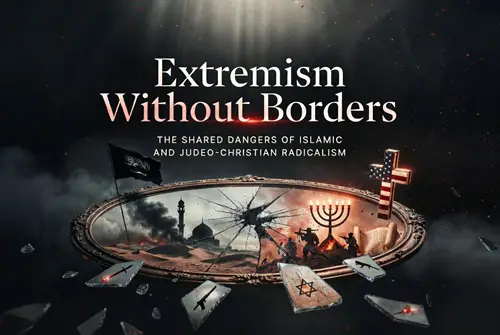 Introduction: A Mirror Few Want to Look IntoPublic discourse, especially in Europe and North America, often treats extremism as a problem primarily associated with Islam. Groups like ISIS or Al-Qaeda have come to symbolize religious violence in the modern imagination. Yet this focus obscures a broader and more uncomfortable truth: extremism is not confined to any one religion. Judeo-Christian traditions—particularly in their radicalized forms—have also generated movements that sacralize violence, exclusion, and authoritarianism. If we are to understand extremism as a human phenomenon rather than a civilizational defect, we must examine both Islamic and Judeo-Christian variants with equal analytical rigor—and with attention to differences in global power. What Is Religious Extremism?Religious extremism emerges when beliefs are absolutized, insulated from critique, and weaponized in the service of political or eschatological goals. It is not simply devoutness or orthodoxy; it is the fusion of: • Literalist interpretation of sacred texts • Apocalyptic or utopian expectations • Moral dualism (good vs. evil, believers vs. infidels) • Legitimation of violence or coercion This pattern recurs across traditions, suggesting that extremism is structurally similar even when its symbols differ. Islamic Extremism: Theocratic Totalism Without Global ReachModern Islamic extremism is often associated with Salafi-jihadist ideology, which seeks to restore a perceived pure form of early Islam and establish governance based on strict interpretations of Sharia law. Groups such as ISIS pursued a territorial “caliphate,” combining medieval legal codes with modern propaganda techniques. Their worldview is characterized by rigid in-group/out-group distinctions, sanctification of martyrdom, and the use of terror as both tactic and theological statement. Events like the Iranian Revolution show how religious ideology can fuse with political upheaval to produce enduring theocratic systems. Yet even at their most powerful, such movements tend to be regionally constrained. Their capacity to project sustained global force is limited by economic, technological, and military factors. This does not make them harmless—far from it—but it does define the scale of their threat. Judeo-Christian Extremism: When Theology Meets SuperpowerExtremist movements rooted in Jewish and Christian traditions often operate within, or adjacent to, highly developed state systems—most notably the United States and, in a different way, Israel. In the U.S., forms of Christian nationalism advocate for governance aligned with specific biblical interpretations. While many adherents remain within democratic norms, more radical fringes blur the line between faith and coercive power. The January 6 United States Capitol attack revealed how religious symbolism and apocalyptic rhetoric can intersect with political violence. Groups like the Army of God have explicitly justified violence as divine mandate. In Israel, certain religious settler movements frame territorial expansion in theological terms, intensifying an already volatile geopolitical conflict. The critical distinction, however, lies in state power. The United States is not merely another country among many; it is the world's most powerful military and economic actor. When elements of religious extremism align—even partially—with such power, the potential consequences extend far beyond national borders. Asymmetry of Power: A Multiplier of RiskHere the analysis becomes more uncomfortable but also more realistic. Extremism embedded within a superpower has a qualitatively different impact than extremism confined to weaker or fragmented states. The global military reach of the United States, its vast nuclear arsenal, and its influence over international institutions mean that any ideological distortion—religious or otherwise—can be amplified on a planetary scale. Foreign policy decisions, military interventions, and alliances can all be shaped, at least in part, by narratives infused with moral absolutism or quasi-religious conviction. This does not imply that the U.S. is a theocracy, nor that its policies are reducible to religious extremism. But it does mean that when such currents are present, they operate within a system capable of projecting force globally. By contrast, extremist groups in many Muslim-majority countries lack this level of structural power. Their violence is often intense but geographically limited; they do not command the same capacity to shape global order. The result is an asymmetry: the scale of potential harm is significantly greater when extremism intersects with hegemonic power. Converging Patterns: Different Theologies, Same DynamicsDespite these differences in scale, Islamic and Judeo-Christian extremisms share core dynamics: • Textual absolutism overriding interpretive nuance • Apocalyptic or redemptive historical narratives • Fusion of religious and political identity • Moral justification of coercion or violence What differs is not the underlying psychology, but the infrastructure through which it operates. The Real Danger: Certainty Armed with PowerThe most dangerous configuration is not any particular religion, but the combination of: • Absolute belief • Institutional authority • Advanced technological and military capacity In such a context, dissent becomes heresy, compromise becomes weakness, and violence can be reframed as righteousness. Conclusion: A Necessary but Uneven CritiqueA credible critique of extremism must remain symmetrical in principle—recognizing that all religious traditions contain both humane and dangerous potentials. But it must also be asymmetrical in practice, acknowledging differences in power. Extremism in weaker states can devastate regions. Extremism entangled with a superpower can destabilize the world. Understanding this distinction is not an act of moral relativism; it is a prerequisite for any serious assessment of threats to global peace.
Comment Form is loading comments...
|