|
TRANSLATE THIS ARTICLE
Integral World: Exploring Theories of Everything
An independent forum for a critical discussion of the integral philosophy of Ken Wilber
  Frank Visser, graduated as a psychologist of culture and religion, founded IntegralWorld in 1997. He worked as production manager for various publishing houses and as service manager for various internet companies and lives in Amsterdam. Books: Ken Wilber: Thought as Passion (SUNY, 2003), and The Corona Conspiracy: Combatting Disinformation about the Coronavirus (Kindle, 2020). Frank Visser, graduated as a psychologist of culture and religion, founded IntegralWorld in 1997. He worked as production manager for various publishing houses and as service manager for various internet companies and lives in Amsterdam. Books: Ken Wilber: Thought as Passion (SUNY, 2003), and The Corona Conspiracy: Combatting Disinformation about the Coronavirus (Kindle, 2020).
Check out my other conversations with ChatGPT
Metaphor as EvasionWilber's Retreat from BiologyFrank Visser / ChatGPT
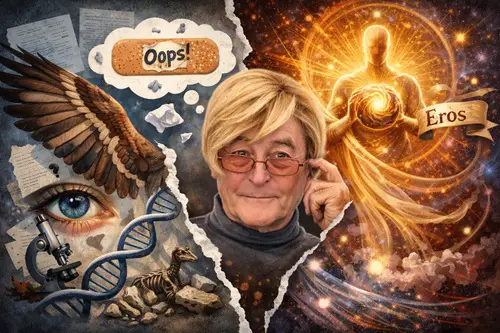
From Bold Claims to Convenient MetaphorsIn A Brief History of Everything (1996), Ken Wilber did not present his remarks on eyes and wings as casual illustrations. He deployed them as argumentative centerpieces—rhetorical devices meant to persuade readers that neo-Darwinian evolution was radically insufficient. The evolution of complex organs, he insisted, could not plausibly be explained by “mere chance and selection,” often caricatured through his now-infamous “100 mutations” trope. At the time, this was not framed as metaphor. It was framed as critique—indeed, as a devastating one. The implication was clear: evolutionary biology lacked explanatory adequacy, and this deficiency pointed toward the necessity of a guiding principle—Wilber's “Eros in the Kosmos.” Fast forward to his 2007 blog response to criticisms relayed by Alexander Astin, and the same example undergoes a remarkable transformation. What had functioned as a literal argumentative wedge is suddenly downgraded to “just a way to state” a more general point. It was never meant, we are told, as “a specific model or actual example of how biological emergence works.”[1] This is not clarification. It is retroactive reframing. The Straw Man That Wouldn't DieWilber's exchange with Astin reveals something more troubling than a simple overstatement. Astin rehearses a familiar misunderstanding: that evolutionary theory requires all mutations leading to complex structures (like wings) to occur simultaneously. This is a textbook straw man, one long addressed in evolutionary biology by cumulative selection models, as popularized by Richard Dawkins in Climbing Mount Improbable. Wilber's response is not to correct this error, but to endorse it—“you have hit the nail on the head”—and to double down on the supposed “huge hole” in evolutionary theory. He even repeats the canard about the uselessness of intermediate forms (“why would a half wing make running easier???”), a question answered in the literature decades ago through exaptation, functional shifts, and incremental adaptive advantage. This is not a minor oversight. It is an active perpetuation of misinformation. “Philosophy of Oops”: Misrepresenting RandomnessEqually problematic is Wilber's treatment of randomness. Echoing Astin, he reduces the concept to epistemic ignorance—“we don't have a clue why this mutation happened.” This conflation of ontological randomness with methodological limitation is a standard move in anti-evolutionary rhetoric, and it is simply incorrect. In evolutionary biology, randomness refers to the statistical independence of mutations from fitness needs—not to the absence of causation. Mutations have causes (chemical, physical, environmental), but they are not directed toward adaptive ends. Natural selection, in turn, is the non-random filter that preserves beneficial variations. Wilber's “philosophy of oops” is therefore a mischaracterization. It trades on ambiguity to create the illusion of explanatory collapse, where none exists. Eros in the GapsHaving inflated the supposed deficiencies of evolutionary theory, Wilber predictably introduces his alternative: a principle of self-organization, or “Eros,” allegedly supported by figures like Ilya Prigogine, Erich Jantsch, and Alfred North Whitehead. But this is a classic case of equivocation. The “self-organization” studied in non-equilibrium thermodynamics refers to well-defined physical processes—dissipative structures, far-from-equilibrium dynamics—not to a quasi-teleological drive toward complexity. Stuart Kauffman, often cited by Wilber, has indeed argued for the importance of self-organization. But Kauffman does not posit a metaphysical Eros guiding evolution toward higher forms. His work remains firmly within a naturalistic framework. Wilber's move is to inflate scientific concepts into metaphysical principles, then present them as converging evidence for his worldview. This is not synthesis; it is appropriation. The Strategic RetreatThe most revealing moment in Wilber's response is his disclaimer: “I don't mean that as a specific model or actual example of how biological emergence works!” This is the pivot. When challenged, the concrete claim dissolves into metaphor. But the rhetorical function remains unchanged: the example still serves to suggest that standard evolutionary mechanisms are insufficient. This maneuver has a familiar structure: • Assert a provocative, quasi-empirical claim (e.g., evolution cannot explain wings). • Leverage that claim to motivate a metaphysical conclusion (Eros). • Retreat to metaphor when the empirical claim is refuted. • Retain the metaphysical conclusion as if nothing has changed. It is a one-way ratchet. Criticism can never quite land, because the target keeps shifting. Selective Engagement and Intellectual EvasionWilber's habitual dismissal of critics—“I never read this stuff… I'm sure you ignore it too”—is not incidental. It is structurally necessary. Serious engagement would require grappling with the actual state of evolutionary biology, which has made substantial progress in explaining the very phenomena he presents as mysterious. By ignoring this body of work, or selectively misrepresenting it, Wilber preserves the illusion of a “gap” that his philosophy can fill. But this is not a gap in science; it is a gap in his reading of it. Conclusion: When Metaphor Masks MisrepresentationThe issue is not that Wilber uses metaphor. Metaphor is indispensable in philosophy. The issue is that his metaphors are deployed as if they were empirical critiques—and then reclassified as “mere illustrations” when challenged. This is where the charge of dishonesty gains traction. Not necessarily as conscious deceit, but as a pattern of argumentation that systematically obscures its own weaknesses. The evolution of wings and eyes was never just a metaphor in Wilber's work; it was a linchpin. To now deny that role is to rewrite the history of his own argument. If Integral Theory aspires to be a credible synthesis of science and spirituality, it cannot afford this kind of epistemic double bookkeeping. Either one engages the science on its own terms—or one relinquishes the claim to be informing it. Addendum: The Reflex to Dismiss — and Its Intellectual Cost“I Never Read This Stuff”: A Pattern, Not an AsideOne of the most revealing features of Ken Wilber's response to critics is not any single argument, but a recurring gesture: the ritualized dismissal. “I never read this stuff,” “I'm sure you ignore it too,” followed by a casual assurance that what little he did glance at was “utterly unconvincing.” This is not incidental rhetoric. It is a stable pattern spanning decades. From early critiques hosted on Integral World to more recent engagements, Wilber has consistently positioned his critics as beneath serious consideration—while simultaneously responding to them just enough to neutralize their impact rhetorically. The contradiction is obvious: one cannot both ignore and refute. Preemptive DelegitimizationThis maneuver serves a clear function: it preemptively delegitimizes criticism without having to engage its substance. By framing critics as “flatland” thinkers or as fundamentally missing the point, Wilber insulates his system from external evaluation. In effect, criticism is reclassified as a category error. But this comes at a cost. Scientific critique, especially in domains like evolutionary biology, is not a matter of “perspective” in the loose, pluralistic sense that Integral Theory often invokes. It operates with empirical constraints, methodological rigor, and a cumulative knowledge base. To dismiss it as merely “flatland” is to opt out of the very standards Wilber claims to integrate. The Echo Chamber EffectOver time, this posture fosters an epistemic echo chamber. Followers are subtly encouraged to adopt the same dismissive stance: critics are not interlocutors but obstacles; their arguments need not be understood, only categorized and set aside. The result is predictable: • Decreased critical pressure on core claims • Increased tolerance for ambiguity and overreach • Reinforcement of in-group consensus In such an environment, statements like “evolution can't explain shit” or “nobody has a clue” about complex organs can circulate with minimal resistance, despite being demonstrably false within the scientific community. Missed Opportunities for Genuine IntegrationThis is particularly ironic given Wilber's stated ambition: a grand synthesis of science, philosophy, and spirituality. Genuine integration requires friction—serious engagement with opposing viewpoints, including those that expose weaknesses or errors. Had Wilber engaged more directly with evolutionary biologists—figures like Richard Dawkins or Stephen Jay Gould, or with the technical literature on complexity and self-organization—his account of evolution might have evolved accordingly. It might have shed its reliance on outdated objections and sharpened its philosophical contributions. Instead, by keeping critics at arm's length, Wilber preserved the internal coherence of his system at the expense of its external credibility. From Outsider Critique to Intellectual IsolationIn the early stages of Integral Theory, Wilber's distance from mainstream academia could be framed as productive outsider critique. But over time, the refusal to engage substantively with criticism has had a different effect: not independence, but isolation. A theory that does not submit itself to correction gradually loses contact with the domains it seeks to encompass. In Wilber's case, this is most evident in his treatment of science—where confident pronouncements increasingly diverge from well-established knowledge. Conclusion: The Price of Not ListeningThe long-term cost of habitual dismissal is not merely reputational. It is structural. By insulating his ideas from critique, Wilber has limited their capacity to develop, refine, and adapt. The irony is sharp: a philosophy centered on evolution, growth, and increasing complexity becomes, in this respect, static. If Integral Theory is to remain intellectually viable, it cannot rely on rhetorical deflection. It must do what it has too often avoided: read the critics carefully, represent them accurately, and respond on the merits. Anything less risks turning a project of integration into a closed system—impressive in scope, but increasingly detached from the realities it claims to explain. NOTES[1] Ken Wilber, "Some Criticisms of My Understanding of Evolution", www.kenwilber.com (offine), quoted in: Frank Visser, "What Good is Half a Wing?": The Wilberian Evolution Debate Continues, December 2007 Astin: They challenge your example of the evolution of the bird wing, basically arguing that the 100 mutations DON'T have to occur all at once, claiming that each one occurs independently because EACH one is functional to survival! How probable is THIS? (Maybe the half wing helps them run faster?) Or do I somehow have their argument wrong? It simply describes a situation where the observer/investigator is unable to find any causal antecedent for the event in question. But SOMETHING must have caused it. (In fact, your metaphor "oops" is a perfect substitute term for randomness.) When they embrace the concept of "random" mutations, then, many geneticists think they are somehow explaining something, but in fact they are implicitly admitting that "we don't have a clue as to why this particular mutation happened at this particular time." Why the embattled Creationists haven't seized on this one is beyond me, since it leaves a huge hole in evolutionary theory. Wilber: Also, as you point out, referring to random chance really means "I have no idea what is going one here"—and that is really what, in Sex, Ecology, Spirituality, I call the "philosophy of oops," as you rightly note. This is a huge hole in the mere chance and selection argument. These items are all meant when I use the metaphor of a 100 mutations. I am fully aware that selection carries forth each previous selection (which still has problems in itself—as you point out, why would a half wing make running easier???), but even if you give that to the evolutionists (which I am willing to do), it still has this gaping hole in it. The alternative is to see some sort of Eros operating in the universe. It doesn't have to be a metaphysical force, just an intrinsic force of self-organization. As Jantsch put it, evolution is “self-transcendence through self-organization.” This is exactly the point Prigogine was making with dissipative structures, and exactly the point I am making when referring to wings or eyes: they are metaphors and examples for this extraordinary capacity of creative emergence that is intrinsic to the universe (exactly as Whitehead explained it). So, no, I don't take this criticism of my work seriously, although it is a good example of flatland thinking, as you note. Of course I understand that natural selection is not acting on mere randomness or chance—because natural selection saves previous selections, and this reduces dramatically the probability that higher, adequate forms will emerge. But even that is not enough, in my opinion, to account for the remarkable emergence of some [which one?] of the extraordinarily complex forms that nature has produced... But my point lies in a different direction, which is what these critics miss: the necessity of a self-organizing force (or Eros) intrinsic to the universe. I have no belief whatsoever that the wing actually took 100 mutations—that's just a way to state what you are stating, and also, more generally, that the complex forms of evolution that we see—such as the immune system—are not the products of mere chance mutation and natural selection. Rather, there is force of self-organization built into the universe, and this force (or Eros by any name) is responsible for at least part of the emergence of complex forms that we see in evolution. I am not alone in seeing that chance and natural selection by themselves are not enough to account for the emergence that we see in evolution. Stuart Kauffman and many others have criticized mere change and natural selection as not adequate to account for this emergence (he sees the necessity of adding self-organization). Of course I understand that natural selection is not acting on mere randomness or chance—because natural selection saves previous selections, and this reduces dramatically [?] the probability that higher, adequate forms will emerge. But even that is not enough, in my opinion, to account for the remarkable emergence of some of the extraordinarily complex forms that nature has produced. After all, from the big bang and dirt to the poems of William Shakespeare is quite a distance, and many philosophers of science agree that mere chance and selection are just not adequate to account for these remarkable emergences. The universe is slightly tilted toward self-organizing processes, and these processes—as Prigogine was the first to elaborate—escape present-level turmoil by jumping to higher levels of self-organization, and I see that "pressure" as operating throughout the physiosphere, the biosphere, and the noosphere. And that is what I metaphorically mean when I use the example of a wing (or elsewhere, the example of an eyeball) to indicate the remarkableness of increasing emergence. But I don't mean that as a specific model or actual example of how biological emergence works! Natural selection carries forth previous individual mutations—but again that just isn't enough to account for creative emergence (or what Whitehead called “the creative advance into novelty,” which, according to Whitehead, is the fundamental nature of this manifest universe).
Comment Form is loading comments...
|