|
TRANSLATE THIS ARTICLE
Integral World: Exploring Theories of Everything
An independent forum for a critical discussion of the integral philosophy of Ken Wilber
  Frank Visser, graduated as a psychologist of culture and religion, founded IntegralWorld in 1997. He worked as production manager for various publishing houses and as service manager for various internet companies and lives in Amsterdam. Books: Ken Wilber: Thought as Passion (SUNY, 2003), and The Corona Conspiracy: Combatting Disinformation about the Coronavirus (Kindle, 2020). Frank Visser, graduated as a psychologist of culture and religion, founded IntegralWorld in 1997. He worked as production manager for various publishing houses and as service manager for various internet companies and lives in Amsterdam. Books: Ken Wilber: Thought as Passion (SUNY, 2003), and The Corona Conspiracy: Combatting Disinformation about the Coronavirus (Kindle, 2020).
Check out my other conversations with ChatGPT
Barbour vs. WilberIntegration as Dialogue vs. Integration as SystemFrank Visser / ChatGPT
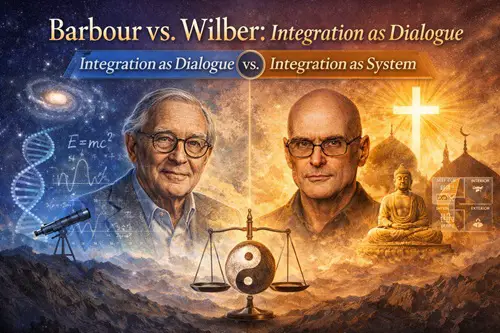 The contrast between Ian Barbour and Ken Wilber is particularly illuminating because both explicitly aim at “integration,” yet operationalize that ambition in fundamentally different ways. Barbour proceeds through disciplined, domain-sensitive comparison, while Wilber constructs a comprehensive metatheoretical architecture into which both science and religion are placed. The difference is not merely stylistic; it reflects divergent epistemologies, standards of evidence, and notions of what counts as a successful synthesis. Barbour's Method: Case-by-Case Integration Under ConstraintBarbour's approach is deliberately modest and methodologically conservative. His famous fourfold typology—conflict, independence, dialogue, integration—serves not as a grand theory but as a heuristic framework for analyzing specific interactions between scientific theories and religious doctrines. What distinguishes his “integration” model is that it does not assume harmony in advance; instead, it seeks convergence where possible, while allowing for revision on both sides. Consider Barbour's treatment of cosmology. Modern Big Bang theory suggests a temporal beginning of the universe, which naturally invites theological reflection on creation. Barbour does not simply equate the Big Bang with the doctrine of creation ex nihilo. Instead, he carefully distinguishes between the physical description of an initial singularity and the metaphysical claim that the universe depends on a divine ground of being. The integration here is layered: science describes the temporal unfolding of the cosmos, while theology addresses the question of why there is something rather than nothing. Crucially, Barbour allows that future developments in cosmology—such as cyclic or multiverse models—could alter the theological implications. Integration remains provisional and revisable. A similar pattern appears in Barbour's engagement with evolutionary biology. Rather than inserting purpose into the mechanism of natural selection, he explores ways in which theological concepts—such as divine creativity or continuous creation—might be reformulated in light of Darwinian contingency. The randomness of mutation and the absence of intrinsic direction are not denied; instead, they become part of a broader theological interpretation that emphasizes openness and freedom in creation. In this sense, Barbour's integration is dialogical and reciprocal: science constrains theology, and theology seeks coherence with science without overriding it. Wilber's Method: Architectonic Integration Through HierarchyWilber's strategy is almost the mirror opposite. Rather than proceeding case by case, he begins with a universal framework—often summarized in terms of quadrants, levels, lines, states, and types—into which all forms of knowledge are mapped. Science and religion are not negotiated into compatibility; they are assigned their respective place within a pre-existing structure. Take the example of evolution. Where Barbour accepts the core tenets of Darwinian theory and asks how theology might adapt, Wilber reinterprets evolution itself. He introduces the notion of Eros as an intrinsic drive toward increasing complexity and consciousness, effectively re-enchanting evolution with a directional, quasi-teleological principle. This move allows him to align biological evolution with spiritual development, presenting both as aspects of a single, unfolding process. However, the integration here is achieved not by reconciling scientific and theological accounts at the level of evidence or mechanism, but by subsuming them under a higher-order narrative. The empirical claims of evolutionary biology remain formally intact, but their interpretation is shifted. Random mutation and natural selection are no longer the full story; they are expressions of a deeper, spiritually inflected dynamic. Unlike Barbour, Wilber does not allow scientific theory to constrain his metaphysical commitments in any significant way. Instead, science is incorporated into a broader metaphysical vision that is not itself subject to empirical validation. Concrete Contrast: Evolution as Test CaseThe divergence becomes especially clear when both thinkers are applied to the same scientific domain. In the case of evolution, Barbour might say: Darwinian mechanisms are well-supported and must be accepted as they stand; any theological interpretation must respect their non-teleological character. If one wishes to speak of purpose, it must be done at a level that does not interfere with the explanatory sufficiency of natural selection. Wilber, by contrast, effectively overlays a second explanatory layer onto evolution. While he does not deny natural selection, he introduces Eros as an additional causal or quasi-causal factor. This creates a dual-account framework: one empirical, one metaphysical. The difficulty is that the relationship between these two accounts remains unclear. Does Eros influence mutation rates, selection pressures, or emergent complexity? Or is it purely symbolic? Wilber tends to leave this underdetermined, which allows the integration to function rhetorically but weakens it analytically. Epistemological Discipline vs. Metatheoretical InclusivityAt a deeper level, the contrast reflects different epistemological commitments. Barbour operates within what might be called critical realism. Scientific theories are taken to be approximately true descriptions of the natural world, subject to revision but constrained by evidence. Theology, while addressing different questions, must remain in dialogue with these descriptions and cannot contradict them without cost. Wilber, on the other hand, adopts a form of epistemological pluralism in which different “zones” or “quadrants” of reality are accessed by different methodologies. This allows him to validate spiritual insight without subjecting it to empirical testing. The advantage is inclusivity: no domain of knowledge is excluded. The disadvantage is that cross-domain claims—such as those linking spiritual development to biological evolution—lack clear criteria for adjudication. Integration Reconsidered: Negotiation vs. ReclassificationWhat ultimately distinguishes Barbour from Wilber is their conception of integration itself. For Barbour, integration is a process of negotiation under constraint. It involves risk, revision, and the possibility of failure. Scientific and religious claims must earn their compatibility through careful argument and mutual adjustment. For Wilber, integration is largely a matter of reclassification within a comprehensive schema. Conflicts are resolved by assigning apparently conflicting claims to different levels or dimensions of reality. This has the advantage of preserving a wide range of perspectives, but it often does so by insulating them from direct comparison rather than by resolving their differences. Conclusion: Two Models, Two StandardsThe comparison reveals two fundamentally different standards for what it means to integrate science and religion. Barbour offers a model that is empirically disciplined, philosophically cautious, and open to revision. Its integrations are partial and provisional, but they are also testable in the sense that they remain accountable to developments in science. Wilber offers a model that is expansive, synthetic, and architecturally elegant. It achieves a kind of conceptual harmony by situating all knowledge within a single framework. Yet this harmony often comes at the cost of explanatory clarity and empirical accountability. If integration is judged by its ability to produce coherent, evidence-sensitive accounts that withstand critical scrutiny, Barbour's approach appears more successful, albeit less spectacular. If it is judged by its ability to generate a unifying vision that accommodates diverse ways of knowing, Wilber's system has a broader appeal. The tension between these criteria mirrors the very problem both thinkers seek to address—and suggests that the integration of science and religion remains, in the end, an unfinished project. Appendix: Ian Barbour received the Templeton Prize in 1999Barbour gave the Gifford lectures from 1989 to 1991 at the University of Aberdeen. These lectures led to the book Religion in an Age of Science. He was awarded the Templeton Prize in 1999 for Progress in Religion in recognition of his efforts to create a dialogue between the worlds of science and religion. In the citation nominating Barbour for the 1999 Templeton Prize, John B. Cobb wrote, "No contemporary has made a more original, deep and lasting contribution toward the needed integration of scientific and religious knowledge and values than Ian Barbour. With respect to the breadth of topics and fields brought into this integration, Barbour has no equal." (Wikipedia) His acceptance speech for the Templeton Prize can be read here. Dialogue. I think this is the most promising approach. It allows us to draw from both the scientific and religious communities, not simply from either one alone. I am particularly interested in the Christian tradition, in which the dialogue has been most extensive, but it has also occurred in Judaism and Islam, and to some extent in Buddhism and Hinduism. We can start from a particular religious tradition and ask how its concept might be reformulated in the light of science without abandoning its central convictions. This requires humility on both sides. Scientists have to acknowledge that science does not have all the answers, and theologians have to recognize the changing historical contexts of theological reflection.
Comment Form is loading comments...
|