|
TRANSLATE THIS ARTICLE
Integral World: Exploring Theories of Everything
An independent forum for a critical discussion of the integral philosophy of Ken Wilber
  Frank Visser, graduated as a psychologist of culture and religion, founded IntegralWorld in 1997. He worked as production manager for various publishing houses and as service manager for various internet companies and lives in Amsterdam. Books: Ken Wilber: Thought as Passion (SUNY, 2003), and The Corona Conspiracy: Combatting Disinformation about the Coronavirus (Kindle, 2020). Frank Visser, graduated as a psychologist of culture and religion, founded IntegralWorld in 1997. He worked as production manager for various publishing houses and as service manager for various internet companies and lives in Amsterdam. Books: Ken Wilber: Thought as Passion (SUNY, 2003), and The Corona Conspiracy: Combatting Disinformation about the Coronavirus (Kindle, 2020).
Check out my other conversations with ChatGPT
The Grand Synthesis That Wasn't?Ken Wilber and the Elusive Integration of Science and ReligionFrank Visser / ChatGPT
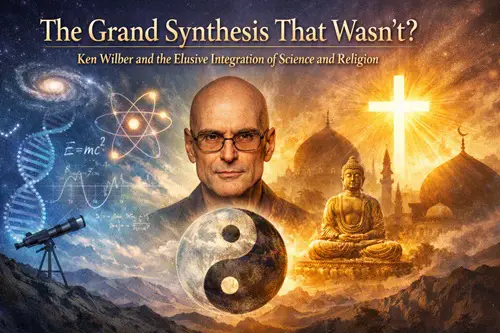 A Vision of Total IntegrationThe ambition to “integrate science and religion” has a long pedigree, but few contemporary thinkers have pursued it as systematically and as ambitiously as Ken Wilber. His Integral Theory presents itself not merely as a synthesis, but as a metatheoretical framework capable of situating all domains of knowledge—empirical, philosophical, and spiritual—within a single, coherent architecture. The question, however, is whether this project genuinely succeeds in integrating science and religion, or whether it instead juxtaposes them in a way that preserves their tensions under a new conceptual vocabulary. The Division of the Real: Eyes of Flesh, Mind, and SpiritAt the heart of Wilber's project lies a distinction between different “ways of knowing,” often framed as the “eyes of flesh, mind, and spirit.” Empirical science corresponds to the sensory-empirical domain, while religion—at least in its mystical core—is assigned to the introspective and contemplative domains. By granting each domain its own epistemological validity, Wilber attempts to defuse the long-standing conflict between science and religion. Science is said to be authoritative in the exterior, objective realm, while spirituality provides insight into interior, subjective realities. In principle, this division of labor avoids the crude reductionism of scientism as well as the dogmatism of religious literalism. Parallel Tracks Rather Than True SynthesisYet this very strategy raises a central difficulty. Integration, in any robust sense, requires not only peaceful coexistence but some form of conceptual or explanatory unification. Wilber's framework tends instead toward what critics have called a “non-overlapping magisteria” approach, reminiscent of Stephen Jay Gould, who argued that science and religion occupy fundamentally separate domains. Wilber goes further by embedding both within a larger developmental and evolutionary schema, but the underlying separation remains largely intact. Science describes the exterior surfaces of reality; spirituality discloses its interior depths. The bridge between them is asserted rather than analytically demonstrated. Evolution Re-Enchanted: From Darwin to ErosWilber's use of evolution is particularly revealing. He adopts the language of evolutionary biology but reinterprets it through a teleological lens, introducing concepts such as Eros or Spirit-in-action as drivers of increasing complexity and consciousness. This move places him in a lineage closer to Pierre Teilhard de Chardin than to mainstream evolutionary theorists. Like Teilhard, Wilber envisions evolution as a directional process culminating in higher forms of awareness. However, this spiritualized account of evolution sits uneasily alongside the Darwinian framework established by Charles Darwin, which explicitly rejects intrinsic purpose or directionality in natural selection. The result is not a synthesis of scientific and religious explanations, but a reinterpretation of science through metaphysical commitments that are not themselves empirically grounded. Alternative Pathways: Process, Dialogue, and Critical RealismIn this respect, Wilber's approach resembles earlier idealist and process-oriented attempts to reconcile science and spirituality. Alfred North Whitehead, for instance, developed a metaphysical system in which scientific insights into process and change were integrated into a broader philosophical theology. Whitehead's “process philosophy” aimed to provide a common ontological framework for both science and religion, grounding them in a shared conception of reality as dynamic and relational. Unlike Wilber, however, Whitehead engaged more directly with the conceptual foundations of physics and mathematics, seeking a genuine philosophical reconstruction rather than a hierarchical ordering of domains. A different strategy can be seen in the work of Ian Barbour, who famously outlined four models of the relationship between science and religion: conflict, independence, dialogue, and integration. Barbour's “integration” model involves careful, case-by-case engagement between scientific theories and theological doctrines, often leading to modest reinterpretations on both sides. Compared to Wilber's sweeping system, Barbour's approach is methodologically conservative but arguably more grounded, as it avoids grand unifying claims that outpace the available evidence. Similarly, John Polkinghorne, a former particle physicist turned Anglican priest, pursued a form of critical realism in which science and theology are seen as complementary but constrained by their respective methods. Polkinghorne does not posit a single overarching framework that subsumes both domains; instead, he emphasizes the limits of human knowledge and the need for epistemic humility. His integration is dialogical rather than architectonic, grounded in the specifics of contemporary physics and theology rather than in a universal developmental schema. Integration or Assimilation?Against this backdrop, Wilber's project appears both more ambitious and more problematic. Its strength lies in its scope: few thinkers have attempted to map as many domains of knowledge into a single framework. For readers dissatisfied with the fragmentation of modern thought, this offers a compelling vision of unity. However, the weakness of the approach lies in its tendency to resolve tensions by reclassification rather than by explanation. Scientific concepts are often redescribed in spiritual terms, while spiritual claims are insulated from empirical scrutiny by being assigned to a different epistemological domain. This raises the question of whether Wilber's “integration” is, in fact, a form of assimilation. Science is accepted insofar as it can be accommodated within a broader spiritual narrative, but its methodological naturalism is quietly set aside when it conflicts with metaphysical commitments. In this sense, Wilber's system risks reproducing the very tensions it seeks to overcome, albeit in a more sophisticated guise. The appearance of integration may mask an underlying dualism between empirical description and spiritual interpretation. Conclusion: A Map Without a MechanismIn comparison with other attempts to relate science and religion, Wilber's approach stands out for its architectural boldness but falls short in terms of epistemological rigor. Where thinkers like Barbour and Polkinghorne emphasize dialogue and mutual constraint, and where Whitehead seeks a shared metaphysical foundation, Wilber offers a comprehensive map that organizes existing knowledge without fully reconciling its internal contradictions. His system provides a language of integration, but whether it delivers integration in substance remains an open—and contested—question. Ultimately, the success of Wilber's project depends on what one expects from an integration of science and religion. If the goal is a grand, unifying vision that honors multiple ways of knowing, then his work can be seen as a significant achievement. If, however, integration requires a disciplined engagement with the methods and findings of science, and a willingness to subject spiritual claims to critical scrutiny, then the verdict is less favorable. In that stricter sense, Wilber may be better understood not as having solved the problem of integration, but as having reformulated it in a new and provocative way. Appendix: Reception of The Marriage of Sense and Soul in Science and Religion DiscourseWhen The Marriage of Sense and Soul appeared in 1998, Ken Wilber explicitly positioned it as his most direct and accessible attempt to reconcile scientific and spiritual worldviews. The subtitle—Integrating Science and Religion—announced an ambitious agenda aimed not only at general readers but also at participants in the then-maturing academic field of science-and-religion studies. The reception of the book, however, revealed a sharp divergence between enthusiasm in spiritual and integral circles and a more reserved, often critical response from scholars working within science and religion as an academic discipline. Within the broader spiritual readership, the book was widely praised for its clarity and scope. Many readers appreciated Wilber's effort to translate his more technical AQAL framework into a narrative that addressed the perceived fragmentation of modern knowledge. The idea that science and spirituality could be harmonized without reducing one to the other resonated strongly, especially among those already inclined toward transpersonal psychology or comparative mysticism. In these circles, the book was often treated as a compelling synthesis, offering a “both-and” alternative to the polarized debates between scientific naturalism and religious fundamentalism. However, within the academic science-and-religion community—represented by figures such as Ian Barbour and John Polkinghorne—the reception was markedly more cautious. One recurring concern was that Wilber's integration lacked methodological discipline. Scholars in this field had, by the late twentieth century, developed a careful practice of engaging specific scientific theories (such as quantum mechanics, cosmology, or evolutionary biology) in dialogue with equally specific theological claims. Against this background, Wilber's sweeping framework appeared insufficiently attentive to the technical details and internal debates within both science and theology. A frequent criticism was that Wilber relied on secondary or popularized accounts of science rather than engaging directly with primary scientific literature. His discussions of physics, for example, were often seen as gestural rather than analytically rigorous, invoking broad themes—such as holism or interconnectedness—without grappling with the mathematical and experimental foundations of the field. This led some reviewers to conclude that his integration operated more at the level of metaphor than at the level of explanatory coherence. The treatment of evolution proved even more contentious. While mainstream science-and-religion scholars had largely come to terms with Darwinian evolution as a non-teleological process, Wilber's introduction of Eros as a directional force was viewed as a regression to earlier, pre-Darwinian forms of thought. Critics argued that this move blurred the distinction between scientific explanation and metaphysical speculation, thereby undermining the credibility of the integration he sought to achieve. In effect, rather than reconciling science and religion, Wilber was seen as re-spiritualizing science in a way that bypassed the constraints of empirical inquiry. Another point of tension concerned Wilber's characterization of religion itself. His emphasis on mystical experience as the “core” of all authentic religion aligned with perennialist traditions but did not sit comfortably with scholars who emphasized the historical, doctrinal, and communal dimensions of religious life. By privileging contemplative experience, Wilber was perceived as narrowing the scope of religion in order to make it more compatible with his overall framework. This selective definition raised questions about whether the integration was achieved by genuinely engaging religion in its full complexity, or by redefining it in more philosophically tractable terms. Despite these criticisms, The Marriage of Sense and Soul was not dismissed outright in academic contexts. Some scholars acknowledged its value as a broad, integrative vision that could stimulate interdisciplinary reflection. It was occasionally cited as an example of a “grand synthesis” approach, in contrast to the more piecemeal methodologies dominant in the field. In this sense, the book functioned more as a provocation than as a definitive contribution—an invitation to think beyond disciplinary boundaries, even if its own solutions were not widely accepted. In summary, the reception of The Marriage of Sense and Soul reflects the broader tensions inherent in attempts to integrate science and religion. Among general and spiritually oriented audiences, it was often celebrated as a bold and inspiring synthesis. Among specialists in science-and-religion studies, it was received with skepticism, praised for its ambition but critiqued for its lack of empirical and methodological rigor. The divide mirrors the very issue the book seeks to address: the difficulty of moving from a compelling vision of unity to a disciplined and convincing integration. Yet another unsuccessful attempt to integrate all of science and all of religion in one Grand Unified Theory. Wilber has attempted before to wed the warring camps of science and religion (A Brief History of Everything; not reviewed; Up From Eden: A Transpersonal View of Human Evolution, 1981; etc.). Here he claims that science is one of the “major differentiations of modernity” that have shattered a previously unified worldview in which all disciplines worked together in the same search for meaning. Today, he says, truth and meaning are distinct; science can provide the former, but religion is necessary to confer the latter. Wilber writes that we need to “integrate the Great Chain [of being] with the major differentiations of modernity,” including science. Fair enough, but he never really explains how this is supposed to occur. Blithely brushing aside centuries-old epistemological dilemmas about how we can know the world, Wilber claims that the empirical methods of science can be applied to mental and spiritual experience. The words —experience,— —knowledge,— and —empirical— seem to be equated in Wilber's loose arguments. As for religion, he considers it in terms of —function,— devoid of specific contents, such as the belief that the Red Sea parted for the Israelites or in the virgin birth of Jesus. He never truly defines what he means by religion, which he inexplicably, continually refers to as “premodern.” So, too, scientists may quibble with Wilber's vague generalizations about “the scientific method.” What kind of science? What types of religion? Wilber's lack of specificity makes this book an exercise in theoretical, purely academic navel-gazing. This fusion of science and religion fails to take either discipline seriously as multifaceted, complex sets of meaning. (Kirkus Review, Kirkus Reviews Issue: March 1, 1998, Review Posted Online: May 19, 2010)
Comment Form is loading comments...
|