|
TRANSLATE THIS ARTICLE
Integral World: Exploring Theories of Everything
An independent forum for a critical discussion of the integral philosophy of Ken Wilber
  Frank Visser, graduated as a psychologist of culture and religion, founded IntegralWorld in 1997. He worked as production manager for various publishing houses and as service manager for various internet companies and lives in Amsterdam. Books: Ken Wilber: Thought as Passion (SUNY, 2003), and The Corona Conspiracy: Combatting Disinformation about the Coronavirus (Kindle, 2020). Frank Visser, graduated as a psychologist of culture and religion, founded IntegralWorld in 1997. He worked as production manager for various publishing houses and as service manager for various internet companies and lives in Amsterdam. Books: Ken Wilber: Thought as Passion (SUNY, 2003), and The Corona Conspiracy: Combatting Disinformation about the Coronavirus (Kindle, 2020).
Check out my other conversations with ChatGPT
The Tyranny of Binary ThinkingIntellectual Polarization and the Quest for Gaza PeaceFrank Visser / ChatGPT
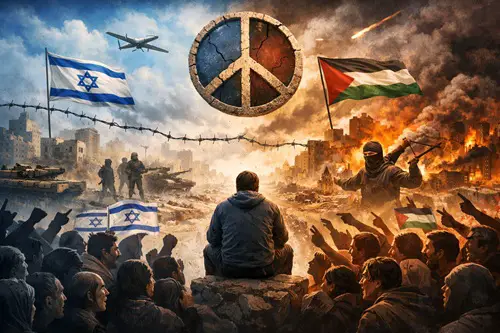 Introduction: The Cost of Choosing SidesThe Gaza conflict has produced an intellectual landscape in which neutrality is nearly impossible. Unlike disputes where mediators can operate from the center, this war pressures individuals to choose sides. Those who attempt to remain both-sides are often dismissed as non-involved or cowardly. This polarization profoundly affects public discourse, policy, and the very possibility of durable solutions. Shrinking the Deliberative SpaceIn a binary environment, moderate voices struggle to be heard. Expressing nuance can provoke suspicion, moral criticism, or hostility. Media, forums, and academic spaces become echo chambers, dominated by extreme positions. Consequently, policy debates tend toward hardline strategies, leaving little room for compromise, mediation, or confidence-building measures—tools essential for lasting peace. Undermining Empathy and HumanizationPolarization reduces the lived experiences of civilians to symbolic instruments in a moral contest. The suffering, grievances, and shared vulnerabilities of “the other” are filtered through ideological lenses, inflating the perceived cost of compromise. As a result, cycles of retaliation, narrative manipulation, and mutual dehumanization become entrenched, making reconciliation increasingly difficult. Delegitimizing Intellectual HumilityA culture of mandatory partisanship discourages questioning assumptions. Individuals acknowledging the complexity of causation or the legitimacy of multiple perspectives risk social and professional censure. This stifles nuanced thinking and channels creative problem-solving into rigid ideological frameworks. Long-term strategies requiring adaptive policies, dialogue, and experimentation are therefore rendered nearly impossible. Global Implications of Polarized PerceptionThe polarization extends beyond the region. International audiences, humanitarian organizations, and mediators must navigate a landscape where any engagement risks being interpreted as partiality. This perception constrains external support for reconciliation efforts and reinforces the structural stalemate that perpetuates the conflict. Diverse Opinions Across the SpectrumTo understand the depth of polarization, it is useful to examine representative opinions from different sides: • Left-leaning perspectives often emphasize the humanitarian plight of Palestinians and critique Israeli military actions. Voices in this camp may call for boycotts or sanctions, highlighting structural inequalities and the asymmetry of power. Critics argue that this framing risks oversimplifying the security concerns of Israelis. • Centrist or moderate perspectives attempt to recognize the rights, security needs, and grievances of both sides. They often advocate for negotiated settlements, phased confidence-building, and humanitarian support while condemning violence from both Hamas and the Israeli military. Moderates are frequently accused by both extremes of moral ambivalence or indecision. • Right-leaning perspectives typically foreground Israeli security and the legitimacy of defensive measures, stressing the threat from Hamas and other militant groups. They may argue for strong deterrents and support for Israel's military responses, framing criticism of these actions as undermining state sovereignty or enabling terrorism. Detractors argue this position risks minimizing Palestinian suffering or ignoring structural issues. Each of these perspectives reflects valid concerns but also demonstrates how entrenched partisanship can obscure the possibility of integrative solutions. Creating Intellectual Spaces for DialogueTo overcome the cycle of polarization, it is necessary to cultivate spaces where complexity is accepted and moderate voices can thrive. This includes promoting forums that value integrative thinking, protecting commentators and mediators from social censure, and emphasizing the shared humanity of all parties over ideological loyalty. By creating conditions in which dialogue and experimentation are safe, practical, and morally respected, actors may begin to explore phased trust-building and compromise without fear of being branded as neutralist cowards. Conclusion: Beyond the BinaryThe Gaza war demonstrates how polarization can entrench conflict, suppress nuance, and constrain reconciliation. Lasting solutions require confronting not just political and material challenges but the cultural frameworks that shape discourse. By fostering intellectual spaces that privilege complexity, empathy, and human dignity, the possibility of durable peace becomes conceivable—even within a context dominated by extremes. Appendix: examples of opinion leaders and columnistsBelow are examples of opinion leaders and columnists whose work on the Gaza conflict reflects left-, centre-, and right-leaning perspectives in public discourse. These are individuals whose columns, essays, or commentary have shaped debate and illustrate how polarization manifests at the level of influential voices. (I include both international and broadly recognised Western commentators.) 1. Left-leaning opinion leadersCaitlin Johnstone - left to far-left (anti-establishment pole), Johnstone sits clearly on the anti-imperialist left, closer to the pole of systemic critique than mainstream liberalism, framing the conflict within a broader critique of Western power, media narratives, and empire. Peter Beinart - American columnist, academic, and public intellectual known for his critique of mainstream pro-Israel positions and emphasis on Palestinian rights and equality. Over time he has shifted from liberal Zionism to a more critical stance toward Israeli policy, arguing for radical reconceptualizations of Israeli-Palestinian relations and insisting that liberal discourse must incorporate empathy for Palestinian suffering while pushing for justice for both peoples. Owen Jones - British left-wing columnist whose recent writings argue that mainstream political figures (including some on the centre-right) mischaracterise left opposition to Israeli policy and that criticism of Israel shouldn't be conflated with prejudice. He frames the humanitarian crisis and disproportionate civilian suffering in Gaza as central moral concerns. These voices tend to foreground humanitarian concerns, international law, and structural critiques of power imbalances in the conflict. 2. Centre / moderate opinion leadersAlyssa Katz and Rob Eshman - Columnists featured in The Forward's opinion section who address the Gaza conflict from perspectives that try to balance concern for Palestinian suffering with recognition of Jewish historical experience and security concerns. Katz focuses on humanising narratives within Jewish communities, while Eshman frames nuanced policy ideas amid broader outrage and turmoil. Thomas Friedman - centre to centre-liberal (with establishment leanings), Friedman occupies what can best be described as the liberal internationalist centre, occasionally drifting into pragmatic realpolitik. Advocacy of a two-state solution as the only viable long-term equilibrium Centrist commentators often condemn violence on all sides and emphasise negotiated settlement paths, humanitarian relief, and respect for rights and security of both populations. 3. Right-leaning or conservative opinion leadersBret Stephens - A conservative columnist (e.g., for The Wall Street Journal) noted for rejecting the claim that the crisis constitutes genocide under international law, stressing legal definitions and caution about politicised narratives. Seth Mandel - Conservative commentator who has criticised mainstream media coverage of Gaza and framed narratives about the conflict in terms of media bias and misrepresentation. Ben-Dror Yemini - Israeli columnist often identified with right-leaning analysis. While he supports Israel's right to self-determination and a two-state solution, he also criticises what he sees as media bias and misrepresentation in coverage of the conflict, positioning himself against extreme narratives on both sides. These voices typically foreground security, legal standards, and skepticism of broad humanitarian-genocide framings, and often push back against what they see as biased reporting or moral equivalence. In practice many of these figures are not monolithic: some, like Yemini or the Forward columnists, defy simple categorisation and try to nuance their positions within broader ideological landscapes, reflecting the complexity of discourse on Gaza.
Widget is loading comments...
|