|
TRANSLATE THIS ARTICLE
Integral World: Exploring Theories of Everything
An independent forum for a critical discussion of the integral philosophy of Ken Wilber
  Frank Visser, graduated as a psychologist of culture and religion, founded IntegralWorld in 1997. He worked as production manager for various publishing houses and as service manager for various internet companies and lives in Amsterdam. Books: Ken Wilber: Thought as Passion (SUNY, 2003), and The Corona Conspiracy: Combatting Disinformation about the Coronavirus (Kindle, 2020). Frank Visser, graduated as a psychologist of culture and religion, founded IntegralWorld in 1997. He worked as production manager for various publishing houses and as service manager for various internet companies and lives in Amsterdam. Books: Ken Wilber: Thought as Passion (SUNY, 2003), and The Corona Conspiracy: Combatting Disinformation about the Coronavirus (Kindle, 2020).
Check out my other conversations with ChatGPT
The Debate Over Group SelectionA Persistent Fault Line in Evolutionary TheoryFrank Visser / ChatGPT
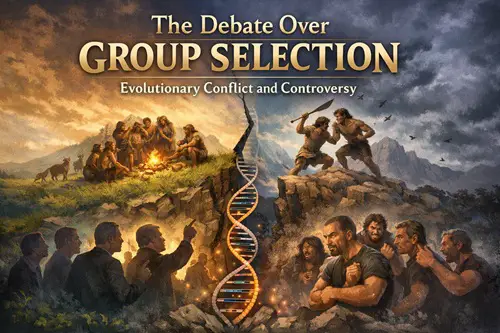 Few topics in evolutionary biology have generated as much sustained controversy as group selection—the idea that natural selection can act not only at the level of genes or individuals, but also at the level of groups. The debate is not merely technical; it touches foundational questions about the units of selection, the evolution of cooperation, and even the philosophical interpretation of Darwinism. What Is Group Selection?Group selection proposes that traits can evolve because they benefit the group, even if they are costly to individuals within that group. A classic example is altruism: behaviors that reduce an individual's fitness while increasing the fitness of others. If groups with more altruists outcompete groups with fewer, such traits might spread. This stands in tension with the more orthodox view that natural selection primarily favors traits that enhance individual reproductive success—or more precisely, the propagation of genes. Historical Origins and Early AdvocatesThe early modern articulation of group selection is often associated with V. C. Wynne-Edwards, who argued in the 1960s that animals regulate their populations for the good of the group. He interpreted behaviors like territoriality and reproductive restraint as group-beneficial adaptations. However, this view was soon subjected to intense criticism, most notably by George C. Williams in his 1966 book Adaptation and Natural Selection. Williams argued that group selection is theoretically weak because it is vulnerable to “cheaters”—individuals who reap the benefits of group cooperation without paying the costs. The Gene-Centered RevolutionThe critique of group selection culminated in the rise of the gene-centered view of evolution, popularized by Richard Dawkins. In this framework, genes—not groups—are the primary units of selection. Altruism is explained not by group benefit but by mechanisms such as: • Kin selection (developed by W. D. Hamilton): organisms help relatives because they share genes. • Reciprocal altruism (associated with Robert Trivers): cooperation emerges through repeated interactions and mutual benefit. From this perspective, apparent group-beneficial traits can be reduced to gene-level strategies. The Revival: Multilevel Selection TheoryDespite its mid-20th-century decline, group selection has experienced a revival under the more nuanced framework of multilevel selection theory. Key proponents include David Sloan Wilson and Elliott Sober, who argue that selection operates simultaneously at multiple levels—genes, individuals, and groups. Their central claim is not that group selection replaces individual selection, but that both can operate in tension: • Within groups, selfish individuals may outcompete altruists. • Between groups, groups of altruists may outcompete groups of selfish individuals. Evolution, then, becomes a balance of these opposing forces. The Opponents: A Matter of Framing?Critics of multilevel selection—often aligned with the gene-centered view—argue that the new formulations are largely semantic repackagings of established theories like kin selection. Prominent skeptics include Steven Pinker and Richard Dawkins (again), who maintain that: • Group selection is mathematically possible but rarely a dominant evolutionary force. • Most cases attributed to group selection can be more parsimoniously explained by gene-level mechanisms. • The multilevel framework risks conceptual inflation without adding predictive power. From this perspective, group selection is not so much wrong as unnecessary. Why Is It So Controversial?The persistence of this debate stems from several deep issues: 1. The Unit of Selection ProblemAt stake is a fundamental question: what exactly is being selected? Genes, individuals, or groups? Different answers lead to different explanatory frameworks. 2. The Evolution of AltruismAltruism appears to violate the logic of natural selection. Group selection offers a seemingly intuitive explanation (“for the good of the group”), but one that is vulnerable to exploitation by selfish individuals. 3. Empirical AmbiguityIt is often difficult to empirically distinguish between group selection and kin selection, since both can produce similar observable outcomes. This leads to disputes that are partly theoretical and partly interpretive. 4. Ideological OvertonesThe debate has occasionally spilled into ideological territory. Group selection has been (sometimes unfairly) associated with collectivist thinking, while gene-centered views have been linked to individualism. Though these associations are extrinsic to the science, they have amplified the controversy. 5. Mathematical Equivalence vs. Conceptual ClaritySome theorists argue that kin selection and multilevel selection are formally equivalent under certain conditions. The disagreement then becomes one of framing: which perspective offers greater clarity, insight, or heuristic value? A Provisional Resolution?Today, many evolutionary biologists adopt a pragmatic stance: multilevel selection is accepted as a valid framework, but its scope is considered limited. The consensus might be summarized as follows: • Group selection can occur, but requires stringent conditions (e.g., limited migration, strong group boundaries). • In many cases, gene-level explanations remain sufficient and more parsimonious. • The choice between frameworks often reflects explanatory preference rather than empirical disagreement. ConclusionThe debate over group selection endures because it sits at the intersection of empirical science, mathematical modeling, and philosophical interpretation. It is not merely about whether groups can be units of selection, but about how best to conceptualize evolution itself. In that sense, the controversy is unlikely to disappear. It reflects a deeper tension within evolutionary theory: between reductionist clarity and holistic intuition. Group selection, whether embraced or resisted, continues to serve as a focal point for that unresolved dialectic. Appendix: Why Does Ken Wilber Resonate with David Sloan Wilson?An intriguing dimension of the group selection debate is its overlap with broader philosophical worldviews. The affinity between Wilber and Wilson is not accidental; it rests on a set of deep structural parallels in how they interpret evolution, cooperation, and complexity. First, both thinkers reject a narrowly reductionist account of evolution. Wilson's advocacy of multilevel selection explicitly challenges the sufficiency of gene-centered explanations associated with Richard Dawkins. While Wilson remains firmly within empirical science, he emphasizes that evolutionary processes operate across hierarchical levels—genes, individuals, and groups. This layered ontology resonates strongly with Wilber's “holarchical” worldview, in which reality is structured as nested levels of increasing complexity. Second, both assign a central role to cooperation as an evolutionary driver. For Wilson, the evolution of prosocial behavior is best understood through the tension between within-group selfishness and between-group competition. Groups that solve cooperation problems more effectively outcompete others. Wilber, in a more speculative and metaphysical register, interprets this same trajectory as evidence of an inherent drive toward greater integration, coherence, and unity—what he often frames as an “Eros” in evolution. While Wilson would not endorse such teleological language, the empirical prominence he gives to cooperation provides a natural bridge to Wilber's more expansive narrative. Third, Wilson's work opens conceptual space for group-level “functional organization,” which can appear—at least rhetorically—to align with Wilber's claims about higher-order unities. In multilevel selection theory, groups can become adaptive units when they are sufficiently cohesive and when mechanisms exist to suppress internal conflict. This can sound, to an integral theorist, like a scientific validation of emergent wholes exerting causal influence—something Wilber generalizes across all domains of reality. Fourth, there is a shared interest in moral and cultural evolution. Wilson has extended his evolutionary framework to human societies, arguing that religions, norms, and institutions can be understood as group-level adaptations that enhance cooperation. Wilber similarly integrates cultural evolution into his developmental schema, though he embeds it within a much broader spiritual and psychological framework. Both thus move beyond biology into the evolution of meaning systems, albeit with very different methodological constraints. However—and this is where the alignment becomes fragile—the similarities are largely structural rather than substantive. Wilson's framework is rigorously naturalistic, empirically constrained, and methodologically Darwinian. Wilber's system, by contrast, incorporates introspection, metaphysics, and spiritual claims that go far beyond what multilevel selection theory can justify. Where Wilson speaks of “selection pressures,” Wilber speaks of “Kosmic habits.” Where Wilson models group dynamics mathematically, Wilber interprets them teleologically. In this sense, the resonance is asymmetrical. Wilber can readily appropriate Wilson's ideas as partial support for a more expansive vision of evolution. But from Wilson's standpoint, Wilber's framework likely represents an overextension—one that risks violating the very domain boundaries that keep evolutionary theory scientifically tractable. This helps explain why group selection remains not just a biological controversy, but a philosophical fault line. It offers just enough conceptual latitude to invite broader interpretations—without providing the empirical warrant to sustain them.
Comment Form is loading comments...
|