|
TRANSLATE THIS ARTICLE
Integral World: Exploring Theories of Everything
An independent forum for a critical discussion of the integral philosophy of Ken Wilber
  Frank Visser, graduated as a psychologist of culture and religion, founded IntegralWorld in 1997. He worked as production manager for various publishing houses and as service manager for various internet companies and lives in Amsterdam. Books: Ken Wilber: Thought as Passion (SUNY, 2003), and The Corona Conspiracy: Combatting Disinformation about the Coronavirus (Kindle, 2020). Frank Visser, graduated as a psychologist of culture and religion, founded IntegralWorld in 1997. He worked as production manager for various publishing houses and as service manager for various internet companies and lives in Amsterdam. Books: Ken Wilber: Thought as Passion (SUNY, 2003), and The Corona Conspiracy: Combatting Disinformation about the Coronavirus (Kindle, 2020).
Check out my other conversations with ChatGPT
Other Ways of Knowing and the Discipline of Domain IntegrityToward a Non-Violative Integral EpistemologyFrank Visser / ChatGPT
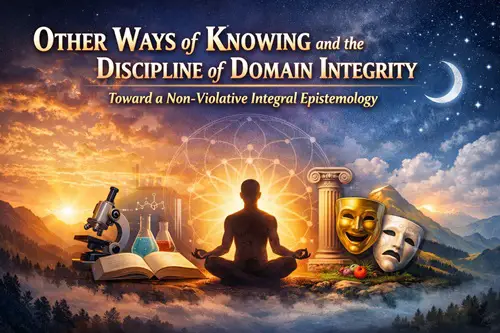 The Appeal of Epistemological PluralismThe phrase “Other Ways of Knowing” occupies a central, almost talismanic role in Integral discourse, especially in the work of Ken Wilber. It serves as both a critique of reductive scientism and a justification for incorporating introspection, meditation, aesthetics, and spirituality into a broader epistemological framework. At its strongest, this position begins with a sound observation: human knowledge is not exhausted by empirical science. The methods pioneered by Francis Bacon—systematic observation, experimentation, and public verification—are extraordinarily effective for investigating the external, measurable world. Yet they are less suited for first-person phenomena such as subjective experience, meaning, and value. Traditions such as phenomenology, exemplified by Edmund Husserl, and contemplative practices across cultures, offer disciplined alternatives for exploring these inner dimensions. So far, the Integral impulse toward pluralism is both legitimate and philosophically grounded. From Pluralism to InflationThe problem arises when “other ways of knowing” are not merely treated as distinct, but as epistemically equivalent—or even superior—to scientific knowledge, especially when they begin making claims about the structure of reality itself. This is where Integral Theory often overreaches. The shift from acknowledging multiple domains of inquiry to asserting a hierarchy of knowledge—where spiritual insight “transcends and includes” empirical science—introduces a subtle but critical inflation. What begins as epistemological pluralism turns into metaphysical ambition. The danger here is not pluralism per se, but the erosion of methodological boundaries. Defining Domain IntegrityDomain integrity refers to the principle that each mode of knowing operates within a specific ontological and methodological scope. Science deals with third-person, publicly observable phenomena. Introspection addresses first-person, privately accessible experience. Hermeneutics and cultural analysis operate in the second-person, intersubjective domain. Each domain has its own standards of evidence, validation, and error correction. Scientific claims require reproducibility and public verification. Phenomenological claims require disciplined introspection and intersubjective comparison. Ethical and aesthetic claims depend on coherence, interpretation, and dialogue. To respect domain integrity is to respect these differences without collapsing them into one another. The Problem of Domain ViolationsViolations occur when insights from one domain are illegitimately extended into another without meeting its evidentiary standards. A familiar example is the meditative report of “non-dual unity” or “pure awareness.” Within the first-person domain, such experiences are valid data. They can be studied, compared, and even mapped across traditions. However, when these experiences are taken as evidence for ontological claims—such as the assertion that consciousness is the fundamental substrate of the universe—a boundary has been crossed. The issue is not the experience itself, but the epistemic leap from phenomenology to metaphysics. This tendency is visible in many Integral formulations, where subjective insights are treated as disclosing objective truths about cosmology or evolution. The result is a category error: first-person data are used to make third-person claims without adopting the methodological constraints required by those domains. A Kantian ReminderA useful corrective can be found in Immanuel Kant, who distinguished between phenomena (the world as experienced) and noumena (the world as it is in itself). Kant fully acknowledged the richness of subjective experience but denied that it provides direct access to ultimate reality. Integral approaches often blur or collapse this distinction, treating refined or “higher” states of consciousness as privileged access to the structure of reality itself. From the standpoint of domain integrity, this move is unwarranted. It conflates the depth of experience with the scope of knowledge. Toward a Non-Violative IntegrationTo preserve domain integrity, “other ways of knowing” must be approached as complementary rather than competitive. Meditation can illuminate the structure of attention and selfhood. Art can disclose layers of meaning and affect. Ethical reflection can clarify values and norms. But none of these domains, on their own, can establish empirical claims about biology, cosmology, or physics. A mature epistemology does not flatten all knowledge into science, nor does it elevate subjective insight into metaphysical authority. Instead, it practices a disciplined pluralism, where each domain is sovereign within its own sphere. Integration, in this sense, is not a matter of synthesis through assertion, but of careful correlation across domains—respecting differences while exploring relationships. The Limits and Potentials of the “Eye of Spirit”Within the epistemological framework of Ken Wilber, the notion of the “Eye of Spirit” occupies the highest tier in his tripartite model of knowing, alongside the Eye of Flesh (empirical perception) and the Eye of Mind (rational cognition). It refers to contemplative or mystical awareness—accessed through practices such as meditation—which purportedly discloses ultimate or non-dual reality. To approach this concept with domain integrity, one must carefully distinguish between what the Eye of Spirit can legitimately disclose and what it cannot. At its strongest, the Eye of Spirit provides refined access to first-person phenomenology. It can disclose the structure of subjective experience at levels of depth rarely accessible in ordinary consciousness: the dissolution of ego boundaries, altered temporal perception, states of unity, or the attenuation of self-referential thought. These are not trivial insights. In fact, they represent a highly specialized form of introspective expertise, comparable—within its own domain—to the trained observational skills of a scientist or diagnostician. Moreover, these experiences can be intersubjectively compared within contemplative traditions. Advanced practitioners across cultures often report strikingly similar phenomenological features, suggesting that the Eye of Spirit is not purely idiosyncratic but has a degree of reproducibility under disciplined conditions. In this sense, it constitutes a legitimate “way of knowing” within the first-person domain. However, its limitations are just as important. The Eye of Spirit does not, by itself, disclose third-person facts about the external world. It cannot determine the age of the universe, the mechanisms of biological evolution, or the structure of subatomic particles. Any claims it makes in these areas are not grounded in its own methodological strengths and therefore represent domain violations. More subtly, it also cannot unambiguously adjudicate between competing metaphysical interpretations of its own experiences. A state of “non-dual awareness” may be interpreted as evidence for metaphysical idealism, panpsychism, or even certain forms of neutral monism—but the experience itself underdetermines these interpretations. The leap from phenomenology to ontology remains a philosophical inference, not a direct disclosure. This point echoes the critical boundary articulated by Immanuel Kant: no matter how profound the structure of experience, it does not grant unmediated access to things-in-themselves. The Eye of Spirit refines experience; it does not dissolve the epistemic gap between appearance and reality. A further limitation concerns error correction. Unlike science, which relies on public verification and systematic falsifiability, spiritual insight lacks robust external checks. Traditions may provide internal criteria—lineage validation, textual consistency, or teacher confirmation—but these do not function as independent arbiters in the same way empirical methods do. This makes the Eye of Spirit particularly vulnerable to overinterpretation and metaphysical inflation. From the standpoint of domain integrity, the appropriate stance is therefore one of disciplined restraint. The Eye of Spirit should be treated as a powerful instrument for exploring the qualitative, structural, and transformative dimensions of consciousness. It can illuminate how reality appears under conditions of deep introspection, how the sense of self is constructed and deconstructed, and how meaning and presence are experienced at their limits. But it should not be treated as a shortcut to cosmology, ontology, or natural science. A non-violative Integral epistemology would thus reposition the Eye of Spirit: not as a supreme arbiter of all knowledge, but as a specialized mode of access to a specific domain. Its insights may inspire metaphysical reflection, but they cannot, on their own, settle metaphysical debates. In this way, the Eye of Spirit retains its significance—while remaining firmly within the bounds of epistemic responsibility. Conclusion: Differentiation Before IntegrationThe real challenge is not to expand knowledge indiscriminately, but to differentiate it properly. Only on that basis can genuine integration occur. Without strict adherence to domain integrity, the inclusion of “other ways of knowing” risks devolving into an epistemic free-for-all, where boundaries are ignored rather than negotiated. A truly integral methodology would not collapse domains into a grand metaphysical narrative, but would instead develop rigorous protocols for translating insights across them—without violating their internal standards. That would be an integration worthy of the name.
Comment Form is loading comments...
|