|
TRANSLATE THIS ARTICLE
Integral World: Exploring Theories of Everything
An independent forum for a critical discussion of the integral philosophy of Ken Wilber
  Frank Visser, graduated as a psychologist of culture and religion, founded IntegralWorld in 1997. He worked as production manager for various publishing houses and as service manager for various internet companies and lives in Amsterdam. Books: Ken Wilber: Thought as Passion (SUNY, 2003), and The Corona Conspiracy: Combatting Disinformation about the Coronavirus (Kindle, 2020). Frank Visser, graduated as a psychologist of culture and religion, founded IntegralWorld in 1997. He worked as production manager for various publishing houses and as service manager for various internet companies and lives in Amsterdam. Books: Ken Wilber: Thought as Passion (SUNY, 2003), and The Corona Conspiracy: Combatting Disinformation about the Coronavirus (Kindle, 2020).
Check out my other conversations with ChatGPT
Evaluating Ken Wilber's WorldviewReading Notes from the Evolutionary Philosophy CircleFrank Visser / Grok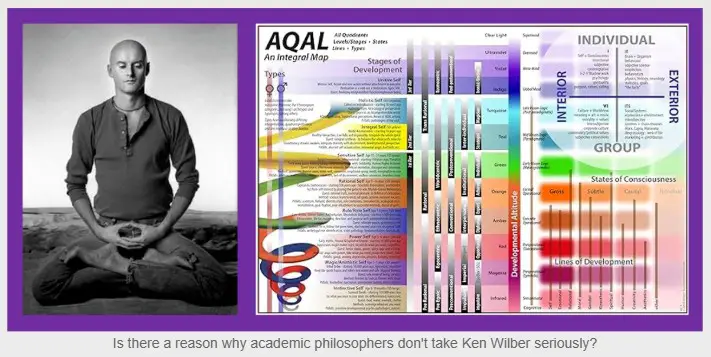 Summary of the Evolutionary Philosophy Circle (EPC) Report on Ken Wilber's Integral PhilosophyThe report, produced in 2022 by the Evolutionary Philosophy Circle (a discussion group within the Prosocial World / Prosocial Commons community founded by David Sloan Wilson), systematically evaluates Ken Wilber's well-documented Integral Philosophy / AQAL metatheory as a meaning system (worldview + unifying narrative) and as a scientific claim.[1] It uses two tools: • Ed Gibney's six-branch philosophical framework (epistemology, metaphysics, logic, ethics, politics, aesthetics) to map Wilber's positions. • David Sloan Wilson's three explicit criteria for judging “narratives of conscious evolution”: - Is it psychologically and emotionally motivating? - What does it cause people to do? - How well does it comport with current scientific knowledge? The EPC's stance is respectful but ultimately quite critical—more devastating on the science side than Wilson himself has been in his published interactions with Wilber. Wilson has praised Wilber as an effective meaning-maker who offers a hopeful, integrative story of conscious evolution that can complement multilevel selection / prosocial theory. The EPC agrees on the value of the project but concludes that Wilber's specific metaphysics and science are outdated, internally contradictory, and actively hinder the shared goal of “a world that works for all.” Wilber's Worldview (as distilled by the EPC)Unifying narrative (inferred, not explicit in Wilber): Scientific reductionism is bleak and cannot explain the universe. Mystical traditions reveal an “Eros in the Kosmos”—a spiritual force (Spirit / involution) that drives matter back toward Spirit through ever-higher, broader, more integrated levels of consciousness. Humans are roughly halfway “up from Eden.” Integral metatheory (AQAL + Integral Methodological Pluralism) lets us integrate all knowledge and consciously accelerate this evolutionary return to Spirit. Key philosophical positions (Table 1 in the report): • Epistemology: Knowledge comes from three “eyes”—flesh (sensory/empirical), mind (rational), and spirit (translogical / deep intuitive senses). Communities of the “adequate” confirm or reject claims. All truths are culturally interpreted; the goal is to include the greatest number of partial truths (non-exclusion) rather than falsify. • Metaphysics: Spirit precedes the Big Bang (involution) and pulls evolution toward higher complexity / cooperation. The universe is made of perspectives (not matter/energy); all existence consists of sentient holons mapped in four quadrants (interior/exterior x individual/collective). Consciousness is distributed across quadrants, not located in organisms. Development is irreversible and directional (pre-personal → personal → transpersonal). • Logic: Translogical / intuitive methods are valid. • Ethics: Spirit is ground and goal; all holons have equal ground value, but higher development yields greater intrinsic value (humans > animals > rocks, etc.). • Politics / Aesthetics: Largely unaddressed in the core sources. Points of Substantial Agreement (EPC with Wilber)• Science is silent on what preceded the Big Bang. • Random evolution can feel cold/bleak; many mysteries remain. • Every worldview starts with metaphysical assumptions. • Truth claims are culturally embedded. • Different domains of knowledge (science, philosophy, spirituality) are often complementary. • Humans can and should consciously guide cultural evolution toward a world that works for all. Points of Strong Disagreement (the report's core critique)The EPC finds Wilber's system internally inconsistent and scientifically untenable: • “Translogical” / “intuitive senses” are never clearly defined and cannot be shared or falsified collectively. Real knowledge requires repeatable evidence + agreed logical rules. • Integral Methodological Pluralism's “non-exclusion” principle is self-contradictory (it still excludes what is deemed “inappropriate”). • Involution + Eros either contradicts evolutionary history or adds nothing testable. Evolutionary “puzzles” Wilber cites (half a wing, half an eye, “dirt writing poetry”) have well-established naturalistic explanations; Wilber's knowledge of modern evolutionary biology is described as “severely lacking.” • Claiming the “stuff” of the universe is perspectives (not matter/forces) confuses epistemology with ontology and revives idealism without evidence. • The spectrum of consciousness (matter → body → mind → soul → spirit) and distributed/holonic sentience lack empirical support and clash with embodied cognition and evolutionary history. • Linear, irreversible stages of consciousness development ignore the fits-and-starts, reversals, and contingency documented in evolutionary science and anthropology. • The claim that Integral Philosophy is non-prescriptive is “disingenuous”; it privileges non-dual Buddhist awareness as the highest stage. • The entire metatheory project (integrating all knowledge) is flawed: incompatible theories cannot always be harmonized, and the best explanations win by accounting for data, not by collecting the most theories. Appendix 2 compiles decades of external criticism (especially from Integral World / Frank Visser) documenting Wilber's repeated misrepresentations of evolutionary biology, his use of creationist-style arguments, and his later retreats into metaphor when challenged.[2] Evaluation Using Wilson's Three CriteriaPsychologically / emotionally motivating? What does the narrative cause people to do? How well does it comport with current scientific knowledge? Overall Conclusion of the ReportIntegral Spirituality's goals (understanding life and creating a world that works for all) are laudable and overlap with Prosocial World's vision. However, Wilber's specific worldview contains metaphysical commitments and scientific inaccuracies that make joint progress difficult. The EPC urges a more accurate, scientifically grounded, and still-motivating narrative—one that keeps the humanistic and integrative spirit but discards involution, Eros-as-cosmic-force, and the pre-Darwinian elements that no longer hold up. In short: Wilson admired Wilber as a meaning-maker; the EPC report respects that but is far more uncompromising in judging Wilber's competence as a scientist of evolution and as a reliable guide for conscious evolution in the 21st century. The report is framed as an opening for dialogue rather than a final verdict. “Completing the Darwinian revolution”David Sloan Wilson's concept of “completing the Darwinian revolution” is the central thesis of his 2019 book This View of Life: Completing the Darwinian Revolution. It argues that while Darwin's theory revolutionized biology, its full potential remains unrealized until evolutionary thinking is systematically applied to human culture, behavior, policy, and all aspects of the human condition. The Core IdeaCharles Darwin's On the Origin of Species (1859) transformed our understanding of life by explaining how species change through natural selection. By the mid-20th century, the “Modern Synthesis” integrated genetics, and Theodosius Dobzhansky famously declared in 1973 that “nothing in biology makes sense except in the light of evolution.” Wilson contends that this revolution is incomplete because it has largely remained confined to genetic/biological evolution. Darwin himself had a broader vision (e.g., in The Descent of Man), including the evolution of human societies and morality. Wilson calls for extending the same evolutionary toolkit—variation, selection, and replication (or heredity)—to cultural evolution and human-designed systems at multiple scales (individuals, groups, organizations, societies, and the planet). “The Darwinian revolution won't be truly complete until it is applied more broadly—to everything associated with the words 'human,' 'culture,' and 'policy.'” This creates an “evolutionary worldview” that serves not just as scientific knowledge but as a practical framework for understanding and improving the world. Key Elements of Wilson's ArgumentMultilevel selection (MLS): Wilson is a leading proponent of this (sometimes called group selection). Natural selection operates at multiple levels: within groups (selfishness often wins) and between groups (cooperative/prosocial groups can outcompete selfish ones). This explains the evolution of altruism, cooperation, and group-level adaptations—topics that were controversial or sidelined for decades under strict gene-centric views (e.g., “selfish gene”). Cultural evolution: Human culture evolves via learned behaviors, norms, institutions, and ideas (not just genes). This is fast-paced and allows “conscious evolution”—we can intentionally shape it. Practical applications: Wilson uses real-world examples to show the toolkit in action: • Breeding hens for productivity (selecting at the group level improved outcomes). • Improving medical practices (e.g., cataract surgery timing). • Designing better organizations and policies (drawing on Elinor Ostrom's core design principles for managing commons). • Addressing social issues like education, business management, and environmental stewardship. The goal is to become “wise managers of evolutionary processes” so we can solve problems at all scales—from personal well-being to global sustainability. Why “Complete” the Revolution?For much of the 20th century, evolutionary biology focused narrowly on genetic mechanisms, often emphasizing competition and individualism. Wilson argues this left out: • The full explanatory power of evolution for human societies, morality, religion, and institutions. • A positive, actionable framework for policy and culture (avoiding misapplications like Social Darwinism, which he explicitly rejects). By “Darwinizing” the human realm, we gain a unified, evidence-based way to understand why groups succeed or fail, how to foster prosociality, and how to guide cultural change toward better outcomes. This aligns with his work on ProSocial World, which applies these ideas practically through multilevel cultural evolution. In short, Wilson sees completing the Darwinian revolution as moving from “nothing in biology makes sense except in the light of evolution” to “nothing in human affairs makes sense except in the light of evolution”—with profound implications for how we live, govern, and solve collective problems. It is both a scientific expansion and a call to use evolutionary insight as a compass for a better future. Compare this to the work of David LoyeYes, there is a meaningful resonance between David Sloan Wilson's project of “completing the Darwinian revolution” and David Loye's extensive (often self-published) work on Darwin's The Descent of Man (1871).[3] Ken Wilber has explicitly engaged with and approved of both interpretations. David Loye's Core ThesisDavid Loye (a psychologist, systems scientist, and longtime partner of Riane Eisler) spent decades arguing that Darwin's full evolutionary theory was split in two and only half was widely accepted: • Origin of Species (1859) - Focused on natural selection, struggle, and competition → This became the dominant “neo-Darwinian” narrative (often reduced to “selfish gene” thinking in popular culture). • The Descent of Man (1871) - Darwin's much longer “sequel” on human evolution, which heavily emphasized moral evolution, sympathy, love, cooperation, community, mutual aid, and cultural/psychological factors. Loye claimed the second half was largely ignored or downplayed for over a century because it didn't fit the mechanistic, reductionist mood of 20th-century biology. He highlighted Darwin's repeated emphasis on: • The evolution of morality through sympathy and “mutual aid.” • Love and caring as powerful evolutionary forces. • Cultural and social influences shaping human development. Key books by Loye include Darwin's Lost Theory of Love (and its expansions into a multi-volume Darwin Anniversary Cycle). He described this as Darwin's “fully human” completion of his theory — a “second revolution” that integrates biology with ethics, culture, and partnership. Loye's work often had a reformist, humanistic flavor (linked to partnership systems theory with Eisler) and was largely self-published or issued through smaller presses, which limited its mainstream academic impact but gave it a dedicated following in progressive, integral, and systems-thinking circles. Resonance with David Sloan WilsonWilson's This View of Life: Completing the Darwinian Revolution (2019) echoes Loye in important ways: • Both argue that the standard evolutionary narrative is incomplete and overly focused on competition/genes. • Both want to “complete” Darwin by fully incorporating cultural evolution, morality, cooperation, and the possibility of conscious guidance. • Wilson's multilevel selection framework (groups can evolve prosocial traits) aligns with Loye's emphasis on community, mutual aid, and higher-order selection in human societies. • Wilson explicitly draws on Darwin's broader vision in The Descent of Man for evolving morality and human affairs. The resonance is real, though their styles differ: Wilson is a mainstream (if sometimes contrarian) evolutionary biologist using rigorous models and empirical applications (e.g., ProSocial World), while Loye was more of an interdisciplinary scholar recovering a “lost” humanistic Darwin. Ken Wilber's Approval of BothWilber has directly endorsed and platformed both thinkers:He has interviewed Loye on Integral Life (e.g., “For the Love of Darwin: Beyond the Selfish Gene”), praising Loye's recovery of Darwin's emphasis on love and moral evolution as complementary to Integral Theory. Wilber has referenced his contacts with both Loye and David Sloan Wilson in discussions of cultural evolution and “Eros in the Kosmos.” He sees their work as fitting into his broader integrative metatheory — updating evolution with interior, cultural, and spiritual dimensions. Wilber views both as allies in moving beyond narrow materialist neo-Darwinism toward a more comprehensive, meaning-rich evolutionary story
This trio represents a strand of thought that tries to reclaim a richer, less reductionist Darwin — one that includes cooperation, culture, morality, and (in Wilber's case) spiritual dimensions — while still claiming fidelity to Darwin's original writings. Critics (including some evolutionary biologists) sometimes see this as romanticizing or selectively reading Darwin, but the connection the user noted is well-documented and actively promoted in integral and prosocial circles.
How has Wilson's view been received by his peers?David Sloan Wilson's "completing the Darwinian revolution" (and his broader advocacy for multilevel selection / group selection) has received a polarized reception among evolutionary biologists. While it garners support from researchers in cultural evolution, human behavior, and applied fields, it faces strong, ongoing criticism from prominent gene-centric or individual-selection advocates. Strong Criticism from Prominent Peers (e.g., Jerry Coyne, Richard Dawkins, Steven Pinker)Jerry Coyne (a leading evolutionary geneticist and author of Why Evolution Is True) is one of Wilson's most vocal and consistent critics. He has repeatedly described Wilson's promotion of group selection as misleading, overstated, or scientifically irresponsible: • Coyne accuses Wilson of zealotry, claiming he distorts the field by asserting that altruism's evolution is "solved" via group selection and that most evolutionists now agree with him. • He views Wilson's public presentations (e.g., BBC interviews) as overconfident and failing to acknowledge the dominance of kin selection / inclusive fitness explanations. • Coyne has criticized Wilson's broader applications (e.g., to religion, culture, and policy) as going beyond evidence and engaging in "pugilistic" or demagogic rhetoric. Richard Dawkins has long opposed strong forms of group selection, famously championing the "selfish gene" view. He has clashed publicly with both E.O. Wilson and David Sloan Wilson, calling some of their claims about group selection misleading or equivalent to outdated ideas. Dawkins has described group selection arguments as weak because within-group selection (favoring selfish individuals) typically overwhelms between-group selection. Steven Pinker echoed similar skepticism in his widely read 2012 Edge.org essay "The False Allure of Group Selection", calling it conceptually flawed for explaining human cooperation and likening it to a "scientific dust bunny." Pinker (and Coyne) often direct readers to this piece as a key rebuttal. These critics argue that: • Multilevel selection is often mathematically equivalent to kin selection / inclusive fitness (the dominant framework) but less parsimonious or useful in many cases. • Wilson's emphasis on it risks reviving discredited "for the good of the species/group" thinking from the 1960s. • His applications to human culture, policy, and "conscious evolution" stray into philosophy or advocacy rather than strict biology. More Nuanced or Positive Reception in Parts of the Field• Many working evolutionary biologists who study cultural evolution, human cooperation, or multilevel processes (e.g., Peter Richerson, Robert Boyd, and others) see value in multilevel selection frameworks, especially for humans where cultural inheritance creates strong group-level dynamics. Surveys of evolutionary anthropologists show broad acceptance that group/multilevel selection "occurs" and plays a role, though debates remain about its relative importance. • A 2011 paper by Omar Eldakar and David Sloan Wilson listed "Eight Criticisms Not to Make About Group Selection," arguing many common objections are outdated or based on misconceptions. They noted that specialists who study the topic largely accept that multilevel selection can occur. • Wilson's ideas have influenced applied areas (e.g., prosocial organizations, policy design via Elinor Ostrom's principles) and are seen as useful heuristics by some, even if not the primary theoretical lens. Overall AssessmentWilson's core scientific work on multilevel selection is respected as part of a legitimate (if minority or complementary) perspective, and the field has moved toward greater nuance: most experts now agree selection can act at multiple levels, but gene/individual/kin selection remains the default explanatory tool for many phenomena. However, Wilson's broader vision ("completing the Darwinian revolution" by applying evolution to culture, policy, meaning systems, and conscious guidance of evolution) is often viewed skeptically by hard-core evolutionary biologists like Coyne. They see it as overreaching, insufficiently rigorous, or too enthusiastic about group-level explanations. Wilson, in turn, has accused critics of outdated thinking, definitional confusion, and failing to engage with the modern literature on equivalence between frameworks. The debate is partly scientific (math/models/evidence) and partly stylistic/philosophical (how ambitious or "revolutionary" evolutionary thinking should be in human affairs). It remains lively but has cooled somewhat since the heated exchanges of the early 2010s. Wilson's ideas continue to influence interdisciplinary work (e.g., via ProSocial World) while facing resistance in core evolutionary biology circles. NOTES[1] Ed Gibney, "EPC Generation 2 - Evaluating Ken Wilber's Worldview", October 17, 2023. We had 10 weekly meetings to consider him in the Fall of 2022, but Wilber's Wikipedia entry lists 30 paperback books where he is the sole author, which altogether have a total of nearly 10,000 pages. So, there was far too much primary source material for our task. As such, and based on recommendations from members of the Integral community, we focused our efforts on a 71-page summary of Ken Wilber that was written by Paul Helfrich called “Ken Wilber's AQAL Metatheory: An Overview.” At the end of our explorations, we produced 46 pages of research, which are attached below. The research consists of a 9-page report of our findings, a 10-page appendix citing direct quotes to support our findings, and a 27-page appendix quoting other relevant material that we felt was helpful for completing our understanding of Wilber. [2] See: Frank Visser, "David Sloan Wilson on Ken Wilber, Together For a Better World?", May 2020 [3] David Loye, "Darwin and Wilber", February 2009, and Frank Visser, "Is Darwin Really 'On Our Side'?, Ken Wilber's Misreading of Neo-Darwinism", June 2017
Widget is loading comments...
|