|
TRANSLATE THIS ARTICLE
Integral World: Exploring Theories of Everything
An independent forum for a critical discussion of the integral philosophy of Ken Wilber
  Frank Visser, graduated as a psychologist of culture and religion, founded IntegralWorld in 1997. He worked as production manager for various publishing houses and as service manager for various internet companies and lives in Amsterdam. Books: Ken Wilber: Thought as Passion (SUNY, 2003), and The Corona Conspiracy: Combatting Disinformation about the Coronavirus (Kindle, 2020). Frank Visser, graduated as a psychologist of culture and religion, founded IntegralWorld in 1997. He worked as production manager for various publishing houses and as service manager for various internet companies and lives in Amsterdam. Books: Ken Wilber: Thought as Passion (SUNY, 2003), and The Corona Conspiracy: Combatting Disinformation about the Coronavirus (Kindle, 2020).
Check out my other conversations with ChatGPT
The Israel-Palestinian ConflictA Non-Partisan Examination of History, Law, Human Suffering, and Contemporary DiscourseFrank Visser / Grok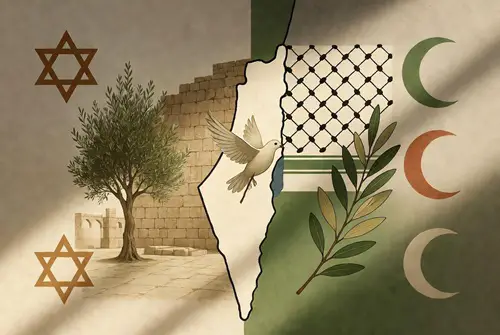 The Israel-Palestinian conflict is one of the most emotionally charged and polarizing disputes in modern history.[1] It has claimed tens of thousands of lives, displaced millions, and shaped global politics, human rights discourse, and academic debate for over a century. For anyone attempting to understand it—especially in the wake of the October 7, 2023 Hamas attacks and the subsequent war in Gaza—the picture quickly becomes confusing. Accusations of genocide clash with claims of legitimate self-defense. Historians appear divided. Human rights organizations issue damning reports, yet critics point to systemic bias. Settlement expansion in the West Bank fuels charges of apartheid, while Palestinian rejectionism and terrorism are cited as root obstacles to peace. This overview essay seeks to provide an integral, non-partisan synthesis grounded solely in verifiable evidence, legal standards, historical records, and reasoned analysis. It does not advocate for any side, assign collective guilt, or minimize suffering. Instead, it examines the conflict as a tragic clash between two peoples with legitimate national aspirations over the same small territory, complicated by repeated failures of leadership, ideology, and compromise on both sides. Historical Foundations: Competing Narratives of Indigeneity and DisplacementThe land between the Jordan River and the Mediterranean Sea—historically known as Judea, Samaria, Palestine, or the Holy Land—holds deep significance for Jews and Arabs alike. Jewish presence dates back over 3,000 years, with ancient kingdoms, the First and Second Temples, and continuous (if minority) communities even after Roman exile. By the late 19th century, Jews formed roughly 8-11 percent of the population amid Ottoman rule, a sparsely populated and economically underdeveloped region. The modern Zionist movement emerged in response to European antisemitism and pogroms, seeking Jewish self-determination in their ancestral homeland rather than as a colonial outpost. Waves of legal immigration under Ottoman and later British Mandate rule increased the Jewish population to about 30-32 percent by 1947, accompanied by economic development that also drew Arab migrants. Arab inhabitants, primarily Muslim with Christian and other minorities, had lived there for centuries, developing their own national consciousness in the early 20th century amid the collapse of the Ottoman Empire. The 1917 Balfour Declaration and 1922 League of Nations Mandate for Palestine explicitly recognized Jewish historical ties and the goal of a “national home for the Jewish people,” while promising to protect the civil and religious rights of all inhabitants. Arab leadership largely rejected this framework, viewing Jewish immigration as a threat. The pivotal events of 1947-1948 illustrate the tragedy. The UN Partition Plan proposed two states—one Jewish, one Arab—with internationalized Jerusalem. Jewish leaders accepted it despite its limitations; Arab states and Palestinian leadership rejected it outright and launched war the day after Israel's declaration of independence on May 14, 1948. Five Arab armies invaded. Israel survived against existential odds, but the war produced both Palestinian refugees (approximately 700,000, many displaced by fighting, expulsions in specific areas, and fear) and roughly 800,000 Jewish refugees expelled from Arab countries. What Israelis call the War of Independence, Palestinians call the Nakba (catastrophe). Benny Morris and other historians using declassified archives have documented atrocities and expulsions by Jewish forces in some locales, but also Arab-initiated massacres (e.g., Hebron 1929, Hadassah convoy 1948) and the broader Arab rejection of coexistence. The “New Historians” (Morris, Avi Shlaim, Ilan Pappé) highlighted Israeli agency in displacements, yet Morris later emphasized that Palestinian and Arab leadership bore primary responsibility for refusing partition and pursuing destruction of the nascent Jewish state. No Palestinian state emerged in 1948; Jordan annexed the West Bank and Egypt controlled Gaza until 1967, with no serious effort to grant Palestinian independence. Subsequent wars (1956, 1967, 1973) were initiated or escalated by Arab coalitions aiming to eliminate Israel. Israel's 1967 victory left it in control of the West Bank, Gaza, Sinai, and Golan—territories captured defensively. UN Security Council Resolution 242 called for “secure and recognized boundaries” in exchange for withdrawal, implying negotiation rather than automatic return to pre-1967 lines. Israel returned Sinai for peace with Egypt (1979) and withdrew unilaterally from Gaza in 2005, only to face Hamas rocket fire and the group's 2007 takeover. Multiple Israeli offers of statehood (Camp David 2000, Olmert 2008) were rejected by Palestinian leaders, who consistently prioritized maximal demands—including a “right of return” that would demographically end Israel as a Jewish state—over pragmatic compromise. Palestinian terrorism, including suicide bombings during the Second Intifada (2000-2005) and Hamas's charter (explicitly antisemitic and calling for Israel's destruction), deepened Israeli skepticism. At the same time, Israeli settlement growth in the West Bank entrenched facts on the ground, complicating any two-state solution. This history is not a simple morality play of colonizer versus colonized. It is a collision of two authentic national movements—Jewish people reclaiming indigenous ties after millennia of exile and persecution, and Palestinian Arabs asserting self-determination amid decolonization. Both have legitimate grievances: Jewish trauma from the Holocaust and repeated wars of annihilation; Palestinian suffering from displacement, occupation, and lost opportunities for statehood. Mutual recognition of the other's legitimacy has been the missing ingredient. The Gaza War (2023-2025): Legal Realities Beyond Emotional RhetoricThe October 7, 2023 Hamas massacre—1,200 Israelis and foreigners murdered, thousands injured, hostages taken, documented cases of rape and mutilation—meets every legal criterion of genocide under the 1948 Genocide Convention: killing members of a group with specific intent to destroy Jews “as such,” as stated in Hamas's founding documents. Israel's response, while inflicting devastating civilian costs (roughly 71,000-72,000 Palestinian deaths per Gaza Health Ministry figures through early 2026, with independent estimates in the same range), does not. Major human rights reports from Amnesty International, Human Rights Watch, B'Tselem, and certain UN bodies allege genocide, citing destruction, displacement, and inflammatory rhetoric from Israeli officials. Yet, as detailed comparative analyses show, these claims fail the Convention's strict requirement of specific intent (dolus specialis). The ICJ's “only reasonable inference” standard is decisive: a plausible alternative explanation exists—high-intensity urban warfare against an enemy that deliberately embeds military assets (500+ km of tunnels, booby-trapped homes, rocket launchers in schools) among civilians to maximize its own casualties for propaganda. Military experts like John Spencer (West Point) and Andrew Fox (Henry Jackson Society) document IDF measures unprecedented in urban conflict: millions of warnings via leaflets, calls, texts, and “roof-knocking”; evacuation corridors; precision strikes where feasible; and continued aid facilitation, polio vaccinations, and births amid fighting. Combatant-to-civilian ratios, even accepting Hamas data, compare favorably to Allied operations in WWII or coalition fights in Mosul and Raqqa. Hamas's tactics—human shields, aid diversion, orders for civilians to remain in combat zones—explain much of the tragedy. Isolated violations of international humanitarian law (IHL) almost certainly occurred and warrant accountability, but the pattern aligns with lawful self-defense against a perfidious foe, not deliberate destruction of Palestinians “as such.” Civilian suffering is immense and demands humanitarian response, but equating it with genocide dilutes the term forged in the Holocaust's ashes and obscures Hamas's primary responsibility for embedding its war machine in populated areas. The West Bank: Security, Settlements, and Cycles of ViolenceWest Bank dynamics differ sharply from Gaza's total war. Israeli military administration persists in a territory captured defensively in 1967, with fragmented Palestinian Authority (PA) control in Areas A and B under the Oslo Accords. Post-October 7, intensified IDF raids have sharply reduced successful terror attacks, though they have also caused Palestinian deaths (roughly 225-240 in 2025) and displacement. Extremist settler violence—arson, assaults, and “price tag” attacks—rose markedly (867 nationalistic crimes in 2025), with inadequate prosecution in some cases, damaging Israel's security interests and moral standing. Israeli governments have advanced thousands of settlement units, including outposts, entrenching a reality that many international bodies deem illegal under the Fourth Geneva Convention's prohibition on population transfer into occupied territory. Israel counters that the land was never sovereign Jordanian territory and that Jewish historical rights, defensive acquisition, and Oslo's deferral of final status justify the presence pending negotiation. Neither side's actions are blameless. Palestinian incitement, pay-for-slay policies, and armed factions in Jenin and Nablus sustain violence. Yet settler vigilantism and settlement expansion erode prospects for a viable Palestinian state. This low-intensity conflict involves real security threats alongside policies that appear aimed at demographic permanence rather than pure defense. It does not constitute genocide or apartheid in the legal sense—Palestinian population has grown steadily, and no policy seeks their physical destruction—but it includes verifiable failures: excessive force in raids, collective punishment via demolitions, and insufficient protection of Palestinian civilians from extremists. Sustainable resolution requires Israeli restraint on illegal outposts, accountability for settler crimes, and Palestinian rejection of terror infrastructure. Human Rights Discourse, Institutional Bias, and AntisemitismMajor institutions—UN Human Rights Council, Amnesty, HRW—have produced voluminous reports on Israeli actions while applying far softer scrutiny to vastly worse abusers (Syria's civil war, China's Uyghur camps, Iranian executions). UNHRC resolutions against Israel outnumber those against all other countries combined since 2006; permanent Agenda Item 7 ensures perpetual focus. Reports often rely on Hamas-controlled data, minimize perfidious tactics, and deploy legal terms (apartheid, genocide) that stretch beyond evidentiary thresholds. This asymmetry reflects structural factors: automatic majorities from authoritarian blocs, ideological “oppressor/oppressed” frameworks in activist cultures, and easier access to open Israel versus closed societies. A bias against Israel—disproportionate hostility that erodes credibility. Post-October 7, global antisemitic incidents surged dramatically (360-700 percent increases in some metrics). Discourse sometimes blurs criticism of policy with tropes: denying Jewish self-determination, Nazi comparisons, or holding diaspora Jews responsible for Israeli actions. The IHRA working definition helps distinguish legitimate critique (evidence-based policy analysis with context) from antisemitism (double standards, delegitimization). Human rights advocacy loses moral authority when it applies universal principles selectively, harming genuine efforts to protect all civilians. Historiography: From Official Narratives to Revisionism, Counter-Revisionism, and Contemporary PolarizationThe historiography of the Israel-Palestinian conflict is not a monolithic academic consensus that “sides with the Palestinians,” as is sometimes asserted in public discourse. Instead, it reflects a dynamic, often contentious evolution shaped by newly available archives, ideological currents, access to sources, and the political context of the times. What began as largely Israeli-centric “official” histories in the 1950s-1970s gave way in the late 1980s to the so-called New Historians, who used declassified Israeli state archives to challenge earlier accounts. This was followed by counter-revisionist scholarship that re-examined the same evidence while incorporating Arab, British, and UN records. Today the field is polarized between rigorous multi-archival empiricism and more ideologically driven postcolonial or activist frameworks, yet no field-wide majority verdict exists that attributes primary or exclusive responsibility to one side. Early “Old Historians” (or traditional Zionist historiography), such as those writing in the immediate post-1948 period (e.g., works associated with the Israeli Ministry of Defense or early scholars like Netanel Lorch), relied on limited sources and emphasized Jewish acceptance of the 1947 UN Partition Plan, the existential threat posed by the invading Arab armies, and the defensive nature of Israel's survival. These accounts portrayed the 1948 war as a straightforward War of Independence against overwhelming odds, with Palestinian refugee flight largely attributed to Arab leaders' calls for evacuation and the chaos of battle. Access to classified materials was restricted, and the narrative served nation-building purposes on the Israeli side, much as Arab states produced parallel official histories framing the war as a colonial betrayal and Nakba. The turning point came in the 1980s with the opening of Israeli archives under the thirty-year rule. A group of younger Israeli scholars—collectively labeled the New Historians—produced works that complicated the traditional story. Benny Morris's seminal 1988 book The Birth of the Palestinian Refugee Problem, 1947-1949 used IDF and Haganah documents to document cases of deliberate expulsions by Jewish forces in specific locales (e.g., Lydda and Ramle), instances of massacre (Deir Yassin), and the role of “transfer” ideas in some Zionist thinking. Avi Shlaim's Collusion Across the Jordan (1988) critiqued Israeli diplomacy and suggested tacit understandings with Transjordan's King Abdullah. Ilan Pappé's later works, such as The Ethnic Cleansing of Palestine (2006), pushed further, arguing that the displacement was part of a premeditated Zionist plan akin to ethnic cleansing. These books illuminated Palestinian suffering, the human cost of war, and elements of coercion that earlier accounts had minimized or omitted. They were hailed in some Western academic circles as correcting a one-sided Israeli narrative. Importantly, the New Historians were not uniform. Morris himself, the most empirically grounded of the group, repeatedly clarified that the evidence did not support a systematic, top-down policy of expulsion ordered by David Ben-Gurion or the Zionist leadership as a whole. In subsequent editions and books—most notably 1948: A History of the First Arab-Israeli War (2008) and The Birth of the Palestinian Refugee Problem Revisited (2004)—Morris incorporated Arab archival material, British intelligence reports, and Palestinian oral histories. He documented widespread Arab flight prompted by fear, local Arab leaders' encouragement of evacuation, and explicit calls by Arab statesmen (such as Azzam Pasha's 1947 statement that the war would be “a war of extermination”) to destroy the emerging Jewish state. Morris concluded that while Israeli actions contributed to the refugee crisis, the primary cause was the Arab rejection of partition and initiation of war, combined with the Palestinians' lack of coherent national leadership. He explicitly rejected the “ethnic cleansing” label as applied by Pappé, noting that the same archives showed no blueprint for mass expulsion and that roughly half the refugees fled before major Israeli offensives. Shlaim also nuanced his views over time, acknowledging Palestinian agency and missed opportunities. Counter-revisionist and traditionalist scholars pushed back vigorously. Efraim Karsh's Palestine Betrayed (2010) drew on the same Israeli archives plus Arab sources to argue that Palestinian leadership (especially the Mufti Haj Amin al-Husseini) and Arab states bore decisive responsibility for both the war and the refugee tragedy through rejectionism, incitement, and abandonment of their own population. Anita Shapira's Israel: A History (2012) and other mainstream Israeli historians integrated the New Historians' findings without accepting their more sweeping interpretations, emphasizing context: the Holocaust's shadow, prior Arab riots (1920, 1929, 1936-39), and the fact that population transfers were a common feature of 20th-century decolonization and partition (e.g., Greece-Turkey, India-Pakistan). British Mandate records and UN documents further show that Jewish immigration was largely legal and economically beneficial to the region, while Arab opposition was framed in pan-Arab and religious terms from the outset. Beyond the 1948 focus, historiography of later periods reveals similar patterns. The 1967 war is documented in declassified materials as a preemptive strike amid Egyptian mobilization and blockade of the Straits of Tiran; yet some postcolonial scholarship recasts it as aggressive expansionism. The Oslo era and Camp David 2000 failure have been analyzed through competing lenses: Israeli accounts (e.g., Dennis Ross's The Missing Peace) highlight Palestinian rejection of territorial compromises and insistence on a right of return that would end Israel's Jewish character; Palestinian and sympathetic historians stress Israeli settlement growth and perceived bad faith. The Second Intifada's suicide-bombing campaign is extensively documented in both Israeli and international reports as a deliberate escalation, yet some academic narratives frame it primarily as resistance to occupation. In recent decades, broader intellectual trends have influenced the field. Postcolonial studies and “settler-colonial” frameworks, prominent in Western universities since the 1990s, often portray Zionism as an external European implant displacing indigenous Arabs, drawing analogies to South Africa or Australia. These approaches—exemplified in works by scholars like Rashid Khalidi or in certain BDS-aligned academia—tend to downplay or minimize Jewish indigeneity (ancient Israelite kingdoms, continuous presence, and post-Holocaust refuge), Arab imperial history in the Levant, and Palestinian political choices. They also sometimes treat oral history and memory as equivalent to archival evidence, leading to critiques of methodological selectivity. Conversely, empirical historians insist on multi-source triangulation: Israeli archives alone are insufficient; Arab League records, Palestinian Authority documents, Soviet-era files, and demographic statistics must all be weighed. Recent digital projects (e.g., the Israel State Archives' online releases and Palestinian oral-history initiatives) have enriched the record but have not produced a new consensus. The result is a polarized but pluralistic historiography. No peer-reviewed scholarly majority “sides with the Palestinians” in the sense of endorsing a one-sided narrative of unprovoked Israeli aggression. Surveys of Middle East studies (e.g., by the Association for Israel Studies or analyses in Israel Studies journal) show persistent divides, with many leading historians (including former New Historians like Morris) stressing mutual agency, repeated Palestinian rejection of viable statehood offers, and the conflict as a clash of two legitimate national movements rather than a simple colonizer-colonized binary. At the same time, legitimate scholarship continues to document Israeli policies that exacerbated suffering—settlement expansion, disproportionate responses in some operations, and failures to curb extremist violence—without erasing Arab responsibility for terror, incitement, and maximalism. Rigorous historiography, at its best, rejects ideological capture. It demands primary-source fidelity, contextualization of every event within the sequence of wars and diplomacy, acknowledgment of traumas on both sides, and avoidance of anachronistic moral judgments. The conflict's history is tragic precisely because both peoples have genuine ties to the land and both have made choices that perpetuated violence. Understanding this requires moving beyond selective narratives—whether traditionalist, revisionist, or postcolonial—to a synthesis that honors evidence wherever it leads. Only such an integral approach can clarify why peace has remained elusive and what mutual recognition would actually entail. Conclusion: Toward Nuance and Mutual RecognitionThe Israel-Palestinian conflict endures because both peoples have legitimate claims and profound traumas, yet leadership on both sides has repeatedly chosen ideology over compromise. Palestinian suffering—from displacement to occupation hardships—is real and demands redress. Israeli security imperatives—against groups explicitly seeking Jewish destruction—are equally real. October 7 and the Gaza war crystallized the stakes: an enemy that weaponizes its own civilians versus a democracy fighting under impossible constraints. West Bank realities show how extremism and settlement entrenchment perpetuate cycles. Biased discourse and polarized historiography deepen confusion rather than illuminate paths forward. Peace requires mutual recognition: Israel as a Jewish state with secure borders; Palestinians with a viable, demilitarized state alongside it. This has been offered imperfectly multiple times and rejected. External actors, including biased institutions, often worsen the impasse by excusing rejectionism or demonizing self-defense. True progress demands rejecting maximalism, ending incitement and terror on one side, and curbing settlement expansion and vigilantism on the other. For observers, the antidote to confusion is evidence over emotion, context over slogans, and law over rhetoric. The tragedy is shared; only honesty about agency, history, and hard choices on both sides can end it. Appendix 1: Summary of the Genocide DebateThe debate over whether Israel's military campaign in Gaza—launched after the Hamas-led attacks on October 7, 2023 (which killed about 1,200 Israelis and took over 250 hostages)—constitutes genocide centers on the 1948 UN Genocide Convention. This defines genocide as specific acts committed with the intent to destroy, in whole or in part, a national, ethnical, racial, or religious group. The protected group here is Palestinians in Gaza. Legal Definition and Key ElementsThe Convention lists five acts: • Killing members of the group. • Causing serious bodily or mental harm. • Deliberately inflicting conditions of life calculated to bring about physical destruction (in whole or in part). • Imposing measures to prevent births. • Forcibly transferring children. Genocide requires both the commission of one or more acts and specific intent (dolus specialis)—not just high civilian casualties or war crimes, but the aim to destroy the group "as such." Proving intent often relies on patterns of conduct, statements by leaders, and context. The ICJ has not issued a final merits ruling in South Africa's 2023 case against Israel (ongoing as of March 2026, with interventions from multiple states on both sides). However, it found a "plausible" risk of genocide in early 2024 and issued provisional measures ordering Israel to prevent genocidal acts, punish incitement, and ensure humanitarian aid. Arguments That Israel's Actions Constitute GenocideA growing number of human rights organizations, UN bodies, genocide scholars, and some Israeli groups conclude that Israel has committed (and continues to commit) genocide. Key points: Acts committed: Widespread killing (Gaza Health Ministry reports ~72,000+ Palestinian deaths by early 2026, with independent studies like one in The Lancet estimating higher figures including indirect deaths; Israel has internally acknowledged ~70,000). Destruction of homes, hospitals, schools, universities, and infrastructure; forced displacement of most of Gaza's ~2.2 million population (often multiple times); severe restrictions on food, water, fuel, electricity, and aid leading to famine risks, disease, and "conditions of life" calculated to destroy the group; attacks on healthcare and reproductive health (e.g., destruction of fertility clinics); and reports of sexual violence, torture, and environmental harm. UN Commission of Inquiry (Sept 2025) found four of five genocidal acts. Intent: Cited evidence includes statements by senior Israeli officials (e.g., references to "erasing" Gaza, "human animals," or collective punishment), patterns of indiscriminate or disproportionate strikes, blocking aid despite ICJ orders, and the scale of destruction (e.g., most of Gaza rendered uninhabitable). Amnesty International (2024), Human Rights Watch, B'Tselem (Israeli group), Physicians for Human Rights Israel, Doctors Without Borders, the International Association of Genocide Scholars (IAGS resolution, 2025), and UN experts/special rapporteurs have concluded genocidal intent exists, viewing the campaign as systematic destruction beyond self-defense. Some describe it as part of a longer pattern tied to occupation and blockade. Supporting context: High civilian-to-combatant ratios claimed by critics; destruction of cultural/educational sites; statements from scholars like Omer Bartov or Raz Segal framing it as a "textbook" or unfolding case. Polling shows increasing public acceptance in some countries (e.g., many Democrats in the US). A 2025 UN report called it a "collective crime" enabled by third-state complicity. These views hold that even if targeting Hamas, the methods and scale demonstrate intent to destroy Palestinian life in Gaza as a group. Arguments Against the Genocide LabelIsrael, the US, and others strongly reject the accusation as "blood libel," false, or a distortion that trivializes the Holocaust and ignores context: No genocidal intent: Israel's stated goal is to eliminate Hamas (a terrorist group whose charter calls for Israel's destruction) and rescue hostages, not destroy Palestinians "as such." Actions target militants, with efforts to warn civilians (e.g., evacuation orders, though critics call them insufficient or deceptive). High casualties result from urban warfare where Hamas embeds among civilians and uses human shields (per Israel). Isolated inflammatory statements by officials do not reflect policy and have been clarified or disavowed. Self-defense and law of war: The campaign responds to October 7 atrocities (sometimes called genocidal by Israel due to intent to kill Jews). Civilian harm, while tragic, does not equal genocide if proportionate to military necessity. Israel claims low combatant-to-civilian ratios compared to other urban wars; it allows some aid (though restricted for security) and disputes casualty figures as inflated or including combatants/Hamas misfires. Critics of the label call it "lawfare" or antisemitic delegitimization. Alternative framing: Actions may involve war crimes or crimes against humanity (e.g., disproportionate strikes, collective punishment, starvation as a method), but lack the specific intent required for genocide. Hamas bears primary responsibility for starting/escalating via its attack and tactics. Some analyses argue casualty data is unreliable or manipulated, and destruction serves military aims, not group destruction. The US has intervened at the ICJ calling the case "false." Broader Context and StatusCasualties: Palestinian deaths ~70,000-75,000+ reported (including combatants); thousands more possibly under rubble or from indirect causes. Israeli deaths from Oct 7 and subsequent fighting ~1,200+ initially, plus soldiers/hostages. Debates persist over verification, with Gaza's Health Ministry (Hamas-run) figures long deemed broadly reliable by UN but contested by Israel on details. Political divide: Accusations amplified by UN bodies, NGOs, some scholars, and left-leaning publics; denial or reframing dominant in Israel, US policy, and pro-Israel groups. ICJ case drags on (merits years away). Ceasefires have been fragile, with violations reported. Implications: The term "genocide" is highly charged—its use invokes duties to prevent/punish under the Convention. Critics say overuse dilutes it; proponents say denial enables impunity. Many agree on severe humanitarian catastrophe, war crimes on multiple sides, and need for accountability (e.g., via ICC warrants sought for leaders). The debate remains polarized along political, legal, and moral lines. A final legal determination rests with courts like the ICJ or ICC, but evidence of mass suffering, destruction, and contested intent fuels ongoing contention. Both sides accuse the other of bad faith, with Hamas's role and Israel's security needs as central flashpoints. Appendix 2: The Outsized Role of US Support for IsraelThe United States has long maintained a uniquely close strategic partnership with Israel, providing it with more cumulative foreign aid than any other country since World War II—over $300 billion (inflation-adjusted) and approximately $174-352 billion (non-adjusted or updated estimates through 2025). This support is overwhelmingly military in nature today, reflecting shared interests in countering Iran, Hezbollah, Hamas, and other regional threats, as well as Israel's role as a key Middle East ally. Under a 2016 Memorandum of Understanding (extended through 2028), the baseline is about $3.8 billion annually ($3.3 billion in Foreign Military Financing + $500 million for missile defense systems like Iron Dome). Israel must spend much of this on U.S.-made weapons, benefiting American industry. Surge in Support Since October 7, 2023Following Hamas's October 7 attacks (killing ~1,200 Israelis and taking hostages), U.S. aid escalated sharply to support Israel's military campaign in Gaza (and related operations against Hezbollah and threats from Iran). From October 2023 through late 2025: • At least $16.3-21.7 billion in additional military aid, per Congressional Research Service, Council on Foreign Relations, and Costs of War analyses. This includes supplementals like $8.7 billion in April 2024, annual appropriations (~$3.8 billion/year), and emergency transfers of munitions (e.g., tank shells, artillery, bombs). • Total post-October 7 military-related support estimates reach nearly $34 billion in some accounting (including broader assistance). • Major arms sales continued (e.g., over $20 billion notified in 2024, including F-15 aircraft), with occasional congressional bypasses for urgency. Some shipments were paused briefly for review, but the flow remained robust. The U.S. also provides intelligence sharing, joint military exercises, and direct deployments (e.g., THAAD missile defense systems). Diplomatic and Military BackingBeyond dollars, U.S. support includes: • UN Security Council vetoes: Dozens historically against resolutions critical of Israel; specifically, multiple vetoes of ceasefire calls post-October 2023 (sources cite 3-14 instances). This has blocked international efforts to impose pauses or accountability. • Qualitative Military Edge (QME) policy: U.S. law requires ensuring Israel's technological superiority over regional adversaries, limiting arms sales to others (e.g., Arab states) unless they do not erode it. Critics describe this as an "outsized" enabler of the conflict's prolongation because: • Financial/military lifeline: Aid covers a significant portion of Israel's defense spending (historically ~20-30%+ in wartime surges), reducing economic pressure to scale back operations, seek ceasefires, or prioritize hostage deals over maximalist goals (e.g., "eliminating Hamas"). It allows sustained high-intensity warfare despite Gaza's destruction and high Palestinian casualties (~70,000+ reported by early 2026). • Impunity and escalation: Vetoes and unconditional arms flows (despite U.S. calls for restraint and international humanitarian law compliance) are said to shield Israel from consequences, enabling broader regional actions (Gaza, West Bank, Lebanon) and discouraging negotiated settlements. Human rights groups (e.g., Amnesty) and some U.S. lawmakers argue this violates U.S. law on arms transfers tied to human rights/IHL, perpetuating a cycle of violence rather than incentivizing de-escalation. • Regional blowback: Seen as fueling anti-U.S. sentiment, complicating alliances, and contributing to wider Middle East instability (e.g., Houthi/Iranian responses). Counterarguments and U.S. Strategic RationaleDefenders (U.S. and Israeli officials) frame the support as essential self-defense aid, not perpetuation: • Israel faces existential threats from groups explicitly calling for its destruction; October 7 was a genocidal-scale attack in Israel's view, justifying robust response. • Aid includes conditions in principle (e.g., Biden-era reviews of compliance), and the U.S. has pushed for humanitarian access, ceasefires, and post-war planning—though enforcement is debated. • Broader U.S. interests: Counterterrorism, intelligence, tech cooperation, and stability against Iran. Israel is not the sole driver; Hamas's tactics, charter, and rejectionism (plus Iranian backing) are primary escalators. The U.S. also provides (limited) aid to Palestinians and supports two-state ideas in principle. • Scale is modest relative to U.S. budget (<0.1% of federal spending; <5% of foreign aid). Public opinion in the U.S. has shifted: Polls (Pew, Gallup, NYT/Siena as of 2025) show declining approval of Israel's actions in Gaza, with pluralities/majorities (especially Democrats and independents) saying the U.S. provides "too much" aid or should condition it more heavily. A majority now opposes additional aid in some surveys, reflecting fatigue over the war's human cost. In summary, U.S. support—financially massive, militarily enabling, and diplomatically shielding—gives Israel unmatched freedom of action, which critics argue has prolonged the Gaza war, enabled escalation, and entrenched the conflict by removing key pressures for compromise. Proponents see it as a necessary bulwark for a vital ally against terrorism. The dynamic remains a core flashpoint in U.S. foreign policy, with ongoing debates over leverage, conditions, and long-term strategy as the conflict persists into 2026. NOTES[1] Twenty years ago, in 2006-2007, I hosted a couple of exchanges between Ray Harris and Jeff Meyerhoff about the Middle East conflict. See: "Integral Thoughts on the Middle East Conflict". Harris represented the position of Israel, Meyerhoff that of the Palestinians, and many of the topics of this current essay were touched upon, e.g. the New Historians and their reception. It showed how difficult it is to reach common ground in these matters of politics and war.
Widget is loading comments...
|