|
TRANSLATE THIS ARTICLE
Integral World: Exploring Theories of Everything
An independent forum for a critical discussion of the integral philosophy of Ken Wilber
  Frank Visser, graduated as a psychologist of culture and religion, founded IntegralWorld in 1997. He worked as production manager for various publishing houses and as service manager for various internet companies and lives in Amsterdam. Books: Ken Wilber: Thought as Passion (SUNY, 2003), and The Corona Conspiracy: Combatting Disinformation about the Coronavirus (Kindle, 2020). Frank Visser, graduated as a psychologist of culture and religion, founded IntegralWorld in 1997. He worked as production manager for various publishing houses and as service manager for various internet companies and lives in Amsterdam. Books: Ken Wilber: Thought as Passion (SUNY, 2003), and The Corona Conspiracy: Combatting Disinformation about the Coronavirus (Kindle, 2020).
Check out my other conversations with ChatGPT
Postmodernism and the 'Performative Contradiction'A Critical Analysis of Wilber's ClaimFrank Visser / ChatGPT
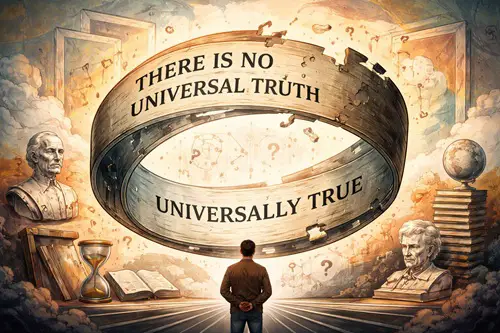
Introduction: Wilber's Critique of PostmodernismIn Trump and the Post-Truth World, Ken Wilber offers a sharp critique of postmodern thought, highlighting what he sees as a fundamental performative contradiction.[1] He writes that postmodernists claimed all knowledge is non-universal, contextual, and interpretive, yet they themselves presented these claims as universally true. Wilber frames this as a “major self-contradiction”: postmodernists assert that all Big Pictures are wrong, while simultaneously constructing a Big Picture of their own. According to him, they believe their epistemological stance applies “to all people, in all places, at all times—no exceptions.” This critique is widely cited in discussions of postmodernism, often as a definitive example of its alleged incoherence. But a closer examination shows that Wilber's reading may conflate postmodern method with postmodern assertion, producing a critique that is rhetorically striking yet philosophically incomplete. The Core of the Performative ContradictionWilber identifies a tension: postmodernists insist that knowledge is always context-bound, yet their summary statements claim universal validity. In his words: “They most definitely and strongly believed that it is universally true that there is no universal truth.” This is precisely what he calls a performative contradiction: postmodernists are “doing what they say either cannot or should not be done.” The accusation is that postmodernism is self-undermining, claiming transcontextual authority while denying the possibility of such authority. At first glance, the charge seems compelling. If all truths are situated and interpretive, then no truth claim—including the claim that “all truths are situated”—can be absolute. Wilber's critique resonates with critics from Jürgen Habermas to Charles Taylor, who have similarly accused postmodernism of violating its own epistemic principles. Contextualizing Postmodern AssertionsYet the alleged contradiction relies on a misunderstanding of postmodern method. Postmodernists rarely intend their meta-theories to function as absolute, universal truths. Rather, they operate as critical reflections on knowledge production. When Derrida, Foucault, or Rorty discuss the context-dependence of truth, they are not asserting a final metaphysical fact about reality; they are highlighting patterns within cultural, historical, and discursive practices. The tension arises when Wilber interprets postmodern meta-claims as ontological statements. To assert that knowledge is contextual does not require one to step outside all context to verify it. Postmodern thinkers are often making methodological, interpretive observations about how knowledge functions within specific systems. Their “Big Picture” is less a claim to ultimate authority than an analytical tool to expose the constructedness of other Big Pictures. The Seductive Trap of the Meta-NarrativeWilber's critique also exposes a psychological pattern in postmodern writing: the paradox of speaking about universality while critiquing it. Postmodern texts often present bold, sweeping analyses—what Wilber describes as “a very extensive metanarrative about why all metanarratives are oppressive.” To a reader, this can appear contradictory, because the critique itself is packaged in persuasive, quasi-universal language. But here, the performative tension is pragmatic rather than strictly logical. Postmodernists use synthesis and summary as rhetorical devices to reveal patterns across contexts. They do not intend their meta-narratives to claim transcontextual truth in the way scientific laws do. The rhetorical style—bold, generalized, occasionally sweeping—makes it tempting to read them as violating their own epistemic rules. Wilber's Oversight: Method vs. MetaphysicsThe fundamental problem in Wilber's reading is the conflation of method with metaphysics. He assumes that any statement about knowledge must either be absolute or false. Postmodernism, by contrast, operates in a space where statements are provisional, critical, and situated. The performative “oops” Wilber observes is often a rhetorical artifact, not a fatal philosophical flaw. In other words, postmodernists are not claiming to have a universal, context-free insight; they are critiquing the illusion of such insights in other epistemic frameworks. The apparent contradiction is largely a category error: Wilber judges postmodern reflexivity with the standards of ontological certainty. Conclusion: Rethinking the “Performative Contradiction”Wilber's critique in Trump and the Post-Truth World captures the rhetorical paradox in postmodern texts—the tension between critique and presentation. Yet the philosophical claim that postmodernism is self-contradictory overstates the case. The statement “all truths are contextual” functions as an epistemic, not an ontological, claim. Postmodernists are engaged in exposing assumptions, not asserting ultimate metaphysical authority. The performative contradiction, as Wilber presents it, is therefore not a fatal flaw but a reflection of the challenging position postmodernism occupies: it destabilizes universal claims while employing strong, sometimes universalizing language to make its critique compelling. Understanding this distinction clarifies why postmodernism's apparent self-undermining is more a stylistic and methodological issue than a logical collapse. In sum, Wilber highlights an important rhetorical tension, but misses the deeper philosophical subtlety: postmodernism's strength lies in its epistemic reflexivity, not in asserting universal truths. The “performative contradiction” is often an invitation to reflection rather than evidence of incoherence. Appendix: How Postmodern Thinkers Would Judge Wilber's ProjectIf we take Wilber's critique seriously, the natural counter-question arises: how would leading postmodern thinkers evaluate Wilber himself? His integral project—ambitious, synthetic, and explicitly “Big Picture”—would not escape the very forms of critique he directs at postmodernism. In fact, it would likely become a prime target. Foucault: Power Behind the “Integral” SynthesisMichel Foucault would likely approach Wilber not as a philosopher of truth, but as a producer of discourse. From a Foucauldian perspective, Wilber's system is not simply an integrative framework; it is a regime of knowledge that organizes and legitimizes certain forms of experience while marginalizing others. Foucault would ask: what power relations are embedded in Wilber's hierarchy of developmental stages? Who gets to define “higher” and “lower”? The integral model, with its structured levels and claims to inclusivity, could be seen as a subtle normalization apparatus—one that classifies, ranks, and disciplines under the guise of synthesis. Rather than transcending perspectives, it might be reinterpreted as governing them. Derrida: The Instability of the Integral SystemJacques Derrida would likely focus on the internal tensions within Wilber's system. Integral theory claims to include and transcend all perspectives, but this very claim invites deconstruction. What does “transcend and include” ultimately privilege? What gets excluded in the act of inclusion? Derrida would probe the binary oppositions underlying Wilber's framework—higher/lower, deeper/surface, integral/partial—and show how these hierarchies depend on unstable conceptual foundations. The supposed synthesis might unravel under scrutiny, revealing that it relies on distinctions it cannot fully justify. Rorty: Redescription Rather Than Final VocabularyRichard Rorty would likely treat Wilber's project as one more “final vocabulary”—a comprehensive attempt to describe reality in a unified way. Rorty's pragmatism resists such ambitions. He would argue that Wilber is not uncovering the structure of reality but offering a particular way of talking that may or may not prove useful. From this perspective, the problem is not that Wilber is wrong, but that he presents his framework as more than a contingent redescription. Rorty would likely suggest that integral theory should be judged by its utility, not by its claim to map reality as such. Lyotard: The Return of the Grand NarrativeJean-François Lyotard, famous for defining postmodernism as “incredulity toward metanarratives,” would almost certainly see Wilber's work as a revival of precisely what postmodernism sought to critique. Integral theory, with its sweeping account of evolution, consciousness, and culture, is a paradigmatic grand narrative. Lyotard would question whether such a narrative can avoid the pitfalls of earlier totalizing systems. Does it silence local, fragmented, and heterogeneous forms of knowledge? Does it impose coherence where there is irreducible plurality? For Lyotard, Wilber's ambition to integrate might itself be a form of epistemic overreach. Habermas: A More Sympathetic but Critical ViewHabermas would not reject Wilber's developmentalism as such, but would likely challenge its metaphysical extension beyond communicative rationality and its reliance on hierarchies that are insufficiently grounded in intersubjective justification. Habermas might ask whether Wilber's framework adequately grounds its claims in communicative rationality—shared processes of justification accessible to all participants. He would be wary of any system that claims epistemic authority without being fully accountable to intersubjective critique. Reversal of the Charge: Is Integral Theory Performatively Contradictory?From a postmodern standpoint, Wilber's accusation of performative contradiction might be turned back on his own project. Integral theory claims to include all perspectives, yet it ranks them hierarchically. It asserts pluralism while maintaining a structured order of development. It critiques reductionism while offering a comprehensive synthesis that risks reducing complexity to a single framework. In this light, postmodernists might argue that Wilber's system performs its own version of contradiction: it aspires to total inclusion while necessarily excluding or subordinating alternative interpretations that do not fit its schema. Conclusion: A Mirror Rather Than a RefutationFrom the perspective of major postmodern thinkers, Wilber's project would not be dismissed outright, but neither would it be accepted on its own terms. It would be treated as a powerful, ambitious, but ultimately situated discourse—one that reflects the very tensions it seeks to resolve. Where Wilber sees postmodernism as trapped in contradiction, postmodernists would likely see his integral theory as reenacting the perennial philosophical desire for unity, coherence, and totality. The difference is not that one side is coherent and the other is not, but that they operate with fundamentally different expectations about what philosophy should achieve. In this sense, the debate is less about who is right and more about which intellectual game one chooses to play: the construction of integrative wholes, or the deconstruction of their underlying assumptions. NOTES[1] Ken Wilber, "Trump and a Post-Truth World", IntegralLife, January 2, 2017: "The catch-22 here was that postmodernism itself did not actually believe a single one of those ideas. That is, the postmodernists themselves violated their own tenets constantly in their own writings, and they did so consistently and often. Critics (from Jürgen Habermas to Karl Otto-Apel to Charles Taylor) would soon jump all over them for committing the so-called “performative contradiction,” which is a major self-contradiction because you yourself are doing what you say either cannot or should not be done. For postmodernists, all knowledge is non-universal, contextual, constructivist, interpretive—found only in a given culture, at a given historical time, in a particular geopolitical location. Unfortunately, the postmodernists aggressively maintained that every one of its summary statements given in the previous paragraph were true for all people, in all places, at all times—no exceptions. Their entire theory itself is a very Big Picture about why all Big Pictures are wrong, a very extensive metanarrative about why all metanarratives are oppressive. They most definitely and strongly believed that it is universally true that there is no universal truth. They believed all knowledge is context bound except for that knowledge, which is always and everywhere transcontextually true. They believed all knowledge is interpretive, except for theirs, which is solidly given and accurately describes conditions everywhere. They believed their view itself is utterly superior in a world where they also believed absolutely nothing is superior. Oops."
Widget is loading comments...
|