|
TRANSLATE THIS ARTICLE
Integral World: Exploring Theories of Everything
An independent forum for a critical discussion of the integral philosophy of Ken Wilber
  Frank Visser, graduated as a psychologist of culture and religion, founded IntegralWorld in 1997. He worked as production manager for various publishing houses and as service manager for various internet companies and lives in Amsterdam. Books: Ken Wilber: Thought as Passion (SUNY, 2003), and The Corona Conspiracy: Combatting Disinformation about the Coronavirus (Kindle, 2020). Frank Visser, graduated as a psychologist of culture and religion, founded IntegralWorld in 1997. He worked as production manager for various publishing houses and as service manager for various internet companies and lives in Amsterdam. Books: Ken Wilber: Thought as Passion (SUNY, 2003), and The Corona Conspiracy: Combatting Disinformation about the Coronavirus (Kindle, 2020).
Check out my other conversations with ChatGPT
Beyond the ExteriorDarwin, Selection, and Wilber's Misreading of EvolutionFrank Visser / ChatGPT
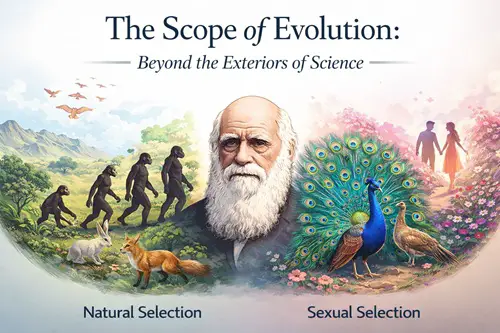 The “Exterior Only” ClaimKen Wilber has long argued that evolutionary science is restricted to the “Right-Hand” quadrants of his integral framework—the domains of observable behavior and physical systems. In this telling, biology explains how organisms change in response to environmental pressures but remains silent on interiority: intention, desire, meaning, and purpose. Evolution, in other words, is reduced to mechanism, stripped of any inner dimension. This critique has rhetorical force, especially when contrasted with Wilber's broader metaphysical vision of a Kosmos infused with Eros. Yet it depends on a simplified picture of what evolutionary theory actually claims and how it has developed since the nineteenth century. Darwin's Dual FrameworkCharles Darwin did not present evolution as a single, purely survival-driven process. In On the Origin of Species and even more explicitly in The Descent of Man, he distinguished between two mechanisms: natural selection and sexual selection. Natural selection operates through differential survival. Traits that enhance an organism's ability to cope with its environment—finding food, avoiding predators, resisting disease—tend to persist. This is the aspect of evolution most often highlighted in textbook summaries and, not coincidentally, the one Wilber targets as “exterior.” Sexual selection, however, introduces a different causal logic. Here, traits evolve not because they enhance survival, but because they increase reproductive success through mate attraction or competition. The extravagant plumage of peacocks, the complex songs of birds, or the ritualized displays of many species are not reducible to brute survival efficiency. In some cases, they even hinder it. Darwin recognized that these traits arise from preference, choice, and competition within a species. Evolution, therefore, is not only shaped by environmental constraints but also by organismic interactions structured around attraction and selection. Sexual Selection as a Bridge ConceptSexual selection occupies an interesting conceptual space. It is fully naturalistic and empirically grounded, yet it incorporates elements that look, at least superficially, like “interiority”: preference, attraction, and even proto-aesthetic judgment. Of course, evolutionary biology does not interpret these in a mystical or introspective sense. Preferences are studied as behavioral dispositions with genetic and neurological underpinnings. Mate choice can be modeled, measured, and experimentally tested. There is no appeal to inner consciousness as an independent causal force. Nevertheless, sexual selection undermines the caricature of evolution as a purely external filtering process. It shows that evolutionary outcomes depend on relational dynamics within populations—on how organisms respond to one another, not just to their environments. Modern Evolutionary Theory: Beyond MechanismSince Darwin, evolutionary biology has expanded considerably. Fields such as behavioral ecology, evolutionary psychology, and signaling theory have deepened our understanding of how organisms interact, compete, and select. Mate choice is now studied in terms of costly signaling, fitness indicators, and runaway selection processes. Traits can evolve because they reliably signal underlying genetic quality or because they become self-reinforcing through feedback loops between preference and display. These developments remain firmly within a third-person, empirical framework. Yet they demonstrate that evolutionary science is far from blind to complexity. It does not merely catalog external forms; it analyzes dynamic systems of interaction that include cognition, behavior, and social structure. Where Wilber OverreachesWilber's claim that science deals only with exteriors rests on a category shift. He equates “interior” with first-person phenomenology—subjective experience as directly lived—and then criticizes science for not addressing it in those terms. But evolutionary biology was never designed to do that. Its explanatory framework is methodological naturalism: it explains phenomena in terms of observable, testable processes. When it encounters behavior that appears to involve choice or preference, it translates these into operational terms that can be studied. To fault science for not invoking irreducible interiority is to demand that it abandon its own epistemic standards. More importantly, it overlooks the fact that science has already incorporated many of the phenomena Wilber claims it ignores—albeit in a different explanatory vocabulary. The Inflation of “Eros”Wilber often introduces “Eros” as a kind of intrinsic drive toward greater complexity, depth, or consciousness. This functions as a unifying principle that supposedly accounts for the directional character of evolution. However, once Darwin's dual framework is properly understood, much of what Eros is meant to explain can be accounted for through established mechanisms. Increasing complexity can emerge from cumulative selection pressures, ecological niches, and feedback loops between organisms and environments. The appearance of direction does not require a guiding force; it can arise from non-random selection acting on random variation. Sexual selection, in particular, explains the emergence of elaborate, seemingly purposive traits without invoking any overarching telos. What looks like aesthetic striving is, in evolutionary terms, the result of iterative selection shaped by reproductive dynamics. Interior Language, Exterior ExplanationThere remains a legitimate philosophical question about whether first-person experience can ever be fully captured in third-person terms. This is a problem not just for evolutionary theory, but for neuroscience and philosophy of mind more broadly. Yet this issue should not be conflated with the empirical scope of evolutionary biology. The discipline does not deny that organisms have experiences; it simply brackets them in favor of explanations that can be publicly tested and validated. Wilber's framework reintroduces interiority at a metaphysical level, but often at the cost of explanatory precision. By contrast, Darwin's approach—extended and refined by modern biology—offers a parsimonious account that explains a vast range of phenomena without multiplying entities beyond necessity. Conclusion: Darwin Against the Straw ManThe claim that evolutionary science deals only with exteriors collapses under closer inspection. From the outset, Darwin recognized that evolution operates through multiple, interacting mechanisms, including those that involve intra-species dynamics of attraction and choice. Far from being a flat, mechanistic theory, evolution is a richly textured account of how life diversifies and complexifies through both environmental pressures and relational interactions. If anything, it is Wilber's critique that appears one-dimensional—constructed against a simplified version of science that ignores its own internal sophistication. In this respect, Darwin stands not as a precursor to Wilber's vision, but as a corrective to it.
Widget is loading comments...
|