|
TRANSLATE THIS ARTICLE
Integral World: Exploring Theories of Everything
An independent forum for a critical discussion of the integral philosophy of Ken Wilber
  Frank Visser, graduated as a psychologist of culture and religion, founded IntegralWorld in 1997. He worked as production manager for various publishing houses and as service manager for various internet companies and lives in Amsterdam. Books: Ken Wilber: Thought as Passion (SUNY, 2003), and The Corona Conspiracy: Combatting Disinformation about the Coronavirus (Kindle, 2020). Frank Visser, graduated as a psychologist of culture and religion, founded IntegralWorld in 1997. He worked as production manager for various publishing houses and as service manager for various internet companies and lives in Amsterdam. Books: Ken Wilber: Thought as Passion (SUNY, 2003), and The Corona Conspiracy: Combatting Disinformation about the Coronavirus (Kindle, 2020).
Check out my other conversations with ChatGPT
The New Nuclear Arms RaceA Historical Perspective and Future PrognosisFrank Visser / ChatGPT
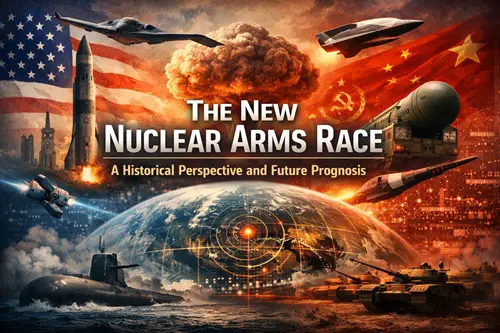 The current nuclear arms race is best understood not as a simple revival of the Cold War, but as a structural transformation of nuclear deterrence under new technological, geopolitical, and doctrinal pressures. While the vocabulary of “arms race” evokes the bipolar competition between the United States and the Soviet Union, today's landscape is multipolar, less regulated, and increasingly entangled with emerging technologies. I. Historical Baseline: From Monopoly to Mutual TerrorThe nuclear age began with the Hiroshima and Nagasaki bombings, after which the United States briefly held a monopoly. This ended in 1949 when the Soviet Union tested its first atomic device, initiating a rapid escalation. The logic of deterrence crystallized into what became known as Mutually Assured Destruction (MAD): neither side could launch a first strike without guaranteeing its own annihilation. Key moments such as the Cuban Missile Crisis demonstrated both the fragility and the stabilizing terror of this system. By the 1970s, recognition of existential risk led to arms control agreements, including the Strategic Arms Limitation Talks and later the Intermediate-Range Nuclear Forces Treaty. These efforts imposed ceilings, increased transparency, and slowed quantitative expansion. The Cold War's end suggested a possible de-escalation. Arsenal sizes declined, and treaties like New START maintained a framework for mutual restraint. Yet this period now appears as an interlude rather than a permanent shift. II. The Contemporary Landscape: Multipolarity and ModernizationToday's nuclear environment differs in three decisive respects. First, it is no longer bipolar. In addition to the United States and Russia, China is rapidly expanding its arsenal, moving from a minimal deterrent to a more robust and diversified force. Meanwhile, regional nuclear powers—India, Pakistan, and North Korea—introduce additional layers of instability, often tied to unresolved territorial conflicts. Second, qualitative competition has overtaken quantitative accumulation. Modernization programs focus on survivability, precision, and flexibility. Hypersonic glide vehicles, advanced missile defense systems, and low-yield “tactical” nuclear weapons complicate traditional deterrence logic. For example, hypersonic systems reduce decision times, increasing the risk of accidental or preemptive escalation. Third, the arms control architecture is eroding. The collapse of the INF Treaty and uncertainty surrounding the renewal of New START signal a breakdown in the institutional mechanisms that once constrained competition. Trust has diminished, verification regimes are under strain, and geopolitical rivalry has intensified. III. Doctrinal Shifts: From Stability to AmbiguityDuring the Cold War, MAD imposed a grim clarity: nuclear war must never be fought. Today, doctrinal ambiguity is growing. Russia has been accused of adopting an “escalate to de-escalate” posture, contemplating limited nuclear use to compel adversaries. The United States has explored flexible response options, including low-yield warheads. China, traditionally committed to no-first-use, is expanding capabilities in ways that raise questions about future doctrine. This shift matters because deterrence depends as much on perception as on capability. The more ambiguous the thresholds and intentions, the greater the risk of miscalculation. IV. Technological Disruption: AI, Cyber, and SpaceEmerging technologies are destabilizing traditional deterrence frameworks. Artificial intelligence may compress decision-making cycles, while cyber capabilities could threaten command-and-control systems, undermining second-strike reliability. Space-based assets—satellites essential for early warning and communication—are increasingly vulnerable, introducing a new domain of strategic competition. These developments erode the assumptions that made MAD relatively stable: secure second-strike capability, clear signaling, and sufficient decision time. V. Prognosis: Managed Competition or Fragmented Escalation?The future of the nuclear arms race will likely hinge on whether a new equilibrium can be established under multipolar conditions. A pessimistic scenario envisions a fragmented arms race with minimal constraints. In such a world, regional conflicts—such as tensions involving India and Pakistan or crises on the Korean Peninsula—could escalate unpredictably. The absence of robust arms control increases the probability of arms buildups, accidental launches, or unauthorized use. A more optimistic scenario would involve the gradual reconstruction of arms control, adapted to contemporary realities. This might include multilateral agreements incorporating China and other nuclear states, new norms governing hypersonic weapons and cyber operations, and confidence-building measures to reduce misperception. However, achieving such a framework is significantly more complex than during the Cold War. Multipolar deterrence lacks the symmetry that made bilateral agreements feasible. Strategic distrust is deeper, and technological change is faster. VI. Iran and the New Focus of Nuclear ProliferationIn the contemporary phase of the nuclear arms race, Iran has become a central focal point of proliferation concerns. Unlike established nuclear powers, Iran occupies an ambiguous position: it has not openly developed nuclear weapons, yet it has steadily advanced capabilities—particularly uranium enrichment—that bring it close to what is often termed “threshold” status. By 2025, Iran was enriching uranium to levels far beyond civilian requirements, reaching up to 60%, while expanding its stockpile and centrifuge capacity. Although still below weapons-grade (90%), this level significantly shortens the technical pathway to weaponization. Subsequent military strikes by the United States and Israel in 2025-2026 damaged parts of Iran's nuclear infrastructure, temporarily halting enrichment activities, but did not eliminate its underlying capability to rebuild . This dynamic illustrates a recurring pattern in nuclear proliferation: attempts at coercive rollback may delay but can also incentivize acceleration. Indeed, there is a credible argument that external military pressure increases Iran's perceived need for a nuclear deterrent, particularly given the demonstrated willingness of its adversaries to conduct direct strikes on its territory. For both the United States and Israel, preventing Iran from acquiring nuclear weapons has become a core strategic objective. Their approaches combine diplomacy, sanctions, covert operations, and, increasingly, overt military action. The breakdown of negotiations—following the erosion of the 2015 nuclear agreement framework—and the launch of joint strikes in February 2026 underscore a shift from containment to active disruption . Israel's position is especially consequential. Although it maintains a policy of nuclear opacity, it is widely understood to possess a significant nuclear arsenal. This asymmetry—where one regional power is nuclear-armed while another is prevented from crossing the threshold—creates a structurally unstable situation. From Iran's perspective, nuclear capability may appear as the only reliable guarantee of regime survival; from Israel's perspective, an Iranian bomb represents an existential threat. The result is a classic security dilemma. Efforts by the United States and Israel to prevent proliferation—through sanctions, sabotage, or military strikes—may paradoxically reinforce Iran's motivation to pursue the very capability they seek to deny. At the same time, failure to prevent such proliferation could trigger a broader regional cascade, with other Middle Eastern states reconsidering their own non-nuclear status. In this sense, Iran represents not merely a regional issue but a systemic stress test for the global non-proliferation regime. Whether its trajectory leads to containment, breakout, or negotiated limitation will have far-reaching implications for the future of nuclear order. VII. ConclusionThe current nuclear arms race is not a repetition of the past but a mutation. The Cold War system, for all its dangers, evolved mechanisms that imposed a certain stability. Today's system is more diffuse, technologically dynamic, and institutionally fragile. The central paradox remains unchanged: nuclear weapons deter large-scale war, yet their continued existence perpetually risks catastrophe. Whether the coming decades will be defined by renewed restraint or by escalating competition depends on political will catching up with technological reality—a race that, unlike the arms race itself, humanity cannot afford to lose.
Widget is loading comments...
|