|
TRANSLATE THIS ARTICLE
Integral World: Exploring Theories of Everything
An independent forum for a critical discussion of the integral philosophy of Ken Wilber
  Frank Visser, graduated as a psychologist of culture and religion, founded IntegralWorld in 1997. He worked as production manager for various publishing houses and as service manager for various internet companies and lives in Amsterdam. Books: Ken Wilber: Thought as Passion (SUNY, 2003), and The Corona Conspiracy: Combatting Disinformation about the Coronavirus (Kindle, 2020). Frank Visser, graduated as a psychologist of culture and religion, founded IntegralWorld in 1997. He worked as production manager for various publishing houses and as service manager for various internet companies and lives in Amsterdam. Books: Ken Wilber: Thought as Passion (SUNY, 2003), and The Corona Conspiracy: Combatting Disinformation about the Coronavirus (Kindle, 2020).
Check out my other conversations with ChatGPT
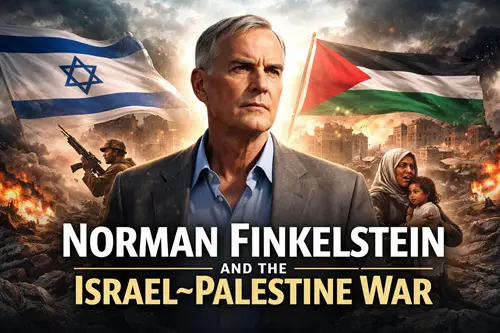
Norman Finkelstein and the Israel-Palestine WarRelevance, Critique, and ControversyFrank Visser / ChatGPT
 IntroductionAny assessment of the relevance of Norman Finkelstein to the Israel-Palestine war quickly becomes a proxy debate about authority, bias, and the role of moral critique in geopolitics. He is not merely a commentator but a deeply polarizing public intellectual whose work straddles scholarship, activism, and polemic. Evaluating his role requires disentangling his academic contributions, his political positioning, and his broader cultural impact. Scholarly Contributions and MethodFinkelstein first gained prominence through his critique of Holocaust memory politics in The Holocaust Industry. This work established a methodological pattern that continues in his later writings on Gaza: heavy reliance on documentary evidence, particularly reports from organizations such as Amnesty International and Human Rights Watch, combined with a prosecutorial rhetorical style. In Gaza: An Inquest into Its Martyrdom, he compiles and synthesizes these reports into a structured argument that Israeli military operations in Gaza reflect systematic violations of international humanitarian law. His strength lies in aggregation and clarity: he translates legalistic findings into a morally charged narrative accessible beyond academia. Political Advocacy and Moral FramingFrom one perspective, Finkelstein's relevance stems from his insistence on reframing the conflict through the lens of international law and human rights. He persistently foregrounds issues such as proportionality, civilian casualties, and collective punishment, often challenging dominant Western narratives that prioritize Israeli security concerns. This approach resonates strongly with activist communities and audiences critical of U.S. and European foreign policy alignment with Israel. His arguments function as a counter-discourse, emphasizing Palestinian suffering and legal accountability in a media landscape often shaped by strategic and state-centric framing. Critiques of Bias and Methodological LimitsCritics argue that Finkelstein's analytical framework is selective and insufficiently symmetrical. They contend that he underemphasizes the strategic realities faced by Israel, including rocket attacks, hostage-taking, and the embedded military tactics of Hamas. His work is often described as prosecutorial rather than exploratory—aimed at establishing culpability rather than understanding complexity. His confrontational public style, especially in debates with figures like Alan Dershowitz, reinforces the perception that he operates more as a polemicist than a neutral scholar. For many in mainstream academia and policy circles, this limits his credibility and reduces his influence in formal decision-making environments. His Most Vocal OpponentsFinkelstein's prominence has generated sustained opposition from a range of high-profile critics, particularly those aligned with pro-Israel legal, political, and intellectual traditions. One of his most notable adversaries is Alan Dershowitz, who has sharply criticized Finkelstein's scholarship, especially regarding interpretations of Holocaust history and Israeli policy. Their dispute—centered in part on Dershowitz's book The Case for Israel—became emblematic of broader academic and ideological divides. Dershowitz and others have accused Finkelstein of misrepresentation and methodological distortion, while Finkelstein has countered with detailed accusations of plagiarism and bad faith argumentation. Another significant critic is Benny Morris, a leading figure among Israel's “New Historians.” While Morris himself has been critical of aspects of Israeli history, he has also argued that Finkelstein's work lacks balance and fails to adequately account for Palestinian political and military actions. This is particularly notable because it reflects criticism not only from pro-Israel advocates but also from revisionist historians who nonetheless reject Finkelstein's conclusions. More broadly, Finkelstein faces opposition from institutional and political actors who view his work as contributing to the delegitimization of Israel. Critics in this camp argue that his framing aligns, intentionally or not, with narratives that minimize Israeli security dilemmas or justify extremist actors. As a result, his academic career has been marked by controversy, including disputes over tenure and professional standing. Biographical Authority and Moral PositioningFinkelstein's background as the child of Holocaust survivors plays a significant role in his public persona. He invokes this history to challenge what he sees as the political misuse of Jewish suffering in justifying Israeli state actions. Supporters regard this as a powerful internal critique that complicates accusations of antisemitism; critics see it as an appeal to moral authority that does not resolve substantive analytical disagreements. His Stance on the Ukraine WarFinkelstein has also commented on the Russo-Ukrainian War, where his position reflects a similar pattern of contrarian critique toward dominant Western narratives. He has argued that the conflict cannot be understood without reference to NATO expansion and Western geopolitical strategy, often assigning significant responsibility to the United States and its allies for escalating tensions with Russia. At the same time, he has acknowledged that Ukraine is the immediate victim of invasion, though critics contend that his framing tends to relativize Russian responsibility by embedding it in a broader critique of Western policy. This has placed him, again, in a controversial middle ground: praised by some for resisting simplified narratives, and criticized by others for what they see as a tendency to downplay authoritarian aggression. The Ukraine case thus reinforces a general pattern in Finkelstein's thought: a consistent skepticism toward Western power, a focus on structural causation over immediate agency, and a willingness to adopt positions that diverge sharply from mainstream liberal consensus. Influence and Real-World ImpactIn terms of direct policy influence, Finkelstein remains marginal. He is not a central figure in diplomatic or strategic decision-making circles. However, his indirect influence is more pronounced. He has shaped activist discourse, student movements, and alternative media narratives, particularly by reinforcing a legalistic and human-rights-centered interpretation of the conflict. His work contributes to a broader shift in how segments of the public—especially younger audiences—understand the Israel-Palestine issue, moving it away from purely geopolitical framing toward questions of justice, legality, and human cost. ConclusionFinkelstein's relevance ultimately depends on the standard applied. As a policy analyst, his impact is limited and his perspective often seen as one-sided. As a moral critic grounded in legal documentation, however, he remains a significant and persistent voice. His work does not resolve the complexities of the Israel-Palestine conflict, but it ensures that questions of legality, proportionality, and civilian suffering remain central to the debate—even, and perhaps especially, when they are most contested.
Widget is loading comments...
|