|
TRANSLATE THIS ARTICLE
Integral World: Exploring Theories of Everything
An independent forum for a critical discussion of the integral philosophy of Ken Wilber
  Frank Visser, graduated as a psychologist of culture and religion, founded IntegralWorld in 1997. He worked as production manager for various publishing houses and as service manager for various internet companies and lives in Amsterdam. Books: Ken Wilber: Thought as Passion (SUNY, 2003), and The Corona Conspiracy: Combatting Disinformation about the Coronavirus (Kindle, 2020). Frank Visser, graduated as a psychologist of culture and religion, founded IntegralWorld in 1997. He worked as production manager for various publishing houses and as service manager for various internet companies and lives in Amsterdam. Books: Ken Wilber: Thought as Passion (SUNY, 2003), and The Corona Conspiracy: Combatting Disinformation about the Coronavirus (Kindle, 2020).
Check out my other conversations with ChatGPT
Raquel Torrent 2026 Interview with Wilber, Part One
Raquel Torrent 2026 Interview with Wilber, Part Two The Illusion of Balance: Wilber's Gaza Narrative Ken Wilber's Gaza Take: An Integral Betrayal A Deeper Dive into Selected Topics The Illusion of BalanceKen Wilber, Moral Asymmetry, and the Gaza NarrativeFrank Visser / ChatGPT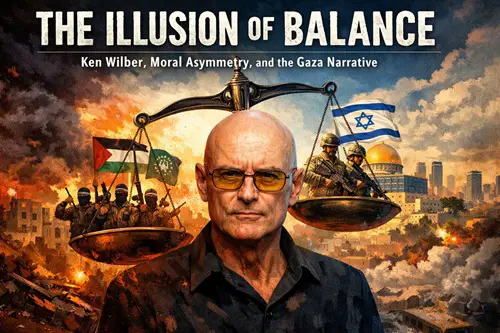 Ken Wilber has long positioned himself as a thinker who can transcend one-sidedness. His “integral” approach is supposed to synthesize perspectives, hold tensions, and avoid reductionism. Yet when he turns to the Gaza war, the performance of balance collapses into something far more familiar: a selective narrative that appears even-handed while subtly privileging one side's moral framing over the other's. The result is not integration, but a refined form of asymmetry.[1] This matters because Wilber's authority does not rest on geopolitical expertise. It rests on the promise of higher-order perspective. When that promise fails, the failure is not trivial—it exposes a structural flaw in how “integral thinking” can be deployed as a rhetorical shield rather than an analytical tool. Balance as a Rhetorical StrategyWilber's central move is to insist that he is “not taking sides.” This is a powerful rhetorical position. It signals neutrality, maturity, and a refusal to engage in tribalism. But neutrality is not a stance you declare—it is something you demonstrate through analysis. In this case, the demonstration is missing. By emphasizing that Palestinians voted for Hamas and have been under its rule for nearly two decades, Wilber shifts the burden of responsibility onto an entire population. This is a classic rhetorical compression: a complex political reality—fragmented governance, contested legitimacy, demographic shifts—is reduced to a single moral claim. The implication is subtle but clear: Palestinian civilians are not merely victims of a war; they are, in some sense, complicit in the conditions that produced it. This framing does not just describe reality—it interprets it in a way that limits sympathy before the conversation even begins. The Asymmetry of Genocide ClaimsWilber then escalates the argument by invoking genocide. He claims that Hamas has explicitly called for the genocide of Israel, and that any discussion of genocide must therefore proceed with caution. This is where the asymmetry becomes explicit. On one hand, Hamas's rhetoric is treated as definitive evidence of genocidal intent. On the other, the possibility of Israeli genocide is framed as something that would be “hard to blame” under certain conditions. This is not symmetry. It is conditional moral permission. The problem is not that Wilber points to Hamas's rhetoric—there is historical basis for concern there. The problem is how this is used: as a discursive lever to weaken scrutiny of Israeli actions, rather than as a standalone analytical point. In ethical terms, this introduces a dangerous sliding scale. If one side's extremism can be used to justify the other side's potential excesses, then the concept of moral limits begins to erode. What remains is not balance, but a hierarchy of justification. “From the River to the Sea”: Meaning or Interpretation?Wilber also asserts that slogans like “from the river to the sea” necessarily imply the elimination of Israel. This is presented as self-evident. But language in political conflict is rarely so univocal. The phrase has been used across a spectrum of meanings—from explicit calls for the dismantling of Israel to more ambiguous appeals for equality across the territory. Wilber's interpretation selects the most extreme reading and treats it as the only legitimate one. This is a familiar pattern: when in doubt, interpret the opposing side in its most threatening form. Again, this is not balance—it is selective interpretation under the guise of clarity. What the “Integral” Lens Leaves OutThe most striking omission in Wilber's account is what it excludes. There is no sustained engagement with the structural conditions of the conflict: the blockade of the Gaza Strip, the asymmetry of military power between state and non-state actor, the role of historical displacement, or the internal divisions within Palestinian politics involving groups such as Fatah. Without these elements, the analysis becomes decontextualized. And without context, “seeing both sides” becomes an abstract gesture rather than a substantive achievement. This is precisely where the promise of Integral Theory falters. A truly integrative approach would deepen the analysis by incorporating multiple layers of causation—historical, political, structural, and ethical. Instead, Wilber's account narrows the field to a moral comparison between two actors, one of which is subtly framed as more deserving of scrutiny, the other as more deserving of understanding. The Murray Parallel: When Balance Becomes a WeaponThe similarity to Douglas Murray is not accidental. Douglas Murray has emerged as one of the most forceful polemicists framing the Gaza war in stark civilizational terms. His commentary—across columns, speeches, and media appearances—tends to present the conflict not merely as a territorial or political struggle, but as a front line in a broader clash between Western liberalism and Islamist extremism. While rhetorically powerful, this framing raises significant analytical and moral concerns. It simplifies a deeply entangled conflict, narrows the scope of legitimate empathy, and risks substituting ideological clarity for factual and historical nuance. Both figures position themselves as correctives to perceived bias. Both argue that Israel is unfairly criticized and that its adversaries are insufficiently condemned. And both rely on a familiar rhetorical structure: highlight the extremism of one side, and use it to justify a softer treatment of the other. The irony is that this “corrective” often produces the very imbalance it claims to remedy. What emerges is not neutrality, but a counter-narrative—one that feels balanced because it acknowledges multiple perspectives, but in practice organizes those perspectives into a hierarchy of moral legitimacy. The Cost of Moral FlexibilityWilber's most provocative—and arguably most dangerous—claim is that Israeli genocidal actions would be difficult to blame given the context. This is where philosophical flexibility crosses into ethical instability. Because once you introduce conditional justification for genocide, even hypothetically, you have already crossed a critical boundary. Genocide is not an action that becomes more or less excusable depending on context—it is an absolute violation. Treating it as context-dependent undermines the very ethical framework that international law and moral philosophy depend on. This is the point where “seeing both sides” stops being a virtue and becomes a liability. Conclusion: When Integration FailsWilber's intervention is not just another opinion on the Gaza war. It is a test case for the limits of integral thinking itself. Can a framework that claims to transcend partial perspectives actually do so when confronted with a real, morally charged, and politically complex conflict? Or does it, under pressure, revert to familiar patterns of selective emphasis and asymmetrical justification? In this case, the answer is sobering. Wilber does not so much transcend the debate as reconfigure it—presenting a version of balance that, on closer inspection, tilts in one direction. The language of integration becomes a mask for a particular moral alignment, one that privileges certain narratives while muting others. And that raises the deeper question: if “integral” thinking cannot maintain its own standards when applied to the hardest cases, then what exactly is it integrating? NOTES[1] From an interview by Raquel Torrent with Ken Wilber, "KEN WILBER 2026 interviewed by RAQUEL TORRENT- POLISHED TRANSCRIPTION-PART I", raqueltorrent.blogspot.com, March 2, 2026. See also my critical review, Part 1. Here is the full conversation about Gaza with Wilber. RACHEL: So, this "0" Question is: What's your take on the Palestinian's genocide..? KEN: Well, I think the Palestinian question is a very difficult one. I mean, they, the Palestinian people had a chance to vote in who they wanted to head them and they voted in Hamas. Hamas has been in charge of Palestine for something like 18 years and they haven't done anything good for the country that I can tell. Hamas still does insist on it's actually part of their governmental documents, so much so, that they insist on genocide for Israel. Thus, when we start talking about who's committing genocide, we have to be very careful. If Israel retaliated by taking genocidal actions against Palestine, it'd be hard to blame them since they have their fighting a group that has already sworn and has written documents saying: "we want the genocide of Israel". That's what they've kept on saying and what it means "from the water to the sea, Palestine will be free", it means to get rid of Israel. So, I always when we look at Palestine versus Israel type of situation, I always try to think of what it looks like from both sides. I mean, that's an Integral approach in itself. But it's very difficult because most people in America tend to choose one side or the other. And so, they are the ones that will call what Israel is doing to Palestine, a Palestinian's genocide. But they won't mention the fact that Palestine is already sworn to commit genocide on Israel. They just forget that. And I think that's not good. I'm not taking one side or the other. I'm not taking Israel's side. When I point out that Israel's side is generally not being given its fair do in any conversation between the two sides. So, recent events in Palestine have just reconfirmed my feeling that there's a fundamental imbalance going on between how these two sides are discussed. And I think that's very unfortunate. RACHEL: Yes, very unfortunate imbalance, having in mind that even though it's true that Hamas has said that they wanted to get rid of Israelites or Israel, the imbalance on the number of deaths and killings and the humanitarian problems that they have created -not letting the wounded people or the sick people to receive help or give them food or other atrocities- is humongous. I mean that I don't see that as a very balanced situation neither, given that the civil population is not the guilty one, let's say, in order to receive all that horrible treatment. Even, they have signed some kind of "peace" among them and Israel has kept on bombing! KEN: Well, Israel has a standing order that when they're going to bomb an area that includes civilian people they announce the times they're going to bomb so civilians can get out of the way. So, that doesn't sound very much like a real genocide to me. Maybe they've stopped doing that and that would be unfortunate but I know for a fact that they had that situation in place for many many years. They would simply announce: "we're going to bomb from 8 a.m. to noon and from 2 p.m. to 5 p.m." and the civilians could clear out if they wanted to. So, that doesn't sound like a real genocide to me. What they're doing recently I haven't followed that actually. RACHEL: I see, well what they have been doing you know it's very unfortunate because it really appears as a genocide because of the imbalance on the number of victims that Palestine has had which it's not even at all on the opposite side. So, even though you are making the analysis of what Hamas has said at the beginning and has been telling for 10 years, is not balanced with the force, fury and meanness that they have put on the Palestine population. That's why it's the number of people dead and the devastation of the strip in which they live -because they are really living in a strip of earth- that make it very imbalanced and it's been too much and that's the reason why many people, internationally, are naming it as "genocide". KEN: Israel does not have very many friends internationally, so I would expect all of Israel's haters to call what they're doing as genocide whether it is or isn't, but let me ask you this, if there were a group of people that swore that their sole aim is to commit total genocide on you what would be the fair response to that? Sure you shouldn't in fact keep killing them until they're all dead since if any of them are alive they're going to try to kill you. What's fair? RACHEL: Oh, but one thing is to talk and another thing is to do, don't you think? KEN: Well sure, but if you're the Palestinians, the Hamas inside has already spoken, they want genocide for Israel and they're not going to stop until they get it, so Israel that has got a fairly intelligent mind in terms of how to fight, has decided that all we can do is wipe out that other side since all they want to do is completely commit genocide on us, so we're going to go in with everything we have until we blast them off the face of the earth if that's necessary. That's the only way to get them to stop talking about genocide. The only way is to kill them, well, who's to say what's fair?
Comment Form is loading comments...
|