|
TRANSLATE THIS ARTICLE
Integral World: Exploring Theories of Everything
An independent forum for a critical discussion of the integral philosophy of Ken Wilber
  Frank Visser, graduated as a psychologist of culture and religion, founded IntegralWorld in 1997. He worked as production manager for various publishing houses and as service manager for various internet companies and lives in Amsterdam. Books: Ken Wilber: Thought as Passion (SUNY, 2003), and The Corona Conspiracy: Combatting Disinformation about the Coronavirus (Kindle, 2020). Frank Visser, graduated as a psychologist of culture and religion, founded IntegralWorld in 1997. He worked as production manager for various publishing houses and as service manager for various internet companies and lives in Amsterdam. Books: Ken Wilber: Thought as Passion (SUNY, 2003), and The Corona Conspiracy: Combatting Disinformation about the Coronavirus (Kindle, 2020).
Check out my other conversations with ChatGPT The Petrodollar SystemHidden Architecture of Global PowerFrank Visser / ChatGPT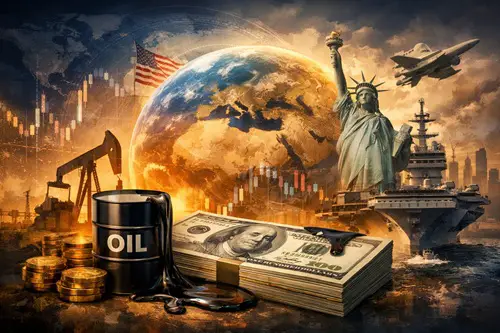 The modern global economy rests on a largely invisible foundation: the linkage between oil and the U.S. dollar. This arrangement—commonly referred to as the “petrodollar system”—is not a formal treaty codified in a single document, but a historically contingent structure of incentives, agreements, and geopolitical enforcement mechanisms. Its influence extends far beyond energy markets, shaping monetary policy, international trade, military strategy, and even the rise and fall of governments. Origins: From Gold to OilThe petrodollar system emerged in the aftermath of the Bretton Woods Agreement, which initially tied global currencies to the U.S. dollar, itself convertible to gold. This system began to fracture in the late 1960s under the strain of U.S. fiscal deficits and overseas military spending, culminating in Nixon Shock, when Richard Nixon unilaterally ended the dollar's gold backing. This move created an existential problem: without gold, why would other nations continue to hold dollars? The answer emerged through a strategic realignment with Saudi Arabia, the world's largest oil exporter at the time. In the mid-1970s, the U.S. and Saudi Arabia reached a series of agreements: oil would be priced exclusively in U.S. dollars, and surplus revenues (“petrodollars”) would be recycled into U.S. financial markets, particularly Treasury bonds. In return, the U.S. provided military protection and political support. This arrangement gradually extended across OPEC, effectively globalizing the system. Mechanism: Why Oil Pricing MattersOil is the most traded commodity in the world and a fundamental input for all industrial economies. By pricing oil exclusively in dollars, the system creates a structural demand for U.S. currency. Any country wishing to import oil must first acquire dollars. This generates a continuous global demand for dollar reserves, regardless of whether those countries trade directly with the United States. The consequences are profound: • The U.S. can run persistent trade deficits without currency collapse. • Foreign governments accumulate dollar reserves and reinvest them in U.S. assets. • The dollar becomes the world's de facto reserve currency. In effect, energy dependency translates into monetary dependency. Financialization and Debt ExpansionThe recycling of petrodollars into U.S. financial markets has enabled an unprecedented expansion of American debt. Countries exporting oil deposit their earnings in Western banks or invest in U.S. government bonds, providing liquidity that fuels credit expansion. Institutions like the International Monetary Fund and the World Bank operate within this dollar-centric system, often reinforcing it through lending practices that require debtor nations to stabilize their economies in dollar terms. This creates a feedback loop: • Oil is sold for dollars. • Dollars are reinvested in U.S. assets. • The U.S. issues more debt, absorbed by global markets. • The dollar's centrality is reinforced. The system thus underwrites both American consumption and global financial stability—at least as long as confidence in the dollar persists. Geopolitics: Enforcement and InstabilityThe petrodollar system is not merely economic; it is geopolitical. Its stability depends on both cooperation and coercion. Countries that have attempted to circumvent dollar-based oil trading have often faced severe consequences. A frequently cited example is Saddam Hussein, who in 2000 announced that Iraq would sell oil in euros. Following the Iraq War, oil transactions reverted to dollars. Similarly, Muammar Gaddafi proposed a pan-African gold-backed currency for oil trade. His regime was overthrown during the Libyan Civil War, after NATO intervention. While it would be reductive to attribute these conflicts solely to currency policy, the pattern raises legitimate questions about the intersection of monetary hegemony and military power. The Role of the U.S. MilitaryThe global reach of the U.S. military—particularly its presence in key routes such as the Strait of Hormuz—serves as a stabilizing force for the oil trade. This security umbrella ensures the uninterrupted flow of energy, reinforcing the dollar's central role. In this sense, the petrodollar system can be viewed as a hybrid construct: part financial architecture, part security regime. Emerging Challenges: Multipolar Currency DynamicsIn recent years, cracks have begun to appear in the system. Countries such as China and Russia have actively pursued alternatives to dollar-based trade. China, in particular, has promoted oil contracts denominated in yuan and backed by gold convertibility mechanisms. Meanwhile, sanctions regimes—especially those imposed by the U.S.—have incentivized countries to develop parallel financial systems to avoid dollar dependency. The freezing of foreign reserves has further eroded trust in the neutrality of the dollar system. Even traditional allies, including Saudi Arabia, have signaled openness to accepting non-dollar currencies for oil transactions, marking a potential structural shift. Structural Implications: Power Without VisibilityWhat makes the petrodollar system particularly potent is its invisibility. Unlike formal empires, it does not require direct territorial control. Its power operates through: • Monetary dependence • Financial infrastructure • Energy necessity It is a system that converts physical resources into financial dominance and financial dominance into geopolitical leverage. Conclusion: Stability or Fragility?The petrodollar system has provided decades of relative stability, enabling global trade and economic expansion. Yet its very success contains the seeds of its vulnerability. As alternative energy sources emerge, as geopolitical rivalries intensify, and as trust in centralized financial systems erodes, the structural foundations of dollar hegemony may weaken. Whether this leads to a multipolar currency system or to financial fragmentation remains uncertain. What is clear, however, is that the petrodollar is not merely an economic arrangement—it is a central organizing principle of modern world affairs, quietly shaping the possibilities and limits of global power. Epilogue: Structural Privilege: The Dollar AdvantageOne of the most consequential—yet often understated—features of the petrodollar system is the asymmetric advantage it confers on the United States. This is not merely a matter of influence; it is a built-in structural privilege embedded in the architecture of global finance. At the core lies what economists call “exorbitant privilege,” a term popularized by Valéry Giscard d'Estaing in the 1960s. The concept captures a simple but powerful reality: because the U.S. issues the world's primary reserve currency, it can finance its deficits in its own money, while other nations must earn or borrow that same currency under often stringent conditions. In practical terms, this yields several compounding advantages. First, the United States can run persistent trade deficits without facing the currency crises that would typically afflict other nations. Countries like Argentina or Turkey, when running similar imbalances, often encounter capital flight, inflation, and IMF intervention. The U.S., by contrast, exports dollars—paper (or digital) claims—while importing real goods and resources. Second, borrowing costs for the U.S. government remain artificially low. Because global demand for dollar-denominated assets is structurally guaranteed by the need to purchase oil, U.S. Treasury bonds are continuously absorbed by foreign central banks. This allows Washington to sustain high levels of public debt at interest rates that do not reflect normal market risk. Third, the U.S. gains unparalleled leverage through its control over the global financial plumbing. Transactions clearing through dollar-based systems—often routed via institutions linked to the Federal Reserve—can be monitored, restricted, or blocked. This underpins the effectiveness of sanctions regimes, enabling the U.S. to exert pressure on adversaries without direct military engagement. Fourth, inflationary pressures can be partially externalized. When the U.S. expands its money supply, the effects are not confined domestically. Because dollars circulate globally as reserve assets, part of the inflationary burden is effectively exported to other economies holding dollar reserves. Taken together, these dynamics create a form of monetary asymmetry: the rules of the global system apply differently depending on whether a country issues the reserve currency or merely uses it. The petrodollar system, by anchoring global energy trade to the dollar, amplifies this asymmetry and locks it into the material foundation of the world economy. This does not mean the system is cost-free for the United States—maintaining it requires military expenditure, diplomatic alignment, and financial stewardship. But the net effect is unmistakable: a persistent, systemic advantage that no other nation currently enjoys.
Widget is loading comments...
|