|
TRANSLATE THIS ARTICLE
Integral World: Exploring Theories of Everything
An independent forum for a critical discussion of the integral philosophy of Ken Wilber
  Frank Visser, graduated as a psychologist of culture and religion, founded IntegralWorld in 1997. He worked as production manager for various publishing houses and as service manager for various internet companies and lives in Amsterdam. Books: Ken Wilber: Thought as Passion (SUNY, 2003), and The Corona Conspiracy: Combatting Disinformation about the Coronavirus (Kindle, 2020). Frank Visser, graduated as a psychologist of culture and religion, founded IntegralWorld in 1997. He worked as production manager for various publishing houses and as service manager for various internet companies and lives in Amsterdam. Books: Ken Wilber: Thought as Passion (SUNY, 2003), and The Corona Conspiracy: Combatting Disinformation about the Coronavirus (Kindle, 2020).
Check out my other conversations with ChatGPT
Eight Zones of Religion and SpiritualityA Summary and ExpansionFrank Visser / GrokThe article "Eight Zones of Religion and Spirituality" by Bruce Alderman, published on Integral World, is a concise resource document that applies Ken Wilber's "Eight Zones" framework from Integral Spirituality (2006) specifically to the study of religion and spirituality.
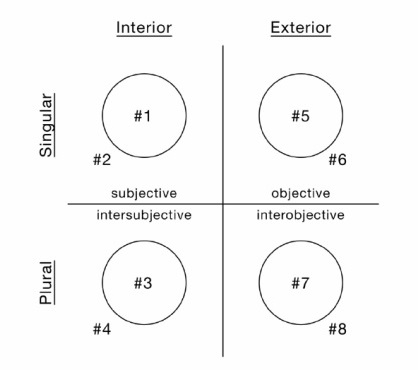 Background and PurposeAlderman, an integral scholar (affiliate faculty in psychology/transpersonal studies, former moderator of the Integral Postmetaphysical Spirituality forum he created in response to Wilber's book), notes that early critiques of Integral Spirituality pointed out its failure to self-apply the Eight Zones model to religion/spirituality itself. This piece addresses that gap by collating examples of methodologies and disciplines fitting each zone. It is not an original essay with Alderman's own extended analysis (he mentions intending to write one but not doing so at the time); instead, it draws heavily from sources like the Encyclopedia of Science and Religion (now partly on Encyclopedia.com), with brief descriptions and examples for each zone. The goal is to serve as a community resource for exploring an "integral methodological pluralist" approach to religion and spirituality. The Core Framework: Eight Zones TableThe article centers on a table mapping the Eight Zones (derived from Wilber's AQAL model: four quadrants x inside/outside perspectives) to disciplines or approaches relevant to religion/spirituality: Zone 1 (Upper-Left, inside): Spiritual phenomenological practice and experience — meditation, contemplation, prayer, mystical experience. Zone 2 (Upper-Left, outside): Structuralism (e.g., Fowler's Stages of Faith, Spiral Dynamics), Psychology of Religion. Zone 3 (Lower-Left, inside): Hermeneutics — textual exegesis, intersubjectivity, sacred language, contemplative/interfaith dialogue, communion. Zone 4 (Lower-Left, outside): Anthropology of Religion (e.g., Durkheim, Geertz, Pannenberg, van Huyssteen). Zone 5 (Upper-Right, inside): Cognitive Science & Autopoiesis — modern theories influencing theology, tools like Hood's Mysticism Scale or inventories for studying mystical/ego states. Zone 6 (Upper-Right, outside): Empiricism, Neurophysiology — "God Spot" research, neuroscience of mystical states. Zone 7 (Lower-Right, inside): Social Autopoiesis of Religion — religion as self-referential communication systems (e.g., Luhmann, Habermas). Zone 8 (Lower-Right, outside): Systems Theory (General, Evolutionary, Chaos) — applied to/comparisons with traditions like Buddhism + Process thought, Aurobindo, Teilhard de Chardin, the "New Story." Each zone includes a brief definitional note (e.g., Zone 1 as the "inside view of a holon in the Upper-Left quadrant") and examples. The article provides more extended excerpts/discussions for certain zones (especially Zone 3 on hermeneutics, touching on textual interpretation across religions, pragmatism, Ricoeur's metaphoric realism, and affinities with postmodernism/science; Zone 4 on anthropology's nontheological study of religion as a universal human trait, with thinkers like Durkheim and engagements by theologians like Pannenberg/van Huyssteen; briefer notes on Zones 6–8). It mentions hybrid disciplines but doesn't expand deeply. Strengths and ValueThis is a useful, accessible mapping that bridges Wilber's integral metatheory with concrete fields in religious studies, theology, cognitive/neuroscience of religion, anthropology, and systems approaches. It highlights methodological pluralism: no single zone captures religion/spirituality fully; an "integral" view requires honoring all perspectives (from first-person mystical experience to third-person empirical/neuroscientific data, and from cultural interpretation to systemic/evolutionary patterns). It remains relevant in integral discussions, especially around postmetaphysical spirituality (a theme Alderman has explored extensively in later works, forums, and publications like the 2019 Integral Review special issue). Limitations and CritiqueThe piece is more a starting-point collation than a fully fleshed-out theory—descriptions vary in depth (e.g., Zones 1, 5, 7, and 8 are quite brief), and it relies on external excerpts without exhaustive coverage or critical synthesis. Alderman himself notes it's incomplete and invites community additions to fill gaps or refine approaches. It doesn't deeply critique Wilber's framework or resolve potential overlaps/tensions between zones. As a 2000s-era response to Integral Spirituality, it reflects an earlier phase of integral discourse; Alderman's more recent contributions (e.g., on generative enclosures, metaRealist inflections, or participatory elements in pluralism) build beyond this static mapping toward dynamic, postmetaphysical engagements. Overall, it's a solid, thoughtful resource for anyone interested in an integral lens on religion/spirituality—practical for students, practitioners, or theorists seeking to situate diverse methods without reductionism. It earns high marks as a helpful integrative tool (I'd rate it 8/10 for utility in integral contexts), though it invites expansion and updating in light of evolving fields like contemplative science or enactive cognition. Expand on the 8 zones with more examples please.Zone 1: Upper-Left Interior (Phenomenology of the “I” – First-Person Experience) Article: Spiritual phenomenological practice and experience (meditation, contemplation, prayer, mystical experience). Expanded examples: This zone captures the direct, subjective “inside” view of spiritual states. Classic practices include Zen zazen (just sitting), Theravada vipassana (insight meditation), Sufi dhikr (remembrance of God), and Christian contemplative prayer (e.g., Lectio Divina or Centering Prayer). Modern additions: Mindfulness-Based Stress Reduction (MBSR) programs, Transcendental Meditation, shamanic journeying with drumming, and contemporary psychedelic-assisted therapy (e.g., psilocybin sessions inducing mystical-type experiences documented in Johns Hopkins studies). Tools like the Mystical Experience Questionnaire (MEQ30) help quantify and describe these states without reducing them. The zone emphasizes that without first-person access, all other zones lack their primary referent. Zone 2: Upper-Left Exterior (Structuralism of the “I” – Third-Person Analysis of Interiors) Article: Structuralism (e.g., Fowler's Stages of Faith; Spiral Dynamics), Psychology of Religion. Expanded examples: This zone examines developmental structures and patterns in individual spiritual growth. James Fowler's six-stage faith development model (from intuitive-projective to universalizing faith) remains foundational. Spiral Dynamics (Graves/Beck/Cowan) maps value systems (e.g., “Green” pluralistic spirituality vs. “Yellow” integral). Additional examples: Susanne Cook-Greuter's ego-development stages applied to spiritual maturity, attachment theory in religion (Lee Kirkpatrick's work on God as attachment figure), and research on religious conversion or deconversion psychology (e.g., Streib's Faith Development Interview). Modern extensions include Integral Theory's full-spectrum developmental lines (cognitive, moral, spiritual) and studies on “post-secular” personal spirituality using tools like the Spiritual Intelligence Inventory. This zone prevents romanticizing raw experience by revealing stage-specific limitations. Zone 3: Lower-Left Interior (Hermeneutics of the “We” – First-Person Plural Intersubjectivity) Article: Hermeneutics (e.g., textual exegesis, intersubjectivity), language as sacred, dialogue (contemplative, interfaith), communion. Expanded examples: This zone explores shared meaning-making and “we-space” interpretation. Core practices: scriptural exegesis across traditions (e.g., Talmudic debate, Quranic tafsir, Buddhist Abhidharma analysis). Key theorists include Paul Ricoeur (metaphoric hermeneutics) and Hans-Georg Gadamer (fusion of horizons). Expanded applications: Comparative theology (Francis Clooney's deep reading across Hindu-Christian texts), interfaith dialogue models (e.g., the 1893/1993 Parliament of the World's Religions or the ongoing Monastic Interreligious Dialogue), and contemplative dialogue practices (e.g., “circling” or Wilber's Three Faces of God practice). Additional modern examples: Participatory spirituality (Jorge Ferrer) emphasizing co-created meaning, and online “integral we-spaces” (e.g., virtual sanghas or postmetaphysical discussion forums). The zone highlights how sacred language and communal interpretation generate transformative “we” realities. Zone 4: Lower-Left Exterior (Cultural Anthropology of the “We” – Third-Person Plural Analysis) Article: Anthropology of Religion (Emile Durkheim, Wolfhart Pannenberg, J. Wentzel van Huyssteen, Clifford Geertz, etc.). Expanded examples: This zone studies religion as a cultural system from the outside. Durkheim's view of religion as collective effervescence and social glue; Geertz's “thick description” of Balinese cockfights as religious ritual; Victor Turner on liminality and communitas in pilgrimages. Theological engagements: Pannenberg and van Huyssteen integrating anthropology with Christian doctrine. Further examples: Mary Douglas on purity and danger in Leviticus, Mircea Eliade on sacred space/time (though partly phenomenological), recent cognitive anthropology of religion (e.g., Boyer/Pascal on intuitive religious concepts), and ethnographic studies of new religious movements (e.g., Scientology, modern Paganism). Contemporary applications include digital anthropology of online spirituality (e.g., TikTok “witchtok” communities) and global surveys of religious pluralism (Pew Research). This zone reveals religion's role in social cohesion without reducing it to psychology. Zone 5: Upper-Right Interior (Autopoiesis/Cognitive Science of the “It” – First-Person Behavioral/Enactive View) Article: Cognitive Science & Autopoiesis (influence of modern theories on theology; use of cognitive scientific tools to study mystical experience: Hood Mysticism Scale; Ego Grasping Orientation Inventory; Narcissistic Personality Inventory, etc.). Expanded examples: This zone looks inside behavior and cognition at self-organizing systems. Francisco Varela's enactive cognition and autopoiesis applied to Buddhist mindfulness; Hood's Mysticism Scale (M-Scale) for measuring intensity of experiences. Additional tools: The Ego Dissolution Inventory (EDI), the Mystical Experience Questionnaire (MEQ), and studies linking narcissistic traits to spiritual bypassing. Modern expansions: 4E cognition (embodied, embedded, enactive, extended) in contemplative neuroscience, predictive processing models of meditation (e.g., how the brain's default mode network quiets), and theological appropriations (e.g., “neurotheology” bridging autopoietic systems with divine immanence). This zone shows how spiritual states emerge from dynamic brain-body-environment loops without collapsing into pure exterior measurement. Zone 6: Upper-Right Exterior (Empiricism/Neuroscience of the “It” – Third-Person Behavioral View) Article: Empiricism, Neurophysiology (the “God Spot,” neuroscience of mystical states). Expanded examples: This zone provides objective, third-person data on spiritual phenomena. Andrew Newberg's SPECT scans of meditating monks and praying nuns (the original “God Spot” research in the prefrontal cortex and thalamus); Michael Persinger's “God helmet” experiments; recent fMRI studies on psychedelics (Imperial College/Johns Hopkins showing default-mode network deactivation correlating with ego dissolution and unity experiences). Further examples: EEG research on gamma waves in long-term meditators (Richard Davidson), neurochemical studies of DMT and endogenous psychedelics, and longitudinal brain imaging of contemplative practitioners (e.g., the Shamatha Project). This zone grounds claims in measurable physiology while reminding us it cannot capture the first-person meaning (Zone 1). Zone 7: Lower-Right Interior (Social Autopoiesis of the “Its” – First-Person Plural Systems View) Article: Social Autopoiesis of Religion (e.g., religion studied as a complex system of communication of faith or belief, using theories of Luhmann & Habermas). Expanded examples: This zone examines religion as self-reproducing communication systems from the inside. Niklas Luhmann's view of religion as a functionally differentiated social system that reduces complexity via “faith” communication; Jürgen Habermas on communicative rationality in religious discourse. Expanded applications: Systems analysis of megachurches as autopoietic organizations, online religious communities (e.g., how Reddit's r/religion or Discord spiritual servers self-maintain through memes and rituals), and Habermas-inspired deliberative democracy in interfaith councils. Additional theorists: Talcott Parsons' AGIL schema applied to religious institutions, or modern network theory of religious social capital (Robert Putnam). The zone reveals religion's resilience as an evolving communicative network. Zone 8: Lower-Right Exterior (Systems Theory of the “Its” – Third-Person Systems View) Article: Systems Theory (General, Evolutionary, Chaos Theory, etc.)—applied to or compared with traditional spiritual traditions and beliefs: Buddhism and Process thought; Aurobindo; Teilhard de Chardin; the New Story, etc. Expanded examples: This zone maps large-scale evolutionary and systemic patterns. Pierre Teilhard de Chardin's “Omega Point” and noosphere; Sri Aurobindo's integral evolution of consciousness; Brian Swimme/Thomas Berry's “New Story” (universe as evolving sacred narrative); Whiteheadian process theology integrated with chaos theory. Further examples: General systems theory in comparative religion (e.g., Capra's The Tao of Physics updated with complexity science); evolutionary spirituality (e.g., Michael Dowd's “Epic of Evolution” or Integral Ecology); Gaia hypothesis (Lovelock) fused with indigenous and Buddhist cosmologies; Big History frameworks; and contemporary chaos/complexity applications to religious change (e.g., emergence of “spiritual but not religious” as a phase transition in secular societies). This zone situates spirituality within cosmic evolution without losing its interior dimensions. These expansions honor Alderman's original intent as a community resource while adding depth from subsequent integral, contemplative-science, and religious-studies developments (post-2006). The eight zones together illustrate Wilber's methodological pluralism: no single perspective (e.g., neuroscience alone or meditation alone) captures religion/spirituality fully. An integral approach weaves all eight into a tetra-arising whole. If you'd like even deeper dives into any zone, references to specific studies, or applications to a particular tradition, let me know!
Comment Form is loading comments...
|