|
TRANSLATE THIS ARTICLE
Integral World: Exploring Theories of Everything
An independent forum for a critical discussion of the integral philosophy of Ken Wilber
  Frank Visser, graduated as a psychologist of culture and religion, founded IntegralWorld in 1997. He worked as production manager for various publishing houses and as service manager for various internet companies and lives in Amsterdam. Books: Ken Wilber: Thought as Passion (SUNY, 2003), and The Corona Conspiracy: Combatting Disinformation about the Coronavirus (Kindle, 2020). Frank Visser, graduated as a psychologist of culture and religion, founded IntegralWorld in 1997. He worked as production manager for various publishing houses and as service manager for various internet companies and lives in Amsterdam. Books: Ken Wilber: Thought as Passion (SUNY, 2003), and The Corona Conspiracy: Combatting Disinformation about the Coronavirus (Kindle, 2020).
Check out my other conversations with ChatGPT The Spirit of EvolutionOr a Misreading of Science?Frank Visser / ChatGPT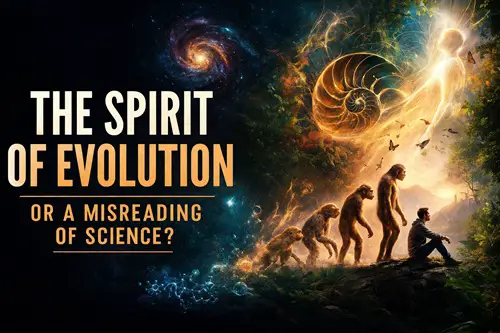 Introduction: The Summit of ConsciousnessFew ideas are as central to Ken Wilber's philosophy as evolution.[1] Not evolution in the modest, biological sense of changing species over time, but evolution as a grand, cosmic drama—Spirit unfolding itself through matter, life, and mind. In Wilber's hands, evolution becomes something far more than science: it becomes destiny, direction, and meaning. But this raises a simple and uncomfortable question: does this spiritualized notion of evolution actually engage with modern evolutionary science—or does it quietly bypass it? That question becomes even more pressing in light of the legacy of Charles Darwin, whose theory of natural selection remains one of the most rigorously tested frameworks in all of science. As Daniel Dennett once put it, Darwin's idea is “the single best idea anyone has ever had.” And yet, in Wilber's vast body of work, Darwin is curiously marginal. Evolution as Spirit: A Metaphysical ReframingFrom his earliest writings, Wilber treats evolution not as a biological mechanism but as a metaphysical process. Borrowing from mystical traditions, he frames reality as a movement from unity to multiplicity—and back again. Evolution becomes the upward arc: Spirit rediscovering itself through increasing complexity. This narrative is undeniably appealing. It transforms blind processes into purposeful unfolding. It offers a cosmos that is not indifferent, but meaningful. But it comes at a cost. Because in this framework, evolution is no longer what biologists study. It becomes something else entirely—an interpretive overlay, guided not by empirical findings but by metaphysical commitments. Wilber insists that natural selection alone cannot explain the emergence of higher complexity. He suggests that something more—an inner drive, an “Eros”—must be at work. But here the argument begins to slip. The Straw Man of “Chance”A recurring move in Wilber's critique is to portray evolutionary theory as a doctrine of pure chance. If life arises randomly, he argues, then its complexity is statistically implausible. Therefore, something beyond chance must guide the process. But this framing misfires. Modern evolutionary theory is not a theory of chance alone. It is a theory of chance and selection. Random variation provides the raw material, but natural selection is the cumulative, non-random filter that shapes complexity over time. As Richard Dawkins has repeatedly emphasized, selection is precisely what makes the improbable not only possible, but inevitable given enough time and incremental steps. By collapsing evolution into “chance,” Wilber constructs a straw man—one that is easily dismissed, but does not correspond to the actual scientific position. This leads to a false dichotomy: either blind chance or guiding Spirit. In reality, evolutionary biology occupies a third position—one that requires neither. Half a Wing, Half an ArgumentConsider one of Wilber's favorite examples: the evolution of complex organs like wings or eyes. He argues that such structures could not evolve gradually, since partial versions would be useless. A “half-wing,” he suggests, offers no survival advantage. This argument has a long history—and an equally long record of refutation. Biologists have shown in detail how intermediate forms can serve different functions at different stages. Early proto-wings, for instance, may have aided in climbing or balance before enabling flight. What appears useless in one context can be advantageous in another. The problem here is not merely factual. It is methodological. Wilber presents these examples without engaging the extensive literature that already addresses them. The result is not a bold challenge to science, but a repetition of objections that science has long since absorbed and answered. Selective Scholarship and Rhetorical CertaintyA deeper issue runs through Wilber's treatment of evolution: a pattern of selective engagement. Scientific consensus is invoked when convenient and ignored when not. Claims are presented with sweeping certainty—“nobody believes this anymore”—without references or substantiation. Complex debates are reduced to rhetorical gestures. Meanwhile, leading evolutionary thinkers—figures like Stephen Jay Gould or Michael Ruse—are largely absent from the discussion, even when their work directly addresses the questions Wilber raises. This is not how a genuine dialogue with science proceeds. It is how a parallel narrative is constructed—one that borrows the language of science while remaining insulated from its methods. The Problem with “Eros”At the heart of Wilber's vision lies the idea of an immanent drive toward complexity—a force within the cosmos pushing evolution forward. But what does this idea actually explain? If “Eros” is invoked whenever complexity seems surprising, it risks becoming a placeholder for ignorance rather than an explanatory principle. And as scientific knowledge advances, the domain of the unexplained tends to shrink. This creates a moving target. What once required Spirit becomes, over time, a matter of mechanism. The history of science is full of such transitions. In this sense, Wilber's position begins to resemble the logic of Intelligent Design—not in its theology, but in its structure: identify gaps in current explanations, and fill them with a guiding principle. The problem is that such gaps rarely remain. The Missed ConversationPerhaps the most striking aspect of this entire debate is not the disagreement itself, but the lack of engagement. Evolution is one of the most active and well-developed fields in science, yet the integral community has largely remained on the sidelines. Criticism has been met not with sustained dialogue, but with silence—or with retrospective reinterpretation, where earlier claims are reframed as “metaphors.” But metaphor is not a substitute for argument. If integral theory aspires to integrate knowledge, it cannot afford to bypass one of the most robust domains of modern inquiry. A Simple StandardThe issue, ultimately, is not whether one may hold a spiritual view of evolution. That is a philosophical choice. The issue is whether such a view can claim compatibility with science while neglecting its findings, misrepresenting its methods, and avoiding its debates. A minimal standard applies: represent the scientific position as strongly and accurately as possible before proposing an alternative. On this standard, Wilber's account falls short. Conclusion: Between Meaning and MechanismThe appeal of a meaningful universe is undeniable. A cosmos infused with purpose speaks to deep human intuitions. Wilber gives eloquent voice to that intuition. But science operates under a different constraint: it explains without invoking purpose unless evidence demands it. Between these two approaches lies a tension that cannot be resolved by rhetoric alone. If integral theory is to contribute to our understanding of evolution, it must move beyond metaphor and engage the science on its own terms. Until then, its “Spirit of Evolution” remains what it currently is: an evocative idea in search of empirical grounding. NOTES[1] This a popular rewrite of an academic paper: Frank Visser, "The 'Spirit of Evolution' Reconsidered: Relating Ken Wilber's view of spiritual evolution to the current evolution debates", Paper presented at the Integral Theory Conference 2010 Saturday, July 31st, 2010 - John F. Kennedy University, San Francisco
Comment Form is loading comments...
|