|
TRANSLATE THIS ARTICLE
Integral World: Exploring Theories of Everything
An independent forum for a critical discussion of the integral philosophy of Ken Wilber
  Frank Visser, graduated as a psychologist of culture and religion, founded IntegralWorld in 1997. He worked as production manager for various publishing houses and as service manager for various internet companies and lives in Amsterdam. Books: Ken Wilber: Thought as Passion (SUNY, 2003), and The Corona Conspiracy: Combatting Disinformation about the Coronavirus (Kindle, 2020). Frank Visser, graduated as a psychologist of culture and religion, founded IntegralWorld in 1997. He worked as production manager for various publishing houses and as service manager for various internet companies and lives in Amsterdam. Books: Ken Wilber: Thought as Passion (SUNY, 2003), and The Corona Conspiracy: Combatting Disinformation about the Coronavirus (Kindle, 2020).
Check out my other conversations with ChatGPT The Limits of Spiritual AlpinismReassessing Higher States in Wilber's Integral VisionFrank Visser / ChatGPT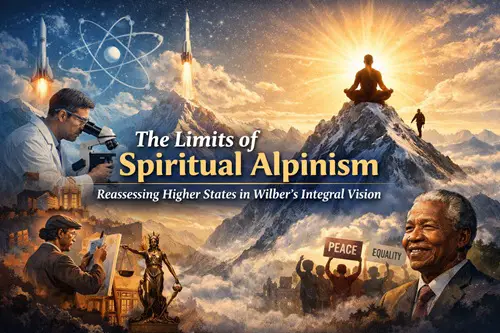 Introduction: The Summit of ConsciousnessKen Wilber's spiritual psychology places central importance on what he calls “higher states of consciousness.” Among these, the “Witness” or “fourth state” and the realization of an ultimate, “ever-present” pure consciousness are presented as the pinnacle of spiritual development. These states are described as universal and transformative, yet they remain, in essence, individual experiences. This raises the critical question: what is the actual value of this spiritual alpinism? Higher States as Individual ExperiencesEven when framed as universal, higher states are mediated by the individual nervous system, personal practice, and cultural interpretation. Mystical experiences are phenomenologically rich, but their metaphysical interpretations are often layered on top, transforming private experience into purported universal truth. Wilber frequently moves from phenomenology to ontology, claiming that witnessing thoughts proves consciousness itself is the ultimate ground. This leap from experience to cosmology is philosophically contentious. The Metaphor of Spiritual AlpinismWilber adopts a vertical metaphor for spiritual growth: higher, rarer, and subtler states are presented as superior. Yet human excellence cannot be fully captured along a single axis. Scientific innovation, moral courage, political insight, and artistic creativity demonstrate human achievement in ways that do not require nondual realization. Mystical attainment often affects the inner landscape more than the shared world, leaving open questions about its broader value. The Tension Between “Waking Up” and “Growing Up”Wilber attempts to integrate higher states with psychological and ethical development, emphasizing that spiritual realization should coexist with “growing up” and “showing up.” In practice, however, the emphasis on nondual states can overshadow other dimensions of human growth. Mystical prestige risks creating subtle hierarchies: those who claim access to higher states may be perceived as having superior insight, potentially insulating claims from scrutiny. Epistemic and Cultural LimitationsMystical states are private and culturally mediated. The same phenomenology can yield radically different interpretations across Buddhist, Advaitic, or Christian frameworks. Modern neuropsychology suggests that experiences of boundless awareness may reflect altered brain networks rather than metaphysical truths, highlighting that higher states may be extraordinary cognitive events rather than revelations of reality itself. Specific Insights from Higher StatesWhile higher states of consciousness may not constitute universal metaphysical knowledge, they can provide certain specific insights—primarily psychological, ethical, and experiential. Practitioners often report enhanced clarity in perception, a heightened sense of presence, and the ability to observe thoughts and emotions without automatic identification. This can reveal patterns of habitual reactivity, underlying fears, and subtle biases in one's mind. In some cases, the Witness perspective allows for greater emotional regulation, increased equanimity under stress, and a deeper appreciation for interconnection, which may influence interpersonal relationships and ethical decision-making. Meditative absorption can also afford a different kind of experiential insight: a sense of impermanence and relativity of phenomena, sometimes described as the “illusory” nature of ego boundaries. For some, this insight can reduce attachment, increase compassion, and foster a sense of humility toward the human condition. However, these insights are largely introspective and personal. They do not automatically translate into scientific understanding, societal transformation, or ethical authority. They may inform moral reflection or creative problem-solving, but their application depends entirely on the practitioner's capacity to integrate subjective experiences into ordinary life. In other words, higher states may illuminate the interior landscape, but they do not, on their own, provide a roadmap for engaging with external reality. Psychological Benefits vs. Metaphysical ClaimsMeditative practices can yield genuine psychological and emotional benefits—enhanced attention, emotional regulation, and existential perspective. Experiences of unity and self-transcendence can be meaningful and transformative on a personal level. However, their value appears primarily psychological, not metaphysical, challenging the assumption that these states represent the summit of human achievement. Potential Pitfalls of Meditation and Exclusive Spiritual FocusWhile higher states and meditation offer benefits, an exclusive focus on spiritual growth can also have downsides—psychological, social, and ethical. One common issue is what psychologists call “spiritual bypassing,” where meditation and mystical practice are used to avoid confronting unresolved emotional or interpersonal issues. A person may cultivate calm and detachment in meditation while neglecting real-world responsibilities, relationships, or personal development. This can produce a subtle form of escapism disguised as spiritual progress. Another risk lies in the inflation of ego or sense of superiority. Ironically, the pursuit of “higher states” can feed a subtle hierarchy within the self: a belief that one is spiritually advanced while others remain unenlightened. Such attitudes may reduce empathy, increase judgment toward others, and weaken the very ethical dimensions of growth that spiritual traditions often emphasize. Extended meditation, especially intensive retreats, can sometimes induce psychological strain. Some practitioners report anxiety, dissociation, or depersonalization when inner absorption is pursued without grounding. Excessive focus on the inner world can also diminish engagement with external reality, leading to social isolation or neglect of practical responsibilities. Finally, an overemphasis on spiritual states risks distorting one's conception of human flourishing. By prioritizing mystical attainment above moral, intellectual, and creative development, a person may inadvertently devalue the diverse ways humans can contribute meaningfully to the world. In effect, spiritual alpinism can become a form of one-dimensional self-elevation: transformative on the inner plane, but potentially blind to the broader responsibilities of living in a shared, complex society. Conclusion: Reframing Human ExcellenceThe pursuit of higher states is one path among many. Spiritual alpinism can enrich individual experience but should not automatically be equated with the apex of human development. History demonstrates that transformative achievements—scientific, political, artistic, and moral—rarely depend on access to mystical states. Wilber's integral vision risks conflating personal realization with universal authority, raising the question of whether spiritual alpinism truly merits its exalted status.
Comment Form is loading comments...
|