|
TRANSLATE THIS ARTICLE
Integral World: Exploring Theories of Everything
An independent forum for a critical discussion of the integral philosophy of Ken Wilber
  Frank Visser, graduated as a psychologist of culture and religion, founded IntegralWorld in 1997. He worked as production manager for various publishing houses and as service manager for various internet companies and lives in Amsterdam. Books: Ken Wilber: Thought as Passion (SUNY, 2003), and The Corona Conspiracy: Combatting Disinformation about the Coronavirus (Kindle, 2020). Frank Visser, graduated as a psychologist of culture and religion, founded IntegralWorld in 1997. He worked as production manager for various publishing houses and as service manager for various internet companies and lives in Amsterdam. Books: Ken Wilber: Thought as Passion (SUNY, 2003), and The Corona Conspiracy: Combatting Disinformation about the Coronavirus (Kindle, 2020).
Check out my other conversations with ChatGPT How Ken Wilber Misreads DarwinEvolution, Teleology, and the Return of Cosmic PurposeFrank Visser / ChatGPT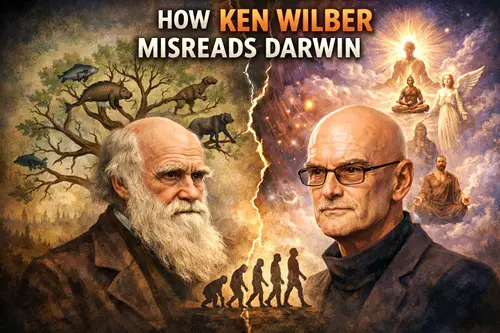 Few scientific ideas have been as widely misunderstood—and as frequently domesticated by philosophical systems—as Charles Darwin's theory of evolution. Among contemporary spiritual philosophers, Ken Wilber offers one of the most ambitious reinterpretations. In Wilber's writings, Darwin is acknowledged as an important figure, yet his contribution is portrayed as far less revolutionary than most historians of science believe. Wilber's claim, stated in Sex, Ecology, Spirituality (1995), is that Darwin introduced “precisely nothing new or unusual.”[1] The idea of evolution, he argues, had already been articulated by philosophers such as Schelling and Hegel, who described the cosmos as an unfolding developmental process. Darwin merely supplied empirical evidence for a worldview that was already philosophically established. This interpretation profoundly misrepresents Darwin's achievement. It reduces one of the most disruptive ideas in intellectual history to a minor empirical footnote in a pre-existing metaphysical narrative. In reality, Darwin did not confirm the philosophical tradition of cosmic development—he undermined it. The Real Revolution Darwin IntroducedBefore Darwin, most evolutionary speculation was teleological. Thinkers believed that life developed according to some intrinsic drive toward perfection or higher forms. This assumption appeared in many guises: divine design, vital forces, or metaphysical principles guiding the growth of nature. Darwin's theory eliminated this guiding intelligence. Evolution occurs through a simple process: heritable variation combined with differential survival and reproduction. Some variations help organisms survive and reproduce; others do not. Over many generations, advantageous traits accumulate. The crucial feature of this mechanism is that it is blind. Natural selection has no foresight, no goals, and no predetermined direction. Adaptations arise because certain variations happen to work better in particular environments. This insight was profoundly unsettling because it showed that apparent design could emerge without a designer. Biological complexity did not require a cosmic intelligence directing the process. Philosopher Daniel Dennett famously called this “Darwin's dangerous idea”: the discovery that a mindless algorithm could generate the appearance of purpose. Wilber's interpretation of evolution effectively neutralizes this insight. In his cosmology, the universe is driven by an intrinsic spiritual force—Eros—which pushes matter toward life, life toward mind, and mind toward Spirit. What Darwin explained through cumulative selection, Wilber explains through cosmic intention. In doing so, Wilber quietly reinstates the very teleology Darwin worked so hard to remove. Confusing Evolution with DevelopmentOne of the conceptual errors underlying Wilber's reading of Darwin is the conflation of evolution with development. Development is a process unfolding according to an internal program. An embryo develops into an adult organism because its genetic architecture guides that transformation. The stages are built into the system from the beginning. Evolution is fundamentally different. It is a historical process shaped by environmental pressures and random variation. It has no predetermined endpoint and no internal program guiding it toward specific outcomes. Wilber repeatedly treats evolution as if it were the cosmic development of Spirit. In his narrative, the universe passes through successive stages—matter, life, mind, and eventually spiritual awareness. But Darwin's theory undermines precisely this type of narrative. Evolution does not guarantee progress, complexity, or consciousness. Many evolutionary lineages become simpler over time. Most species that have ever existed are now extinct. Evolution is not the unfolding of a cosmic embryo. It is an open-ended branching process shaped by contingency. The Ladder That Darwin DestroyedAnother persistent theme in Wilber's writings is the portrayal of evolution as a hierarchical ascent toward higher levels of reality. This view closely resembles the ancient philosophical model known as the Great Chain of Being, which arranged existence on a vertical ladder from matter to God. Each rung represented a higher level of perfection. Darwin replaced this ladder with a branching tree. Species are not arranged in a fixed hierarchy; they diverge from common ancestors. Evolution produces diversity, not a single upward trajectory. Humans are not the predetermined goal of evolution. They are one branch among many on a vast and historically contingent tree of life. Wilber's framework effectively restores the ladder Darwin dismantled. The Micro/Macro Evolution Straw ManWilber and other spiritually inclined critics of Darwin often claim that natural selection can explain small changes within species but not major evolutionary innovations. This argument is deeply misleading. Modern evolutionary biology demonstrates that large-scale transformations arise through the cumulative effects of small changes over long periods. Fossil evidence, comparative genomics, and developmental biology all support this conclusion. The distinction between microevolution and macroevolution is primarily one of scale, not of mechanism. Once populations diverge sufficiently, new species—and eventually new anatomical structures—emerge. By portraying Darwinism as incapable of explaining complexity, Wilber creates a conceptual gap that his metaphysical principle of Eros conveniently fills. But the gap exists largely because Darwin's theory has been misrepresented. Eros vs Natural SelectionThe contrast between Wilber's concept of Eros and Darwin's natural selection reveals the fundamental incompatibility between spiritual teleology and evolutionary science. Wilber describes Eros as a driving force within the universe that pushes evolution toward greater complexity, consciousness, and unity. It is the cosmic impulse toward higher forms of organization. The problem is that Eros explains nothing in scientific terms. Scientific explanations require mechanisms that generate testable predictions. Natural selection meets this criterion. It specifies a clear causal process: variation, inheritance, and differential reproduction. This mechanism can be observed, modeled mathematically, and tested through experiments and fossil evidence. Eros, by contrast, is purely descriptive. It labels the pattern Wilber believes he sees in evolution but does not explain how that pattern arises. If complexity increases, Eros is said to be operating. If complexity stagnates or collapses—as happens in countless evolutionary lineages—Eros is either ignored or reinterpreted in vague metaphysical terms. In practice, Eros functions as a cosmic placeholder for ignorance. It adds no predictive power, introduces no measurable variables, and cannot be falsified. Unlike natural selection, it cannot be operationalized in biological research. This is why evolutionary biologists do not invoke spiritual forces when explaining adaptation or speciation. The mechanisms required to explain these phenomena already exist within the framework of evolutionary theory. Eros is therefore not an alternative explanation of evolution. It is a metaphysical overlay placed on top of it. Wilber's Sources: Spencer, Not DarwinA revealing question is this: if Wilber's evolutionary narrative does not resemble Darwin's, where does it actually come from? The answer lies less with Darwin than with Victorian evolutionism, particularly the philosophy of Herbert Spencer. Spencer developed a grand theory of cosmic evolution decades before Darwin's ideas had been fully integrated into biology. In Spencer's system, the universe evolves from simplicity to complexity, from homogeneity to heterogeneity, through an intrinsic developmental drive. Evolution for Spencer was not merely biological—it was cosmic, social, and spiritual. This framework closely resembles Wilber's own evolutionary cosmology. The idea that the universe progresses toward ever higher levels of organization and consciousness echoes Spencer far more than it echoes Darwin. But Spencer's philosophy, once enormously influential, is now largely regarded as an instructive historical mistake. His sweeping evolutionary metaphysics outran the available scientific evidence and blurred the crucial distinction between descriptive patterns and causal explanations. Darwin's contribution was precisely to replace Spencerian grand narratives with a concrete mechanism—natural selection—that could be studied empirically. Wilber's system, by contrast, reverses this move. It returns from mechanism to metaphysical narrative, reintroducing a cosmic developmental principle that Darwin's theory had rendered unnecessary. In effect, Wilber revives the spirit of nineteenth-century evolutionary romanticism while presenting it as an integration of modern science. Why Evolutionary Biologists Ignore ErosIf Wilber's concept of Eros truly offered an explanatory key to evolution, one might expect evolutionary biology to take it seriously. Yet the idea has made virtually no impact on scientific research. This silence is not the result of disciplinary narrow-mindedness, as some spiritual philosophers suggest. It reflects a straightforward methodological fact: Eros provides no operational framework for scientific investigation. Scientific explanations must specify mechanisms that can be measured, modeled, and tested. Natural selection satisfies these criteria. Population genetics quantifies how gene frequencies change over time. Evolutionary developmental biology explains how small genetic variations alter anatomical structures. Comparative genomics traces evolutionary relationships through DNA. Within this framework, evolutionary phenomena are explained through identifiable processes: mutation, selection, genetic drift, recombination, and developmental constraints. Eros introduces none of these elements. It does not identify a causal mechanism, propose measurable variables, or generate testable predictions. Instead, it functions as a retrospective interpretation: after complexity appears, Eros is invoked as its underlying cause. But because the concept does not specify how the process works, it cannot guide research or generate new discoveries. This is why evolutionary biologists—from Ernst Mayr to Richard Dawkins and Stephen Jay Gould—have been able to explain the emergence of biological complexity without appealing to cosmic drives. Natural selection already accounts for the phenomena Eros claims to explain. Adding Eros to evolutionary theory is therefore not an expansion of explanatory power. It is a philosophical reinterpretation layered on top of an already sufficient scientific framework. The Philosophical Cost of Re-Enchanting EvolutionThe attraction of Wilber's evolutionary vision is easy to understand. Darwin's theory can feel existentially stark. If evolution is driven by blind processes, then the universe may lack the intrinsic meaning that earlier metaphysical systems promised. Wilber's philosophy attempts to restore that meaning by embedding evolution within a spiritual narrative of ascent. Complexity becomes the unfolding of Spirit; consciousness becomes the universe awakening to itself. The price of this restoration, however, is intellectual clarity. Once evolution is interpreted as the expression of a cosmic drive toward higher forms, the distinction between scientific explanation and metaphysical speculation becomes blurred. Empirical theories are absorbed into philosophical narratives that were never derived from them. In practice, this move reverses the lesson Darwin taught. Darwin showed that nature's apparent design does not require a guiding intelligence. Wilber reinterprets evolution so that it once again appears to express a hidden spiritual intention. This move may satisfy a desire for cosmic meaning, but it comes at the cost of misunderstanding the theory that made modern evolutionary biology possible. Darwin's revolution lies precisely in the recognition that nature does not need to be spiritually directed in order to produce complexity, beauty, and intelligence. Re-enchanting evolution may be philosophically comforting. But it obscures the deeper—and far more astonishing—insight that Darwin uncovered: the creative power of mindless processes operating over vast stretches of time. The Persistent Temptation of Cosmic MeaningWilber's reinterpretation of Darwin illustrates a broader intellectual temptation. Darwin's theory strips nature of inherent purpose. Evolution becomes an open-ended process driven by contingent events and blind selection. For thinkers committed to a meaningful cosmos, this conclusion can feel existentially unsatisfying. The desire to reintroduce direction, purpose, or spiritual significance is understandable. Wilber's philosophy represents one attempt to restore cosmic meaning by embedding evolution within a spiritual narrative of ascent. But this restoration comes at the cost of misrepresenting Darwin's theory. Darwin did not merely provide empirical confirmation for a philosophical worldview that already existed. He dismantled that worldview by showing that complexity can arise without purpose. ConclusionKen Wilber's reading of Darwin transforms a profoundly disruptive scientific theory into a supporting actor in a metaphysical drama about the evolution of Spirit. By portraying Darwin as merely confirming an ancient developmental philosophy, Wilber obscures the radical implications of natural selection. Darwin's true contribution was not the idea that life evolves. It was the discovery that evolution can occur without guidance, intention, or cosmic purpose. That insight remains one of the most powerful—and unsettling—ideas in modern thought. Wilber's philosophy attempts to soften its impact by reintroducing teleology in the form of Eros. But in doing so, it abandons the very scientific framework it claims to integrate. Darwin's revolution lies precisely in the fact that the appearance of design can emerge from processes that have no design at all. That is what Wilber ultimately fails to grasp. Epilogue: Wilber's Eros as Spiritual CreationismKen Wilber has often distanced himself from traditional creationism. He correctly notes that the biblical picture of a fully formed world created in six days cannot withstand the overwhelming evidence for evolution. In this respect, Wilber presents himself as firmly aligned with modern science. Yet the concept of Eros in the Kosmos performs a remarkably similar function to the creationist idea it replaces. Creationism explains biological complexity by invoking an external designer who intentionally shaped life's forms. Wilber rejects this explicit supernatural intervention but introduces a subtler alternative: an intrinsic cosmic drive that pushes matter toward life, life toward mind, and mind toward Spirit. The difference is stylistic rather than structural. Instead of a divine engineer periodically inserting complexity into the natural world, Wilber proposes a built-in metaphysical force that ensures complexity emerges. The mechanism changes, but the explanatory logic remains the same: biological complexity ultimately reflects intentionality built into the universe. Darwin's theory eliminated the need for precisely this assumption. Through natural selection, Darwin demonstrated that the appearance of design can emerge from cumulative processes that possess no foresight or purpose. Adaptations arise because certain variations happen to work better in particular environments—not because the universe is striving toward higher forms. From this perspective, Wilber's Eros functions as a kind of spiritualized creationism. It preserves the intuition that evolution must be guided by a deeper intelligence, even while acknowledging the empirical evidence for evolutionary change. But the strength of Darwin's theory lies precisely in its refusal to invoke such guidance. The power of natural selection is that it explains complexity without appealing to hidden purposes or cosmic intentions. This is why evolutionary biology has flourished without metaphysical principles like Eros. The mechanisms required to explain life's diversity already exist within the framework of variation, selection, and inheritance. Wilber's philosophy therefore does not extend evolutionary theory. It reinterprets it through the lens of an older metaphysical impulse—the desire to see the universe as moving toward spiritual fulfillment. That impulse may be psychologically compelling. But it is not supported by the science Wilber claims to integrate. Darwin's revolution remains intact: the extraordinary complexity of life can arise from processes that are, at their core, profoundly simple and profoundly blind. And that insight continues to challenge every philosophy that insists the universe must ultimately be guided by Spirit. NOTES[1] Sex, Ecology, Spirituality: The Spirit of Evolution, Shambhala, 1995, p. 10-11: The idea of the continuity of life—the web of life, the tree of life, the "no gaps in nature" view—was at least as old as Plato and Aristotle, and, as I briefly mentioned, it formed an essential ingredient in the notion of the Great Chain of Being. Spirit manifests itself in the world in such a complete and full fashion that it leaves no gaps in nature, no missing links in the Great Chain. And, as Lovejoy noted, it was the philosophical belief that there are no gaps in creation that directly led to the scientific attempts to find not only the missing links in nature (which is where that phrase originated) but also evidence of life on other planets. All of these "gaps" needed to be filled in, in order to round out the Great Chain, and there was precisely nothing new or unusual in Darwin's presentation of the continuous tree of life. See also: Frank Visser, "'Precisely nothing new or unusual', Ken Wilber on Darwin's Lasting Contribution", www.integralworld.net, November 2019.
Widget is loading comments...
|