|
TRANSLATE THIS ARTICLE
Integral World: Exploring Theories of Everything
An independent forum for a critical discussion of the integral philosophy of Ken Wilber
  Frank Visser, graduated as a psychologist of culture and religion, founded IntegralWorld in 1997. He worked as production manager for various publishing houses and as service manager for various internet companies and lives in Amsterdam. Books: Ken Wilber: Thought as Passion (SUNY, 2003), and The Corona Conspiracy: Combatting Disinformation about the Coronavirus (Kindle, 2020). Frank Visser, graduated as a psychologist of culture and religion, founded IntegralWorld in 1997. He worked as production manager for various publishing houses and as service manager for various internet companies and lives in Amsterdam. Books: Ken Wilber: Thought as Passion (SUNY, 2003), and The Corona Conspiracy: Combatting Disinformation about the Coronavirus (Kindle, 2020).
Check out my other conversations with ChatGPT Minutes from CatastropheHow a Cosmic Rock Shaped Life on EarthFrank Visser / ChatGPT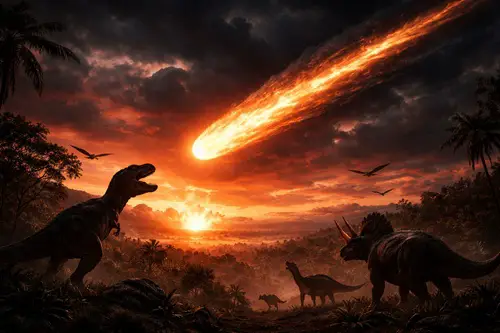 Imagine Earth on a warm Cretaceous day, 66 million years ago. The sun shines over lush forests, ferns, and towering dinosaurs that roam continents free from the mammals that now dominate our imagination. Life hums with the slow certainty of survival—but the universe is about to intervene. High above, a comet—a fragment of rock and metal, no larger than a mountain—plunges through the atmosphere at unimaginable speed. Within seconds, it will strike the planet with the energy of billions of atomic bombs. And yet, this catastrophe teeters on a knife-edge of contingency. Minutes earlier, it might have flown harmlessly into open ocean; minutes later, the same. The timing, the trajectory, the exact spot—it all matters. The Chicxulub Impact: Fire, Dust, and DeathThe asteroid strikes the Yucatán carbonate platform. In an instant, a fireball brighter than the sun flashes across the sky. Rocks melt, forests ignite, and a towering plume of dust and sulfur gas shoots skyward. Across the globe, the atmosphere darkens; photosynthesis halts. Temperatures swing from searing heat to freezing cold. Dinosaurs, dominant for over 160 million years, are doomed, along with countless other species. Earth is plunged into an ecological nightmare. But consider the alternative. A few minutes' difference, a slight drift in trajectory, and the rock plunges into the deep Atlantic instead. The immediate cataclysm—firestorms, sulfur clouds, the collapse of land ecosystems—is muted. Dinosaurs might have survived, mammals would have remained minor players, and the evolutionary stage we take for granted might never have been set. Perhaps humans would never exist; perhaps the forests of the Cretaceous would still flourish, with their colossal inhabitants reigning unchallenged. Contingency in Evolutionary BiologyModern evolutionary biology increasingly stresses the role of contingency—chance events, accidents, and historical happenstance—in shaping life. Paleontologist Stephen Jay Gould, in Wonderful Life, argued that if we could “rewind the tape of life” and let it play again, the outcome would almost certainly be radically different. The evolutionary trajectories that led to the dominance of particular lineages—mammals, birds, or humans—are not preordained but depend on a complex web of random mutations, environmental pressures, and catastrophic events like asteroid impacts. Contingency operates alongside natural selection; adaptation explains why certain traits persist, but contingency explains why certain lineages survive at all. Similarly, molecular biologists and developmental geneticists, including Sean B. Carroll, highlight that small, seemingly minor events at the genetic or ecological level can ripple outward to produce large-scale evolutionary consequences. Mass extinctions act as sudden resets, creating ecological opportunities for survivors. Evolution is less a predictable march toward complexity or consciousness and more a dynamic interplay of chance and necessity. Wilber's Vision of Evolution: Teleology Over ContingencyKen Wilber's integral framework, by contrast, often leans toward a quasi-deterministic vision of evolution. In works like The Religion of Tomorrow and Integral Spirituality, he treats evolution as progressing through fixed stages of consciousness—gross, subtle, causal—culminating in the realization of a transpersonal, nondual awareness. While Wilber occasionally acknowledges environmental and historical factors, he frames them largely as instruments of a larger spiritual trajectory rather than as genuinely contingent variables. From this perspective, the Chicxulub asteroid would be interpreted less as an unpredictable contingency and more as a catalytic mechanism for the unfolding of consciousness, a “stage-wise” inevitability embedded in a cosmic plan. The asteroid's timing and impact become meaningful only insofar as they contribute to the spiritual trajectory he envisions—not as a demonstration of the fragility and randomness that evolutionary science emphasizes. Life on the Edge: Lessons from ContingencyThe story of Earth is profoundly contingent. The rise of mammals, and eventually humans, depended as much on random catastrophes and chance survival as on adaptive advantage. Events like the dinosaur extinction illustrate that life is not predetermined, but precarious, shaped by unpredictable events that ripple across eons. By contrasting this reality with Wilber's teleological interpretation, we gain a clearer appreciation of the difference between scientific and philosophical perspectives on evolution. Evolutionary biology reminds us that the tapestry of life is stitched from both necessity and chance. Wilber's framework, in contrast, interprets that tapestry as a carefully orchestrated ascent of consciousness, downplaying the very contingencies that gave rise to mammals, birds, and ultimately humans. In the end, the fate of life on Earth hinges on a cosmic lottery. A single asteroid, minutes early or late, could have rewritten the history of our planet. The story of contingency challenges deterministic interpretations of evolution, reminding us that life's path is fragile, unpredictable, and endlessly fascinating.
Widget is loading comments...
|