|
TRANSLATE THIS ARTICLE
Integral World: Exploring Theories of Everything
An independent forum for a critical discussion of the integral philosophy of Ken Wilber
  Frank Visser, graduated as a psychologist of culture and religion, founded IntegralWorld in 1997. He worked as production manager for various publishing houses and as service manager for various internet companies and lives in Amsterdam. Books: Ken Wilber: Thought as Passion (SUNY, 2003), and The Corona Conspiracy: Combatting Disinformation about the Coronavirus (Kindle, 2020). Frank Visser, graduated as a psychologist of culture and religion, founded IntegralWorld in 1997. He worked as production manager for various publishing houses and as service manager for various internet companies and lives in Amsterdam. Books: Ken Wilber: Thought as Passion (SUNY, 2003), and The Corona Conspiracy: Combatting Disinformation about the Coronavirus (Kindle, 2020).
Check out my other conversations with ChatGPT The Personality Typology IllusionWhy Systems That Divide Humanity into Types Fail to Describe RealityFrank Visser / ChatGPT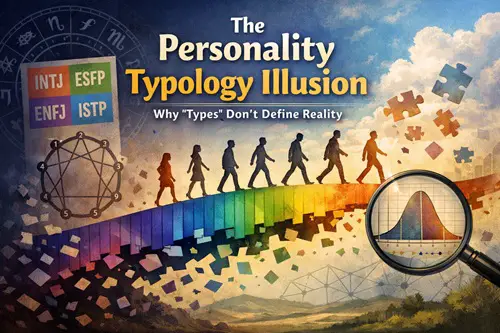 Personality type systems are endlessly appealing. They promise clarity in a confusing social world: a handful of categories that supposedly explain why people think, feel, and behave as they do. From the enormously popular Myers-Briggs Type Indicator to the mystical symbolism of the Enneagram of Personality, these frameworks present themselves as deep psychological insights. Many people report feeling “seen” by them, and organizations use them in hiring, leadership training, and team-building exercises. Yet when evaluated scientifically, personality type systems collapse. They rest on weak theoretical foundations, fail basic psychometric tests, and contradict what modern personality research actually shows about human variation. In short: personality types are psychologically compelling—but empirically empty. The Seduction of CategoriesHuman cognition naturally organizes the world into categories. This tendency—known in cognitive science as categorical thinking—helps us simplify complexity. We divide animals into species, foods into groups, and people into roles. Personality typologies exploit this instinct. Systems such as the Myers-Briggs Type Indicator sort people into discrete boxes (e.g., “INTJ,” “ESFP”), while the Enneagram of Personality assigns individuals to one of nine archetypal motivations. The appeal is obvious: • Types are simple. • Types are memorable. • Types feel explanatory. But the psychological attractiveness of a framework tells us nothing about its accuracy. Astrology is also memorable and meaningful to its adherents. The Scientific Problem: Personality Is ContinuousModern personality science—especially research on the Big Five personality traits—shows that personality traits exist on continuous spectrums, not discrete categories. For example: • Extraversion varies gradually from very introverted to very extraverted. • Conscientiousness ranges from disorganized to highly disciplined. • Neuroticism ranges from emotionally stable to highly reactive. There are no natural breakpoints where one “type” ends and another begins. Instead, individuals occupy positions along multiple overlapping distributions. The difference between someone with an extraversion score of 51 and 49 is trivial—but a type system might place them in completely different categories. Nature simply does not produce personality in boxes. The Arbitrary Boundaries ProblemType systems require artificial thresholds. Consider the scoring logic behind the Myers-Briggs Type Indicator: • If you score slightly above the midpoint on extraversion → you are an E. • Slightly below → you are an I. Someone scoring 51% extraversion and someone scoring 90% extraversion receive the same label. Meanwhile, someone scoring 49% is classified as a completely different type. This produces a statistical absurdity: people who are almost identical can be assigned to entirely different “types.” In real scientific measurement, such arbitrary divisions are considered a methodological red flag. Catastrophic Test-Retest FailureAnother major problem is reliability. When people retake many type-based personality tests weeks later, they frequently receive different results. Studies repeatedly show that 30-50% of participants change type when retested. This instability reflects the underlying statistical issue: when scores sit near arbitrary thresholds, minor fluctuations push individuals across category boundaries. A personality type that changes every few weeks is not a personality type—it is measurement noise. The Barnum EffectPerhaps the most powerful force behind the popularity of personality types is a psychological phenomenon known as the Barnum effect. The Barnum effect occurs when people interpret vague, general statements as uniquely accurate descriptions of themselves. Horoscopes exploit this effect, but personality typing systems do as well. Consider typical type descriptions: • “You value independence but also crave connection.” • “You sometimes doubt yourself despite your strengths.” • “You can be highly motivated when something matters to you.” These statements apply to almost everyone. But when individuals believe the description is tailored specifically to their “type,” it feels uncannily personal. The Illusion of DepthAnother cognitive bias, the illusion of explanatory depth, contributes to the persistence of personality typologies. The terminology used by systems like the Myers-Briggs Type Indicator—“intuitive function,” “thinking preference,” “judging orientation”—creates an impression of theoretical sophistication. Yet when psychologists attempt to operationalize these constructs scientifically, they dissolve into vague metaphors rather than measurable mechanisms. The system feels deep largely because its vocabulary sounds technical. Why the Systems PersistDespite their scientific weakness, personality type systems remain extraordinarily popular. Several forces explain this persistence: 1. Narrative IdentityHumans naturally construct stories about themselves. Personality types offer ready-made identities—INTJ strategist, Enneagram reformer, empathic mediator. 2. Social SignalingTyping systems function as social shorthand. Saying “I'm an INFP” signals values, temperament, and identity in a compact form. 3. Corporate SimplicityOrganizations prefer simple tools. A four-letter code is easier to deploy in workshops than nuanced trait distributions. 4. Existential ComfortPerhaps most importantly, types provide a reassuring idea: that our psychological makeup fits into a meaningful pattern. Reality is less tidy. What Real Personality Science Looks LikeUnlike typologies, modern personality psychology relies on factor analysis, large datasets, and statistical modeling. The most widely supported framework—the Big Five personality traits—emerged from decades of empirical research across cultures. It identifies five major dimensions: • Openness • Conscientiousness • Extraversion • Agreeableness • Neuroticism Crucially, these are traits, not types. People possess them in varying degrees, creating an almost infinite spectrum of personality combinations. Human individuality arises not from belonging to a category but from occupying a unique point in a multidimensional trait space. The Deeper LessonThe failure of personality typologies illustrates a broader pattern in human thinking. We crave simple frameworks that compress complexity into clean conceptual boxes. But many aspects of reality—ecosystems, cultures, minds—are continuous, dynamic systems that resist categorical classification. Personality is one of those systems. Reducing it to types may be psychologically satisfying, but it is scientifically indefensible. ConclusionPersonality type systems—from the Myers-Briggs Type Indicator to the Enneagram of Personality—persist not because they accurately describe human psychology, but because they satisfy deep cognitive and social needs. They provide identity, narrative, and simplicity in a domain that is inherently complex. Modern personality science tells a different story: people are not members of psychological species. They are points in a continuous landscape of traits shaped by biology, development, and culture. The human personality is not a box. It is a spectrum. Appendix: Two Case Studies in Personality TypologyTo illustrate how personality typologies gain cultural traction despite weak empirical foundations, it is useful to examine two prominent examples in detail: astrological sun signs and the Enneagram system. These case studies demonstrate how symbolic systems can produce strong psychological resonance without corresponding scientific validity. Case Study 1: Sun Signs in AstrologyThe personality framework most widely recognized across cultures is the system of astrological sun signs within Western astrology. In this system, individuals are assigned a personality category based on the position of the Sun at the time of birth. The twelve signs—Aries, Taurus, Gemini, Cancer, Leo, Virgo, Libra, Scorpio, Sagittarius, Capricorn, Aquarius, and Pisces—are each associated with characteristic personality traits. For example: • Aries: bold, energetic, competitive • Taurus: stable, sensual, stubborn • Gemini: curious, communicative, restless • Scorpio: intense, passionate, secretive The appeal of this system lies in its elegant simplicity. With only twelve categories, astrology offers a universal typology into which all human personalities can be placed. Scientific EvaluationEmpirical testing of astrological personality claims has consistently failed. Studies comparing personality test scores with astrological signs find no statistically significant correlations. One of the most famous demonstrations of this failure occurred in the experiments of Shawn Carlson, published in Nature in 1985. Professional astrologers were asked to match natal charts with personality profiles derived from validated psychological assessments. Their accuracy was indistinguishable from random guessing. The conclusion was unambiguous: astrological personality claims do not outperform chance. Why Sun Signs Still Work PsychologicallyDespite the lack of evidence, sun sign astrology remains culturally powerful. Several psychological mechanisms explain this persistence: • Selective validation – people remember accurate descriptions and forget mismatches. • Vague trait descriptions – many sign profiles contain universally applicable statements. • Identity play – individuals enjoy experimenting with symbolic identities. In effect, astrology functions as a cultural storytelling device, not a psychological measurement tool. Case Study 2: The EnneagramThe Enneagram of Personality is a more recent and psychologically sophisticated typology. It divides personality into nine types, each organized around a core motivation or psychological fixation. The types are typically described as follows: • 1. The Reformer – principled and self-controlled • 2. The Helper – generous and people-oriented • 3. The Achiever – ambitious and success-driven • 4. The Individualist – expressive and introspective • 5. The Investigator – analytical and detached • 6. The Loyalist – security-oriented and vigilant • 7. The Enthusiast – spontaneous and pleasure-seeking • 8. The Challenger – assertive and protective • 9. The Peacemaker – easygoing and accommodating Unlike astrology, the Enneagram does not claim celestial origins. Its modern form emerged in the twentieth century through a mixture of mysticism, spiritual teaching, and psychological speculation associated with figures such as Oscar Ichazo and Claudio Naranjo. In recent decades the system has become extremely popular in leadership coaching, therapy workshops, and spiritual communities. Scientific EvaluationDespite its popularity, the Enneagram faces serious empirical problems. 1. Lack of theoretical grounding The origin of the nine types is largely speculative. There is no established psychological mechanism explaining why exactly nine personality structures should exist. 2. Weak psychometric validation Attempts to measure Enneagram types reliably have produced inconsistent results. Factor-analytic studies generally fail to reproduce the clean nine-type structure claimed by the theory. 3. Continuous traits disguised as types Many Enneagram descriptions overlap strongly with dimensions already captured by the Big Five personality traits. What the Enneagram labels as types often correspond to particular trait profiles rather than distinct personality categories. Why the Enneagram Feels InsightfulThe Enneagram nevertheless produces powerful subjective experiences of recognition. Several features contribute to this effect: • Rich narrative descriptions of motivations and fears • Dynamic growth paths that give the system a developmental arc • Spiritual framing, which resonates with introspective communities In practice, the Enneagram functions less as a scientific taxonomy and more as a symbolic map for self-reflection. What These Case Studies RevealAlthough astrology and the Enneagram differ dramatically in cultural prestige, they share several structural features:
Both systems succeed by providing meaning rather than measurement. They help people talk about themselves, interpret relationships, and explore identity. But this usefulness should not be confused with empirical validity. Final ReflectionThe persistence of systems like sun signs and the Enneagram of Personality highlights a central tension in the study of personality. Humans seek clear psychological identities, yet real personality variation is messy, continuous, and context-dependent. Typologies satisfy the desire for clarity. Science reveals the complexity. Understanding that distinction is essential if we want to separate narrative tools for self-understanding from evidence-based models of human psychology.
Comment Form is loading comments...
|