|
TRANSLATE THIS ARTICLE
Integral World: Exploring Theories of Everything
An independent forum for a critical discussion of the integral philosophy of Ken Wilber
  Frank Visser, graduated as a psychologist of culture and religion, founded IntegralWorld in 1997. He worked as production manager for various publishing houses and as service manager for various internet companies and lives in Amsterdam. Books: Ken Wilber: Thought as Passion (SUNY, 2003), and The Corona Conspiracy: Combatting Disinformation about the Coronavirus (Kindle, 2020). Frank Visser, graduated as a psychologist of culture and religion, founded IntegralWorld in 1997. He worked as production manager for various publishing houses and as service manager for various internet companies and lives in Amsterdam. Books: Ken Wilber: Thought as Passion (SUNY, 2003), and The Corona Conspiracy: Combatting Disinformation about the Coronavirus (Kindle, 2020).
Check out my other conversations with ChatGPT Infinity or Embodiment?John Abramson and George Lakoff on the Nature of MathematicsFrank Visser / ChatGPT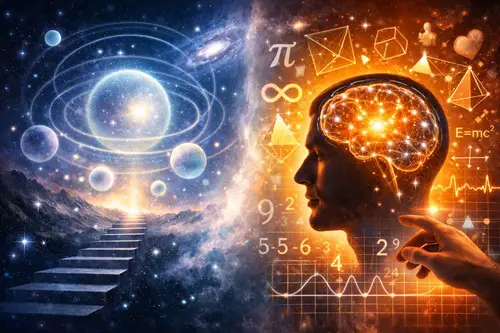 The Eternal Question: Is Mathematics Discovered or Constructed?Few intellectual questions cut as deeply into philosophy, science, and metaphysics as the nature of mathematics. Are mathematical truths eternal realities waiting to be discovered, or are they human constructions emerging from the structure of our cognition? The contrast between the views of John Abramson and George Lakoff illustrates this divide vividly. Abramson approaches mathematics from a broadly Platonic and metaphysical perspective, invoking realms of infinity and trans-physical structures. Lakoff, by contrast, argues from cognitive science, grounding mathematics in the bodily and neural structure of human beings. Their positions represent two radically different answers to the question of where mathematical truth ultimately resides. Abramson: Mathematics as Access to Infinite RealmsAbramson's approach belongs to the long tradition of mathematical Platonism, which traces back to Plato. In this view, mathematical entities—numbers, sets, geometric forms—exist independently of human minds. Humans do not invent them; they discover them. Abramson strengthens this classical view by invoking ideas from modern mathematics associated with Georg Cantor, the founder of set theory. Cantor's work introduced the concept of multiple infinities, showing that some infinite sets are larger than others. Abramson interprets this not merely as a formal mathematical result but as evidence for a layered metaphysical reality. In his interpretation, mathematical structures reflect �spheres of infinity�—levels or domains of reality that transcend the physical world. Mathematical knowledge, therefore, is not simply a human intellectual activity but a form of epistemic access to these higher structures. From this standpoint, the uncanny effectiveness of mathematics in physics—famously called �the unreasonable effectiveness of mathematics� by Eugene Wigner—is not mysterious at all. The physical universe itself participates in deeper mathematical orders, and human reason can partially access them. Abramson therefore sees mathematics as evidence for a trans-empirical ontology: a reality structured by abstract entities that exist independently of human cognition. Lakoff: Mathematics as Embodied CognitionLakoff offers a nearly opposite explanation. In his influential work with philosopher Rafael E. N��ez, especially in Where Mathematics Comes From, Lakoff argues that mathematics is fundamentally a product of human cognitive architecture. The central claim of Lakoff's theory is that mathematics grows out of embodied experience. Human beings possess sensorimotor systems—ways of moving, perceiving space, counting objects, and manipulating physical things. These experiences generate conceptual metaphors that eventually develop into mathematical structures. For example: • Counting emerges from object collection experiences. • Arithmetic builds on metaphors of combining and separating groups. • Geometry arises from spatial perception and bodily orientation. More abstract mathematics, including infinity, is constructed through increasingly sophisticated metaphorical extensions of these basic experiences. In Lakoff's view, mathematical entities do not inhabit a Platonic realm. Instead, they are conceptual systems created by human brains operating within particular biological constraints. Thus, when mathematics appears to describe the universe so well, this is not because humans access transcendent structures. Rather, it is because human cognition evolved within the same physical universe it later attempts to model. Two Explanations for Mathematical EffectivenessThe contrast between Abramson and Lakoff becomes particularly clear when addressing the puzzle of why mathematics works so well in science. Abramson's explanation • Mathematical structures exist independently. • The physical universe is structured according to those same mathematical principles. • Human minds are capable of discovering these structures. Mathematics works because it reflects objective features of reality itself. Lakoff's explanation • Mathematics is built from cognitive structures grounded in bodily experience. • Those experiences arise from interaction with the physical world. • Mathematical models therefore mirror aspects of the world indirectly. Mathematics works because our minds evolved within the universe they describe. The Status of InfinityThe disagreement becomes especially pronounced around the concept of infinity. For Abramson, inspired by Cantor's hierarchy of infinities, infinity points toward transfinite domains of existence. The mathematical concept of infinite sets reveals something real about the structure of being itself. Lakoff takes a far more cautious stance. In his framework, infinity is not a literal entity but a conceptual construct created through cognitive metaphors—such as the idea of an endlessly repeatable process (�keep adding one forever�). Thus: • Abramson treats infinity as ontological. • Lakoff treats it as cognitive. The same mathematical idea becomes either a window into metaphysical reality or a product of human conceptualization. Philosophical LineagesEach position aligns with broader intellectual traditions. Abramson stands in a lineage that includes: • Plato • Kurt Gödel • Georg Cantor All argued, in different ways, that mathematical truths exist independently of human minds. Lakoff, by contrast, belongs to the tradition of naturalized epistemology and cognitive science, drawing on research into neural processes, language, and conceptual metaphor. His work reflects the broader shift toward embodied cognition in contemporary philosophy of mind. A Deeper Divide: Metaphysics vs. NaturalismUltimately the disagreement between Abramson and Lakoff is not only about mathematics. It reflects two fundamentally different worldviews. Abramson's perspective points toward a metaphysical realism in which abstract entities inhabit higher levels of reality. Mathematics becomes evidence for the existence of such realms. Lakoff's framework fits comfortably within scientific naturalism. Mathematical systems are cognitive tools generated by brains embedded in biological bodies. In this sense, the debate over mathematics becomes a proxy for a deeper philosophical choice: Is mind accessing a pre-existing abstract universe? Or is mathematics an extension of human cognition shaped by evolution and embodiment? Between Heaven and the BodyThe contrast could hardly be sharper. Abramson's mathematics ascends toward spheres of infinity, suggesting a layered cosmos of abstract realities. Lakoff's mathematics descends into the body, grounding even the most abstract ideas in neural and sensory experience. Both perspectives attempt to explain the same remarkable phenomenon: the extraordinary power of mathematics to describe the world. Whether that power reflects transcendent structures or the architecture of the human mind remains one of the most profound unresolved questions in philosophy. And perhaps that very ambiguity—standing somewhere between heaven and the body—is part of what makes mathematics so endlessly fascinating.
Comment Form is loading comments...
|