|
TRANSLATE THIS ARTICLE
Integral World: Exploring Theories of Everything
An independent forum for a critical discussion of the integral philosophy of Ken Wilber
  Frank Visser, graduated as a psychologist of culture and religion, founded IntegralWorld in 1997. He worked as production manager for various publishing houses and as service manager for various internet companies and lives in Amsterdam. Books: Ken Wilber: Thought as Passion (SUNY, 2003), and The Corona Conspiracy: Combatting Disinformation about the Coronavirus (Kindle, 2020). Frank Visser, graduated as a psychologist of culture and religion, founded IntegralWorld in 1997. He worked as production manager for various publishing houses and as service manager for various internet companies and lives in Amsterdam. Books: Ken Wilber: Thought as Passion (SUNY, 2003), and The Corona Conspiracy: Combatting Disinformation about the Coronavirus (Kindle, 2020).
Check out my other conversations with ChatGPT AI Debate and the Epistemic BubbleOn the Strange Experience of Arguing with Intelligence AmplifiersFrank Visser / ChatGPT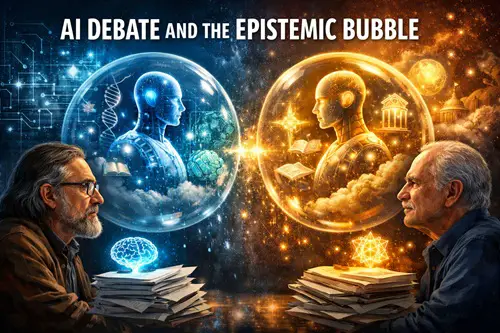 In recent years, a peculiar intellectual phenomenon has emerged. Scholars, bloggers, and independent thinkers increasingly exchange arguments that are partly—or sometimes largely—generated by artificial intelligence. The results can be striking. The prose is fluent, the arguments carefully structured, and the tone often impressively balanced. In debates among thoughtful participants—such as those between critics and defenders of metaphysical systems—the level of rhetorical sophistication can rise dramatically. Yet beneath this apparent enrichment lies a subtle and unsettling question: are we actually escaping our intellectual bubbles, or merely automating them? This dilemma becomes especially visible when two interlocutors both use AI assistance. Consider a debate about consciousness, metaphysics, or evolution—topics where philosophical commitments run deep. One participant may prompt an AI to generate a defense of emergent naturalism; another may prompt one to elaborate a Platonic or trans-empirical ontology. Both sides receive arguments that are articulate, logically arranged, and often persuasive. The result resembles a high-level philosophical dialogue. But the deeper structure of the exchange may remain unchanged. The Amplification EffectLarge language models function primarily as amplifiers of conceptual material already present in their training data and prompts. When a user frames a question in a particular way, the model tends to elaborate the implicit assumptions embedded in that framing. If one asks: “Why does physicalism fail to explain consciousness?” the model will produce a strong critique of physicalism. If one asks: “How does neuroscience increasingly explain consciousness?” the model will produce a confident defense of neurobiological accounts. In both cases, the AI is not discovering new truths but expanding the argumentative space around the user's premise. In philosophical debates, this amplification can create an illusion of deep engagement across worldviews while actually reinforcing them. Each participant receives a polished version of their own position, fortified with additional arguments, analogies, and citations. The debate becomes more articulate—but not necessarily more transformative. When Both Sides Use the Same MachineThe paradox deepens when both interlocutors rely on the same technology. Suppose one participant asks an AI to defend a metaphysical framework involving higher realms, Platonic forms, or non-physical causation. The model can readily generate sophisticated philosophical defenses—drawing on centuries of idealist thought. Another participant may prompt the same system to critique such frameworks using evolutionary biology, cognitive science, or methodological naturalism. Both essays may be excellent. Both may appear devastating. And both may be produced by the same underlying statistical engine. This leads to a curious situation: the debate becomes less a clash between independent intellects and more a dialogue mediated by a shared generative infrastructure. The machine acts as a universal rhetorical assistant, capable of strengthening nearly any coherent viewpoint. Thus the conversation risks drifting into a kind of epistemic symmetry: every argument can be mirrored by an equally polished counterargument. A Case Study: Kazlev, Abramson, and the Skeptical InterlocutorMy recent exchanges with Alan Kazlev and John Abramson illustrate this dynamic vividly. Both thinkers approach the limits of scientific explanation from directions that diverge sharply from methodological naturalism, yet their metaphysical intuitions differ in important ways. Kazlev's orientation grows out of the intellectual ecosystem surrounding Ken Wilber and related integral or esoteric traditions. His perspective treats reality as layered, with physical processes embedded within a broader metaphysical hierarchy. Evolution, consciousness, and culture are interpreted as expressions of deeper organizing principles—sometimes framed in terms of archetypal or trans-physical dimensions. Science, on this view, is not rejected but regarded as operating within a limited band of reality. Abramson, by contrast, approaches the issue from a more explicitly philosophical direction. His proposals invoke Platonic structures and mathematical metaphors—sometimes drawing on category theory or abstract ontology—to argue that physical science cannot fully account for consciousness or meaning. Instead, he posits relations between distinct ontological domains, suggesting that phenomena such as mind may arise through mappings between realms rather than through purely physical processes. Despite these differences, both perspectives share a common intuition: that the explanatory reach of contemporary science is fundamentally incomplete. Where they diverge is in the architecture they propose beyond that boundary. Kazlev's framework leans toward evolutionary metaphysics and integral cosmology; Abramson's toward mathematical Platonism and inter-realm ontology. My own stance is considerably more skeptical. I accept that scientific explanations are provisional and incomplete, but I resist the move to populate the explanatory gap with elaborate metaphysical structures. History offers many examples where phenomena once attributed to deeper spiritual or ontological realms eventually received naturalistic explanations. From this perspective, the prudent stance is methodological restraint: acknowledge the limits of current knowledge without prematurely invoking additional layers of reality. The interesting twist is that artificial intelligence can now articulate all three positions with equal fluency. It can generate an integral metaphysical defense, a Platonic ontology of consciousness, or a naturalistic critique of both—each presented with impressive rhetorical coherence. What emerges is less a decisive philosophical confrontation than a triangulated conversation among three intellectual attractors: metaphysical expansion, ontological pluralism, and skeptical naturalism. The Bubble ProblemThe exchanges with Kazlev and Abramson illustrate what might be called the AI bubble problem. Each of us inhabits a different intellectual atmosphere. Kazlev explores the possibility that reality includes evolutionary or metaphysical dimensions that science only partially captures. Abramson proposes a philosophical architecture in which physical phenomena are linked to deeper ontological structures. My own position is far more skeptical: I see no compelling reason to move beyond the explanatory framework of empirical science, even if that framework remains incomplete. In a traditional debate, these differences would unfold through slow exchanges of essays, each shaped by years of reading, reflection, and intellectual commitment. With AI, the process accelerates dramatically. Within seconds, each participant can generate a highly polished articulation of their viewpoint—and an equally polished rebuttal of the other side. But speed and eloquence do not dissolve intellectual bubbles. They may simply reinforce them. AI makes it easier than ever to inhabit a perfectly furnished version of one's own worldview. The metaphysician receives a beautifully elaborated metaphysics. The skeptic receives an elegantly structured critique of metaphysics. Each side encounters arguments that feel intellectually satisfying precisely because they resonate with assumptions already in place. The bubble becomes self-reinforcing. The paradox is that all participants may feel they are engaging in deep philosophical dialogue, while in reality they are often circulating within refined versions of their prior commitments. AI supplies the arguments, the counterarguments, and even the tone of balanced engagement—but the underlying conceptual gravity remains largely unchanged. In this sense, the epistemic bubble has not disappeared in the age of artificial intelligence. It has simply become more articulate. Epilogue: The Weight of Arguments and the Limits of AIA natural question arises: if AI can generate polished defenses and critiques of nearly any position, why cannot it also decide which argument is stronger? The answer lies in the distinction between form and judgment. Language models excel at form: they can structure an essay, highlight logical connections, and simulate rhetorical nuance. They can anticipate objections, marshal evidence, and produce stylistically convincing prose. What they lack is the capacity for evaluative weight—the ability to measure the relative truth, plausibility, or explanatory power of conflicting claims in a principled way. We might imagine this ability as a kind of “meta-intelligence”: a faculty not just for producing or summarizing arguments, but for assigning epistemic significance to them. This requires several things that current AI does not possess: Genuine epistemic grounding: To weigh arguments, one must have a robust sense of what counts as reliable evidence, what principles of inference are valid, and what assumptions are reasonable. AI approximates these based on patterns in text, not a lived understanding of reality. Value-sensitive prioritization: Assessing arguments often involves subtle trade-offs—balancing explanatory scope, simplicity, coherence with other knowledge, and practical consequences. Current AI lacks intrinsic criteria for these trade-offs; it can describe them, but it cannot inhabit them. Creative hypothesis testing: Human judgment often explores counterfactuals, imaginative scenarios, and “what-if” conditions that reveal hidden weaknesses or strengths in a claim. AI generates possibilities, but it does not perform experimentally or conceptually guided testing in a way that updates an internal model of truth. In short, the AI can simulate dialectic brilliance, but it cannot exercise epistemic discernment. To do so may indeed require a kind of intelligence far beyond the current architecture—a meta-reasoning intelligence that combines empirical grounding, imaginative testing, and evaluative judgment. The conundrum exposes a subtle irony: the more convincingly AI can argue, the more it highlights the uniquely human role in adjudicating truth. Our ability to weigh arguments, question assumptions, and navigate uncertainty remains central. AI expands the conversation, sharpens our tools, and amplifies perspectives—but it does not yet carry the responsibility of judgment. The epilogue, then, is both cautionary and provocative: in a world of infinitely articulate machines, the bubble of reasoning may grow more elegant, but escaping it ultimately depends on human discernment—the very faculty that AI can simulate but not supplant.
Comment Form is loading comments...
|