|
TRANSLATE THIS ARTICLE
Integral World: Exploring Theories of Everything
An independent forum for a critical discussion of the integral philosophy of Ken Wilber
  Frank Visser, graduated as a psychologist of culture and religion, founded IntegralWorld in 1997. He worked as production manager for various publishing houses and as service manager for various internet companies and lives in Amsterdam. Books: Ken Wilber: Thought as Passion (SUNY, 2003), and The Corona Conspiracy: Combatting Disinformation about the Coronavirus (Kindle, 2020). Frank Visser, graduated as a psychologist of culture and religion, founded IntegralWorld in 1997. He worked as production manager for various publishing houses and as service manager for various internet companies and lives in Amsterdam. Books: Ken Wilber: Thought as Passion (SUNY, 2003), and The Corona Conspiracy: Combatting Disinformation about the Coronavirus (Kindle, 2020).
Check out my other conversations with ChatGPT The Development DilemmaIndividual Freedom, Global Reputation, and the Political Divide Between West and Non-WestFrank Visser / ChatGPT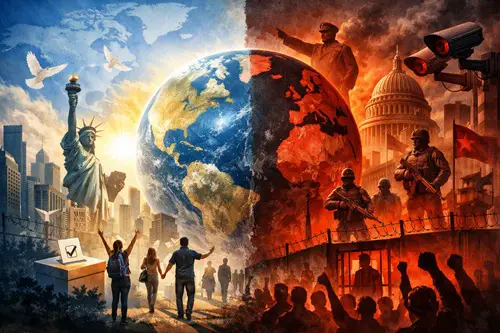 One of the most striking paradoxes of the contemporary world is the gap between the ideals Western countries claim to uphold and the way those same countries are perceived across much of the Global South. Western societies—especially in Europe and North America—have developed strong cultural and institutional support for individual autonomy, human rights, and personal development. Yet these same countries are often viewed with deep suspicion or hostility in many parts of Africa, Asia, and Latin America. Meanwhile, a number of influential non-Western states present themselves as defenders of sovereignty and cultural authenticity but frequently operate under authoritarian political systems that restrict individual freedom. This creates a genuine dilemma: if Western societies champion values that enable individual flourishing, why are they widely criticized or distrusted? And if many of their critics live under regimes that restrict freedom, does that undermine the critique? The answer is that both sides of this debate contain important truths—and important distortions. The Western Commitment to Individual DevelopmentModern Western societies have historically been the primary institutional home of liberal ideas about the individual. Philosophical traditions stemming from the Enlightenment—associated with thinkers such as John Locke, Immanuel Kant, and John Stuart Mill—helped shape political systems centered on personal liberty, the rule of law, and freedom of thought. These ideas eventually translated into concrete political structures: • constitutional democracy • protection of civil liberties • independent courts • freedom of speech and religion • protection of minority rights Documents such as the United Nations' Universal Declaration of Human Rights, strongly influenced by Western political traditions, articulated a vision of universal human dignity that many countries formally endorse. In practice, Western societies often provide environments where individuals can pursue education, criticize authority, change governments through elections, and develop personal identities without state coercion. These conditions are historically unusual and remain rare in much of the world. From this perspective, Western critics often argue that despite its flaws, the liberal democratic model has produced the most reliable framework for individual flourishing. The Global South's Critique of the WestYet the West's global reputation is deeply shaped not only by its internal ideals but by its external behavior. Much of the Global South remembers Western power primarily through the experiences of colonialism, intervention, and economic domination. The legacy of European empires—such as those of British Empire and French Colonial Empire—still shapes political consciousness across Africa, the Middle East, and Asia. Colonial rule often involved: • resource extraction • racial hierarchies • suppression of local political autonomy • arbitrary borders that later fueled conflict Even after decolonization, Western influence has continued through geopolitical interventions and economic pressure. Events such as the 1953 Iranian coup d'état, the Vietnam War, and the 2003 invasion of Iraq reinforced the perception that Western powers promote democracy selectively—supporting it when convenient and undermining it when strategic interests are at stake. Critics also point to global economic structures. Institutions such as the International Monetary Fund and the World Bank have sometimes imposed austerity policies that weakened social systems in developing countries. For many in the Global South, Western rhetoric about freedom appears inconsistent with the realities of geopolitical power. From this viewpoint, the West is seen less as a champion of universal rights than as a hegemonic system that promotes its own interests under the banner of liberal values. The Authoritarian AlternativeHowever, the critique of Western hypocrisy does not automatically validate the political systems that oppose it. Many non-Western governments that present themselves as defenders of sovereignty or traditional values maintain highly restrictive political environments. Examples include centralized political systems such as those of China under the leadership of Xi Jinping, or Russia under Vladimir Putin. These states often emphasize stability, national unity, and resistance to Western influence, but critics argue that they do so by limiting political opposition, controlling media, and restricting civil society. Other governments in parts of Africa, the Middle East, and Asia follow similar patterns. Elections may occur, but opposition parties operate under severe constraints, and dissent is often suppressed. From a human-rights perspective, this creates a troubling trade-off. While these regimes may reject Western domination, they frequently do so at the cost of individual freedoms within their own societies. Two Different Moral FrameworksPart of the conflict arises from fundamentally different political philosophies. Western liberalism prioritizes the individual as the primary unit of moral concern. Governments exist to protect personal rights and allow individuals to pursue their own goals. Many non-Western political traditions place greater emphasis on collective order, cultural continuity, or state sovereignty. In these frameworks, social harmony or national stability may take precedence over individual autonomy. This difference can produce mutual misunderstanding. Western critics see authoritarian repression; non-Western critics see Western societies as culturally disruptive, morally relativistic, or politically intrusive. In reality, both perspectives contain elements of truth. Individual freedom can foster creativity, innovation, and personal fulfillment—but unrestrained individualism can also erode social cohesion. Conversely, strong collective systems can maintain stability but may suppress personal liberty and dissent. Hypocrisy, Realism, and PowerThe dilemma is intensified by the fact that international politics rarely operates according to pure moral principles. All major powers pursue strategic interests. Western governments sometimes support authoritarian allies when it suits geopolitical goals. Non-Western powers likewise invoke sovereignty or anti-imperial rhetoric while pursuing regional dominance or suppressing domestic opposition. The result is a global discourse filled with competing accusations of hypocrisy. Western countries argue that liberal democracy provides the best protection for human dignity. Their critics argue that Western powers violate those principles whenever they conflict with strategic interests. Both claims are partly correct. The Deeper Question: Universal Values or Cultural Pluralism?At the heart of the debate lies a philosophical question: are human rights truly universal, or are they culturally specific products of Western history? Supporters of universality argue that the moral worth of individuals does not depend on culture or geography. Freedom from torture, freedom of expression, and political participation should apply everywhere. Critics argue that imposing Western political norms can amount to a new form of cultural imperialism, ignoring alternative traditions of governance and social organization. In practice, most societies occupy a middle ground. Even governments that criticize Western values often adopt elements of international human rights discourse, while Western societies themselves continue to struggle with inequalities and historical injustices. Who Is Right?The dilemma cannot be resolved by declaring one side entirely correct. Western societies have indeed created institutions that support individual development and freedom more consistently than most alternatives. That achievement should not be dismissed. At the same time, Western global behavior has often contradicted its own ideals, generating justified resentment across much of the world. Likewise, many non-Western governments legitimately resist external domination—but their resistance frequently comes packaged with political systems that deny the very freedoms they criticize the West for violating. In short: • Western ideals about individual freedom are valuable and historically significant. • Western geopolitical behavior has often undermined those ideals. • Non-Western critiques of Western dominance are often justified. • Many non-Western political systems still fail to protect individual rights. ConclusionThe real challenge of the twenty-first century may not be choosing between Western liberalism and non-Western alternatives, but reconciling the legitimate insights of both. A sustainable global order would require Western countries to align their geopolitical behavior more closely with the human-rights principles they proclaim. At the same time, societies outside the West would need to demonstrate that resistance to Western influence does not require abandoning political freedom and individual dignity. Until such a balance emerges, the world will continue to live with this paradox: the societies most associated with individual liberty are often mistrusted abroad, while some of their most vocal critics govern systems that deny those very liberties at home.
Comment Form is loading comments...
|