|
TRANSLATE THIS ARTICLE
Integral World: Exploring Theories of Everything
An independent forum for a critical discussion of the integral philosophy of Ken Wilber
  Frank Visser, graduated as a psychologist of culture and religion, founded IntegralWorld in 1997. He worked as production manager for various publishing houses and as service manager for various internet companies and lives in Amsterdam. Books: Ken Wilber: Thought as Passion (SUNY, 2003), and The Corona Conspiracy: Combatting Disinformation about the Coronavirus (Kindle, 2020). Frank Visser, graduated as a psychologist of culture and religion, founded IntegralWorld in 1997. He worked as production manager for various publishing houses and as service manager for various internet companies and lives in Amsterdam. Books: Ken Wilber: Thought as Passion (SUNY, 2003), and The Corona Conspiracy: Combatting Disinformation about the Coronavirus (Kindle, 2020).
Check out my other conversations with ChatGPT Beyond Blind EvolutionThe Many Varieties of Guided EvolutionFrank Visser / ChatGPT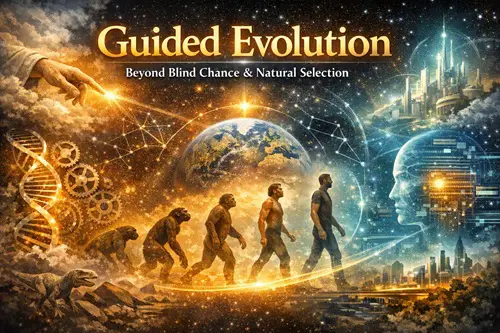 Since the publication of On the Origin of Species by Charles Darwin in 1859, evolutionary biology has largely been understood as an unguided process driven by variation, heredity, and natural selection. Random mutations arise; the environment filters them; populations gradually change over time. In this standard account, evolution has no foresight, intention, or direction beyond what natural processes produce. Yet many thinkers—particularly those sympathetic to religion, spirituality, or metaphysical philosophy—have found this picture unsatisfying. To them, the complexity of life, the emergence of consciousness, and the apparent directionality of biological history suggest some form of guidance or deeper organizing principle. Rather than rejecting evolution outright, they attempt to reinterpret it as guided, directed, or purpose-driven. Over the past century and a half, numerous models of guided evolution have been proposed. These differ widely in how explicit the guidance is, where it operates, and whether it is scientifically testable or purely metaphysical. What they share is the conviction that Darwinian evolution alone is incomplete. 1. Classical Theistic EvolutionOne of the earliest reconciliations of evolution and religion is theistic evolution. In this view, evolution is real but ultimately directed by God. This position is associated with many Christian theologians and institutions, including the modern stance of the Catholic Church. Figures such as Pierre Teilhard de Chardin integrated evolutionary science with a theological vision of cosmic progress toward divine fulfillment. Theistic evolution comes in several forms: • Front-loaded design: God sets up the initial conditions of the universe so that evolution inevitably produces life and intelligence. • Interventionist guidance: God occasionally influences mutations or evolutionary pathways. • Providential oversight: Evolution appears random but unfolds within divine providence. From a scientific standpoint, these proposals typically add no testable mechanisms, functioning instead as theological interpretations of natural processes. 2. Intelligent DesignA more explicit attempt to challenge unguided evolution is the Intelligent Design (ID) movement, associated with the Discovery Institute. Prominent proponents include: • Michael Behe • William Dembski • Stephen Meyer Intelligent Design argues that certain biological structures exhibit “irreducible complexity” or specified information that cannot plausibly arise through natural selection alone. Examples often cited include: • the bacterial flagellum • molecular machines • the origin of genetic information Unlike traditional creationism, Intelligent Design generally accepts common descent but claims that periodic design interventions were necessary to produce major evolutionary innovations. Critics argue that ID primarily relies on arguments from ignorance—asserting design wherever evolutionary explanations remain incomplete. 3. Orthogenetic EvolutionBefore modern genetics clarified the mechanisms of evolution, many biologists proposed orthogenesis—the idea that evolution follows intrinsic directional trends. Advocates believed that organisms possessed internal drives pushing them toward certain forms. Evolution was thus not merely shaped by natural selection but guided by built-in biological tendencies. Orthogenesis fell out of favor once the modern synthesis integrated genetics with Darwinian selection in the mid-20th century. However, the intuition that evolution has direction has continued to inspire later theories. 4. Cosmic Teleology and Spiritual EvolutionSome thinkers frame evolution as a cosmic spiritual process rather than a purely biological one. The most famous example is Pierre Teilhard de Chardin, who proposed that evolution moves toward increasing complexity and consciousness, culminating in the Omega Point—a unification of humanity and divinity. A similar modern interpretation appears in the work of Ken Wilber, whose Integral Theory posits a universal evolutionary drive called Eros pushing matter toward life, mind, and spirit. In these models: • Evolution has an intrinsic direction toward higher consciousness. • Biological evolution is only one expression of a broader cosmic developmental process. Critics argue that such proposals rely heavily on metaphysical interpretation rather than empirical evidence, projecting human notions of progress onto natural history. 5. Process TheologyInfluenced by the philosophy of Alfred North Whitehead, process theology offers another version of guided evolution. Here, God does not directly control events but persuasively influences the unfolding universe. Evolution becomes a collaborative process between natural processes and divine persuasion. In this framework: • randomness and contingency remain real • God gently nudges creation toward greater complexity and value Because this guidance operates at a metaphysical level, it again remains beyond empirical verification. 6. Panpsychist and Idealist EvolutionSome philosophers propose that evolution is guided by mind-like properties inherent in nature itself. In panpsychism, consciousness or proto-consciousness is present in all matter. Evolution therefore reflects the gradual organization and amplification of mind. Idealist philosophies go further, suggesting that mind is the fundamental reality, and evolution is simply the unfolding of consciousness through physical forms. Contemporary advocates sometimes argue that the rise of consciousness in evolution is too improbable to be purely accidental, implying an underlying mental principle shaping biological development. 7. Fine-Tuning and Front-Loaded EvolutionAnother variation shifts guidance from biology to cosmology. According to this view, the universe itself appears fine-tuned for life. If the laws and constants of physics were slightly different, life might never have emerged. Advocates therefore propose front-loaded evolution: • The universe is designed with life-permitting constants. • Evolution then unfolds naturally within those parameters. Guidance occurs at the level of the initial conditions of the cosmos, not through later biological intervention. 8. Simulation and Algorithmic GuidanceA modern technological twist proposes that the universe may be a simulation run by advanced intelligence. If reality is computational, then evolution could be guided by the underlying program—either through initial coding or ongoing adjustments. While highly speculative, this idea illustrates how the intuition of guided evolution continues to adapt to contemporary intellectual frameworks. 9. Why Guided Evolution PersistsDespite the success of Darwinian biology, guided evolution remains attractive for several reasons. 1. The intuition of progressMany people perceive evolution as moving from simple to complex, unconscious to conscious, suggesting a directional process. 2. The improbability argumentComplex biological structures and the emergence of intelligence appear improbable, leading some to suspect deeper design. 3. Existential meaningUnguided evolution implies that humanity is a contingent byproduct of natural processes. Guided evolution restores a sense of cosmic purpose. 4. Religious reconciliationFor believers who accept scientific evidence, guided evolution provides a way to preserve faith while acknowledging evolutionary biology. 10. The Scientific ChallengeFrom a strictly scientific perspective, guided evolution faces a fundamental difficulty: testability. Evolutionary biology already explains adaptation through mechanisms such as: • mutation • natural selection • genetic drift • gene flow • developmental constraints To demonstrate guidance, one would need evidence of systematic direction beyond these mechanisms. So far, no empirical method has reliably detected such guidance. As a result, most forms of guided evolution function primarily as philosophical or theological interpretations layered on top of evolutionary science, rather than alternative scientific theories. ConclusionThe idea of guided evolution has taken many forms: divine providence, intelligent design, cosmic teleology, spiritual Eros, process theology, panpsychist development, and cosmological fine-tuning. Each attempts to reconcile the creative power of evolution with a sense that the universe is not merely the product of blind processes. Yet despite their diversity, these proposals share a common feature: they introduce purpose or direction that lies outside the explanatory framework of evolutionary biology. Whether such guidance exists remains a philosophical question rather than a scientific one. Evolutionary theory, as currently understood, operates successfully without invoking it. The impulse to see purpose in evolution may therefore tell us less about biology itself than about the enduring human desire to find meaning and direction in the story of life.
Widget is loading comments...
|