|
TRANSLATE THIS ARTICLE
Integral World: Exploring Theories of Everything
An independent forum for a critical discussion of the integral philosophy of Ken Wilber
  Frank Visser, graduated as a psychologist of culture and religion, founded IntegralWorld in 1997. He worked as production manager for various publishing houses and as service manager for various internet companies and lives in Amsterdam. Books: Ken Wilber: Thought as Passion (SUNY, 2003), and The Corona Conspiracy: Combatting Disinformation about the Coronavirus (Kindle, 2020). Frank Visser, graduated as a psychologist of culture and religion, founded IntegralWorld in 1997. He worked as production manager for various publishing houses and as service manager for various internet companies and lives in Amsterdam. Books: Ken Wilber: Thought as Passion (SUNY, 2003), and The Corona Conspiracy: Combatting Disinformation about the Coronavirus (Kindle, 2020).
Check out my other conversations with ChatGPT The Myth of Flatland's DullnessWhy Scientific Naturalism Is Often More Imaginative Than Spiritual MetaphysicsFrank Visser / ChatGPT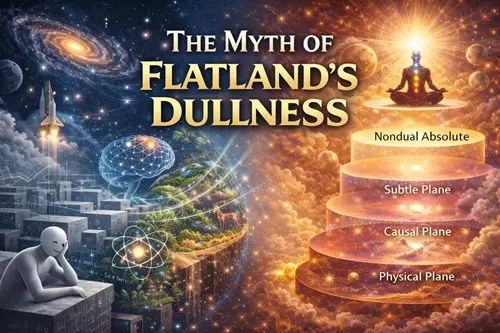 Within spiritual and integral circles, one frequently encounters a familiar criticism: modern scientific naturalism is dismissed as “flatland.” The term suggests a world reduced to surfaces—a reality stripped of depth, meaning, value, and spirit. According to this narrative, science offers only a gray mechanical universe, while spiritual philosophies restore richness by revealing deeper dimensions: subtle realms, cosmic purposes, and hidden layers of consciousness. Yet this accusation often turns out to be profoundly ironic. When examined closely, the supposedly “flat” scientific worldview is frequently far more imaginative, dynamic, and complex than the metaphysical cosmologies proposed to replace it. Meanwhile, many spiritual philosophies that promise depth end up presenting surprisingly schematic and simplistic pictures of reality. The contrast deserves careful examination. The Rhetoric of “Flatland”The term flatland became popular in contemporary spiritual discourse largely through the influence of Ken Wilber, who used it to describe modernity's alleged reduction of reality to the material domain. In Wilber's framing, modern science recognizes only the exterior surfaces of things—the measurable, observable, third-person world—while ignoring interior consciousness and higher spiritual realities. In this story, the modern worldview suffers from three major limitations: • reduction of mind to matter • denial of intrinsic meaning and value • blindness to spiritual dimensions of reality Spiritual and integral philosophies therefore present themselves as restorations of depth. They promise to reveal additional layers of reality—subtle energies, evolutionary drives like Eros, and transpersonal realms beyond the physical universe. To many readers, this narrative is compelling. Science appears austere and technical, while spiritual metaphysics offers a universe alive with purpose and mystery. But appearances can be misleading. The Astonishing Depth of the Scientific UniverseModern science, far from describing a dull universe, has revealed a cosmos of staggering richness and complexity. Consider just a few examples: Cosmic evolution. The universe began roughly 13.8 billion years ago in the event known as the Big Bang. From an initial state of extreme simplicity emerged galaxies, stars, planets, chemistry, biology, and eventually conscious beings capable of reflecting on the universe itself. Biological evolution. Through the mechanism described in On the Origin of Species by Charles Darwin, life diversified into millions of species through natural selection, genetic variation, and ecological interaction. Genomic complexity. Within each cell lies DNA containing billions of nucleotides organized into regulatory networks whose intricacy scientists are still deciphering. Neuroscience. The human brain contains roughly 86 billion neurons, connected through trillions of synapses, generating cognition, perception, language, and self-awareness. None of this is remotely “flat.” It is layered, emergent, historically structured, and astonishingly intricate. The scientific universe is not a static machine but an evolving system of staggering depth. Every new discovery—from quantum field dynamics to microbial ecosystems—adds further complexity to the picture. In fact, the deeper science investigates reality, the more unexpected structures it uncovers. The Surprising Flatness of Spiritual CosmologiesIronically, many spiritual cosmologies that claim to transcend flatland often describe reality in remarkably schematic terms. A typical model might divide the cosmos into a small number of ontological layers: • physical realm • subtle realm • causal realm • nondual absolute Each level is presented as more “refined” or “higher” than the previous one. Evolution is then interpreted as the progressive unfolding of consciousness through these stages. While such models appear profound at first glance, they often lack explanatory detail. Compared to the elaborate mechanisms uncovered by science, these metaphysical maps are frequently strikingly abstract. For example: • How exactly do subtle energies interact with physical processes? • Through what mechanisms does cosmic consciousness guide biological evolution? • How are spiritual realms connected to the measurable universe? These questions rarely receive clear answers. Instead, metaphysical explanations often rely on metaphor, analogy, or appeals to mystical insight. The result is a cosmology that feels deep rhetorically but remains thin conceptually. When Depth Becomes DecorationAnother feature of spiritual metaphysics is what might be called decorative depth. Complex terminology—subtle bodies, morphogenetic fields, involution, supermind—creates an impression of sophistication. Yet these concepts often function more as symbolic language than as empirically grounded explanatory frameworks. By contrast, scientific explanations must survive rigorous testing. Hypotheses must generate predictions, survive falsification attempts, and integrate with existing knowledge. This constraint forces scientific theories to become extraordinarily detailed. A single biological process—such as protein synthesis—requires hundreds of interacting molecular components. A single astrophysical model may involve precise equations describing gravitational dynamics, radiation transfer, and thermonuclear reactions. In short, science earns its depth the hard way. The Psychological Appeal of Metaphysical DepthWhy, then, does the myth of flatland remain so attractive? Part of the answer lies in existential psychology. Scientific explanations can feel impersonal. Natural selection, for example, describes adaptation without purpose or intention. The universe evolves through physical processes rather than cosmic plans. Spiritual metaphysics restores a sense of narrative: • evolution becomes the unfolding of Spirit • consciousness becomes the hidden ground of reality • the cosmos acquires a directional purpose Such interpretations offer emotional reassurance and existential meaning. They make the universe feel more intimate and purposeful. But psychological appeal should not be confused with explanatory depth. Flatland ReconsideredIronically, the perspective sometimes dismissed as “flatland” may actually be closer to what one might call epistemic humility. Scientific naturalism does not claim to possess final metaphysical answers. Instead, it constructs progressively refined models of reality based on observation, experimentation, and theoretical analysis. This approach has produced: • the modern understanding of cosmology • the theory of biological evolution • molecular biology and genetics • neuroscience and cognitive science Each of these domains reveals layers of complexity far exceeding the tidy metaphysical hierarchies often proposed by spiritual systems. From this standpoint, the charge of flatness may actually reflect a misunderstanding. Science does not deny depth; it discovers it. The Irony of the DebateThe real irony is that the roles are often reversed. Those who accuse science of flattening reality frequently rely on cosmologies that reduce the universe to a few metaphysical principles—Spirit, consciousness, or evolutionary Eros. The richness of natural processes becomes secondary to an overarching spiritual narrative. Science, meanwhile, uncovers an ever-expanding landscape of phenomena whose complexity resists simple metaphysical summarization. Far from flattening reality, the scientific worldview reveals a universe so intricate that our conceptual frameworks struggle to keep up. ConclusionThe stereotype of scientific naturalism as “flatland” collapses under closer inspection. Modern science describes a universe of extraordinary depth: billions of years of cosmic history, the intricate evolution of life, and the bewildering complexity of the brain. By contrast, many spiritual cosmologies that promise multidimensional richness often rely on relatively simple metaphysical schemas. This does not mean that questions of meaning, value, or consciousness are unimportant. But it does suggest that intellectual humility is warranted before declaring the scientific worldview shallow. The true wonder of reality may lie not in hidden spiritual dimensions, but in the endlessly unfolding complexity of the natural world itself—a universe whose depth continues to surprise us the more carefully we study it.
Widget is loading comments...
|