|
TRANSLATE THIS ARTICLE
Integral World: Exploring Theories of Everything
An independent forum for a critical discussion of the integral philosophy of Ken Wilber
  Frank Visser, graduated as a psychologist of culture and religion, founded IntegralWorld in 1997. He worked as production manager for various publishing houses and as service manager for various internet companies and lives in Amsterdam. Books: Ken Wilber: Thought as Passion (SUNY, 2003), and The Corona Conspiracy: Combatting Disinformation about the Coronavirus (Kindle, 2020). Frank Visser, graduated as a psychologist of culture and religion, founded IntegralWorld in 1997. He worked as production manager for various publishing houses and as service manager for various internet companies and lives in Amsterdam. Books: Ken Wilber: Thought as Passion (SUNY, 2003), and The Corona Conspiracy: Combatting Disinformation about the Coronavirus (Kindle, 2020).
Check out my other conversations with ChatGPT The Multiple Ways of Knowing ArgumentAnd the Inflation of MetaphysicsFrank Visser / ChatGPT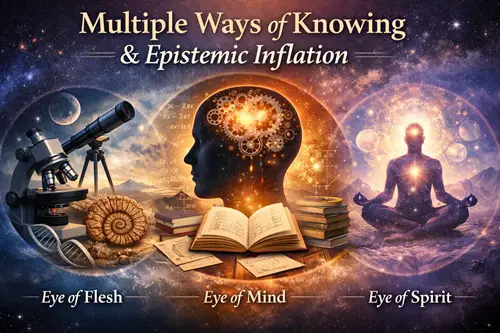 Debates about spirituality, science, and philosophy often turn on a familiar claim: that reality can be known through multiple ways of knowing. Proponents of metaphysical or spiritual worldviews frequently argue that modern science illegitimately restricts knowledge to third-person empirical observation, thereby ignoring other legitimate epistemic modes such as introspection, intuition, revelation, or contemplative insight. Once these alternative modes are admitted, the argument continues, spiritual metaphysics—cosmic purpose, evolutionary Eros, subtle realms, divine intelligence—can be treated as forms of knowledge rather than belief. At first glance, this seems reasonable. Human cognition clearly operates through several distinct modes: sensory perception, conceptual interpretation, and introspective awareness. Science itself depends on all three. But problems arise when these modes are mischaracterized and then used to justify sweeping claims about the structure of the cosmos. The key issue is not whether multiple ways of knowing exist—they obviously do—but what each mode can legitimately tell us. A careful analysis shows that the domains of perception, interpretation, and introspection are quite different. Confusing their boundaries creates the illusion that private experience can generate objective knowledge about cosmology or biological evolution. Three Basic Knowledge Domains1. Perception: Knowledge of the External WorldPerception refers to sensory engagement with the external environment. Through vision, hearing, touch, and instrumental extensions of those senses (microscopes, telescopes, particle detectors), humans gather data about physical processes. Perception provides the empirical foundation for disciplines such as physics, chemistry, biology, and astronomy. Importantly, perceptual knowledge is: • Publicly observable – others can examine the same phenomena. • Repeatable – observations can be replicated. • Correctable – errors can be identified through independent verification. Scientific knowledge emerges when perceptual observations are organized through experiment and measurement. The critical limitation of perception is that it deals with observable processes. It can reveal evolutionary mechanisms, ecological interactions, planetary motion, or neural activity. But it does not directly disclose meanings, values, or subjective experience. 2. Interpretation: Conceptual UnderstandingInterpretation refers to the conceptual frameworks used to make sense of perceptual data. Scientific theories, philosophical models, historical narratives, and cultural explanations all belong here. Interpretation operates through reasoning, modeling, and inference. Evolutionary theory, for example, interprets biological data through concepts such as natural selection, mutation, genetic drift, and ecological adaptation. Unlike perception, interpretation involves abstraction. It constructs explanatory frameworks that link observed facts into coherent systems. These frameworks can be evaluated by criteria such as: • explanatory power • internal consistency • predictive success • empirical fit Importantly, interpretation does not generate data by itself. It organizes and explains perceptual evidence. When metaphysical systems claim authority over empirical questions—such as the mechanisms of evolution—they often exceed the legitimate role of interpretation by introducing explanatory entities that lack empirical grounding. 3. Introspection: Knowledge of Subjective ExperienceIntrospection refers to the direct awareness individuals have of their own mental states: thoughts, emotions, sensations, and states of consciousness. Meditative traditions have refined introspective practices for centuries, exploring attention, awareness, and altered states of consciousness. Such practices can yield valuable insights into: • phenomenology of perception • emotional processes • cognitive habits • states of concentration or absorption However, introspection provides first-person knowledge only. It reveals how experience feels, not how the universe is structured. A meditator may experience profound unity with reality, boundless compassion, or a sense of cosmic intelligence. These experiences are psychologically real and often transformative. But they do not constitute empirical evidence about cosmology, evolutionary biology, or physics. Confusing phenomenological insight with ontological knowledge is the central epistemic error. Wilber's Original Clarification: The Three Eyes of KnowingIronically, the need to distinguish these domains was already recognized by Ken Wilber himself in his early epistemological model known as the “Three Eyes of Knowing.” Drawing on medieval philosophy, Wilber distinguished three forms of cognition: • Eye of Flesh – sensory perception of the physical world • Eye of Mind – rational and conceptual thought • Eye of Spirit – contemplative or mystical awareness The purpose of this model was precisely to prevent the kinds of category mistakes discussed above. Each “eye” was meant to have its own proper domain and its own validation procedures. Wilber repeatedly emphasized that the eyes should not be confused: •The Eye of Flesh investigates the empirical world through observation and experiment. •The Eye of Mind develops theories, mathematics, and philosophical reasoning. •The Eye of Spirit explores interior states through contemplative practice. In principle, this framework was a sophisticated epistemological safeguard. It recognized the legitimacy of spiritual experience without allowing it to intrude into empirical science. Wilber even criticized what he called the “category error” of trying to prove spiritual realities through sensory evidence or scientific instrumentation. Mystical insight, he argued, must be validated through contemplative practice rather than laboratory experiments. However, a tension gradually emerged within his own system. While the Three Eyes were intended to maintain clear epistemic boundaries, Wilber's later writings increasingly treated contemplative insight as revealing truths about the structure of the cosmos itself—including evolutionary directionality, subtle realms of existence, and spiritual forces guiding complexity. At that point the original epistemological firewall began to collapse. The Eye of Spirit, originally confined to the domain of subjective realization, was implicitly granted authority to describe objective cosmological processes. In other words, the very model designed to prevent epistemic inflation became the platform from which metaphysical claims about evolution and the universe were advanced. How “Multiple Ways of Knowing” Becomes Epistemic InflationThe problem arises when advocates collapse the distinctions between these domains. The typical pattern unfolds in three steps. Step 1: Legitimate Recognition of Interior ExperienceThe argument begins by correctly noting that human knowledge includes subjective experience and introspective awareness. Science does not exhaust all forms of human understanding. This step is unobjectionable. Step 2: Elevation of Introspection to Equal Epistemic AuthorityNext, introspection is treated as an epistemic method capable of revealing truths about reality comparable to those produced by empirical science. At this point the boundaries blur. Private experiences are interpreted as insights into the fundamental nature of the cosmos. Step 3: Metaphysical ProjectionFinally, interpretations of these experiences are projected outward as claims about objective reality: • the universe evolves through a spiritual force (Eros) • consciousness drives biological evolution • subtle realms guide material processes • cosmic intelligence directs complexity These claims move far beyond what introspection can establish. They transform subjective meaning into cosmological fact. Evolution as a Case StudyThe misuse of multiple ways of knowing becomes particularly clear in discussions of evolution. Biological evolution is studied through: • fossils • genetics • comparative anatomy • population biology • ecological dynamics These are perceptual data interpreted through evolutionary theory. When metaphysical systems claim that evolution is driven by an intrinsic cosmic Eros or spiritual impulse, they are not adding a new “way of knowing.” They are introducing an interpretive narrative that lacks empirical support. Such narratives often arise from introspective experiences of unity or purpose. But a feeling that the universe is meaningful does not demonstrate that biological complexity is guided by a cosmic intelligence. This move effectively reintroduces teleology into evolution without empirical evidence. The Psychological Power of Interior ExperienceWhy does this confusion persist? Because introspective experiences can be extraordinarily convincing. Mystical states often produce powerful feelings of certainty, unity, and revelation. From within the experience, it may seem obvious that one has perceived ultimate reality. But psychology provides alternative explanations. Altered states of consciousness can produce profound emotional and cognitive shifts without corresponding changes in the external world. In other words: the intensity of an experience does not determine the scope of its truth. A powerful inner realization may transform a person's life while still remaining a psychological event rather than a cosmological discovery. A Modest EpistemologyRecognizing multiple ways of knowing does not require abandoning epistemic discipline. A more modest framework would acknowledge the distinct contributions of each domain:
Each domain produces legitimate knowledge within its proper scope. Problems arise only when one domain claims authority over questions belonging to another. Introspection cannot determine evolutionary mechanisms, just as microscopes cannot measure the meaning of a poem. The Appeal of Cosmic MeaningMetaphysical inflation often reflects a deeper human desire: the wish that the universe itself embodies the values we experience inwardly. Feelings of unity, compassion, or transcendence are interpreted as evidence that reality itself is structured around these principles. This move transforms existential meaning into metaphysical doctrine. But meaning may arise from the human mind interacting with the world rather than from cosmic design. Recognizing this possibility does not diminish the value of spiritual experience. It simply locates such experience within the psychological and cultural domains where it can be studied without projecting it onto the entire universe. ConclusionThe claim that knowledge arises through multiple ways of knowing is correct but frequently misapplied. Perception, interpretation, and introspection are distinct epistemic tools, each suited to different questions. Perception reveals the structure of the external world. Interpretation organizes that information into explanatory frameworks. Introspection illuminates the landscape of subjective experience. Ironically, even Wilber's original Three Eyes of Knowing were designed to safeguard these distinctions. When those boundaries are respected, the different modes of knowing complement one another. When they are blurred, introspective insights are inflated into cosmological doctrines and spiritual metaphysics masquerades as knowledge about evolution or the universe. The real challenge is not defending science against spirituality, or spirituality against science. It is maintaining epistemic clarity about what each way of knowing can—and cannot—legitimately reveal.
Widget is loading comments...
|