|
TRANSLATE THIS ARTICLE
Integral World: Exploring Theories of Everything
An independent forum for a critical discussion of the integral philosophy of Ken Wilber
  Frank Visser, graduated as a psychologist of culture and religion, founded IntegralWorld in 1997. He worked as production manager for various publishing houses and as service manager for various internet companies and lives in Amsterdam. Books: Ken Wilber: Thought as Passion (SUNY, 2003), and The Corona Conspiracy: Combatting Disinformation about the Coronavirus (Kindle, 2020). Frank Visser, graduated as a psychologist of culture and religion, founded IntegralWorld in 1997. He worked as production manager for various publishing houses and as service manager for various internet companies and lives in Amsterdam. Books: Ken Wilber: Thought as Passion (SUNY, 2003), and The Corona Conspiracy: Combatting Disinformation about the Coronavirus (Kindle, 2020).
Check out my other conversations with ChatGPT What Happened to Secularization?Is Religion on the Way Back?Frank Visser / ChatGPT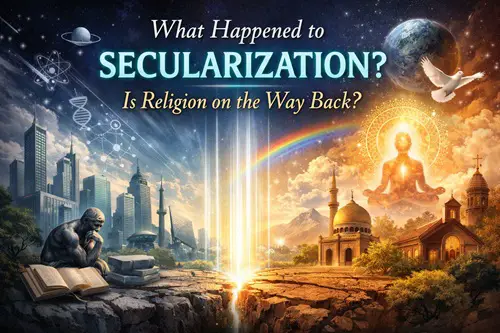 The secularization thesis—once a dominant assumption in sociology, political science, and philosophy—held that modernization inevitably pushes religion from public life into private spheres. Industrialization, urbanization, scientific progress, and expanded education were expected to reduce religious authority and diminish its social and political influence. By the late twentieth century, this view seemed widely accepted in the West: modern societies would become increasingly secular, and religion would retreat to the margins. Yet, contemporary developments suggest that the story is far more complicated. Far from disappearing, religion is reasserting itself in multiple arenas, from politics to social movements to cultural identity. The Rise, Challenge, and Limits of SecularizationClassical theorists like Max Weber and Émile Durkheim framed secularization as an almost inevitable outcome of rationalization and modernization. Peter Berger, a key twentieth-century sociologist, initially embraced this view, arguing that modernity undermines the plausibility of religious worldviews. The state, science, and markets were expected to replace the moral and social functions of religion. However, empirical reality has repeatedly challenged this linear trajectory. Berger himself later revised his thesis, acknowledging that religion persists robustly in modern societies, sometimes in adapted or revitalized forms. Historical and contemporary examples demonstrate the limits of secularization. The Iranian Revolution of 1979 showed how modernization could actually amplify religious mobilization rather than diminish it. Similarly, the rise of evangelical movements in the United States, Hindu nationalism in India, and political Islam across parts of the Middle East illustrate that religion retains deep institutional, cultural, and political power. Globalization has further complicated the picture: exposure to diverse religious ideas and transnational networks often strengthens rather than weakens faith. Rather than disappearing, religion has transformed, sometimes retreating from formal institutions while flourishing in civil society, media, and personal identity. The Rise of the “Nones” in the WestWhile religion persists globally, Western societies have seen significant growth in the proportion of people identifying as religiously unaffiliated, often called the “Nones.” In the United States, Pew Research Center data indicates that the share of adults claiming no religious affiliation rose from about 16% in 2007 to nearly 29% in 2020. Similar trends appear across Europe, where countries like Sweden, the Netherlands, and the Czech Republic report 40-60% of adults as unaffiliated. The rise of the Nones represents a complex phenomenon. Many of these individuals retain spiritual beliefs or practices, engage in moral and communal activities traditionally associated with religion, or adopt hybrid forms of spiritual expression. In other words, secularization in the West is often a shift in religious form rather than an outright disappearance. The growth of the Nones reflects changes in identity, institutional trust, and cultural norms, but it does not eliminate the role of religion in shaping values, social cohesion, or political discourse. Religion's Resurgence in Modern ContextsSeveral dynamics explain religion's persistence or resurgence outside Europe and the U.S. First, religion continues to provide social cohesion, moral frameworks, and a sense of existential meaning that secular ideologies struggle to supply. Second, religious institutions often adapt creatively to modernity, leveraging media, education, and digital technologies to maintain relevance. Third, in contexts of social upheaval or perceived moral crisis, religion can function as a powerful mobilizing force, as seen in Iran, the U.S. culture wars, or the resurgence of Orthodox Christianity in post-Soviet Russia. Finally, the symbolic and narrative power of religion—the stories, rituals, and moral exemplars it provides—often outlasts political or economic structures. In some cases, secularization appears selective rather than absolute. While Western Europe exhibits lower levels of formal religiosity, moral and cultural influence often remains high. People may reject institutional religion while maintaining spiritual practices or invoking religious language in public debates. Conversely, societies experiencing rapid modernization without political liberalization, such as parts of the Middle East, Asia, and Africa, often see a fusion of modernity with intensified religiosity. This suggests that secularization is not a universal law but a historically contingent process shaped by political, social, and cultural contexts. Ken Wilber and “The Religion of Tomorrow”Ken Wilber, in The Religion of Tomorrow, frames religion not as a static set of beliefs or rituals but as an evolving structure of consciousness and moral development. He argues that traditional religions often serve as vehicles for spiritual growth and social cohesion, but they can become rigid, dogmatic, or corrupt when isolated from reason, science, or pluralistic awareness. Wilber envisions a “post-modern” religious consciousness that integrates the ethical, symbolic, and transcendent dimensions of traditional faith with rational inquiry, scientific understanding, and global awareness. From Wilber's perspective, the apparent decline of religion in some societies—such as the rise of the Nones in the West—is not a disappearance of spiritual potential but a transformation of its form. Religion must evolve to remain relevant, synthesizing mysticism, moral insight, and empirical knowledge. He sees the future of religion as multidimensional: fostering personal awakening, ethical responsibility, and a recognition of the interdependence of all life, while avoiding the pitfalls of literalism, authoritarianism, and cultural chauvinism. In this sense, the “return” of religion is less a reversal of secularization than a metamorphosis—a reassertion of spiritual structures adapted to contemporary consciousness. Implications and ConclusionThe presumed inevitability of secularization has not held. Religion continues to shape societies in subtle and profound ways, even in ostensibly secular contexts. What has changed is not the disappearance of religion but its forms, expressions, and modalities of influence. From Wilber's integrative vision to the political and cultural resurgences observed globally, the evidence suggests that religion is far from finished; it is adapting, persisting, and in some cases, intensifying. In the West, the rise of the Nones signals a shift in affiliation rather than the end of religious or spiritual influence. Globally, religion remains a mobilizing, legitimizing, and meaning-making force. Modern societies may not become post-religious; instead, they are witnessing a reconfiguration of religious life, one that challenges assumptions about the linear decline of faith and opens new possibilities for spiritual engagement in the twenty-first century. In the end, secularization, once a confident prediction, now appears contingent and historically limited. Religion is neither disappearing nor static—it is transforming, evolving, and finding new forms of influence in modern societies.
Comment Form is loading comments...
|