|
TRANSLATE THIS ARTICLE
Integral World: Exploring Theories of Everything
An independent forum for a critical discussion of the integral philosophy of Ken Wilber
  Frank Visser, graduated as a psychologist of culture and religion, founded IntegralWorld in 1997. He worked as production manager for various publishing houses and as service manager for various internet companies and lives in Amsterdam. Books: Ken Wilber: Thought as Passion (SUNY, 2003), and The Corona Conspiracy: Combatting Disinformation about the Coronavirus (Kindle, 2020). Frank Visser, graduated as a psychologist of culture and religion, founded IntegralWorld in 1997. He worked as production manager for various publishing houses and as service manager for various internet companies and lives in Amsterdam. Books: Ken Wilber: Thought as Passion (SUNY, 2003), and The Corona Conspiracy: Combatting Disinformation about the Coronavirus (Kindle, 2020).
Check out my other conversations with ChatGPT DNA, Information, and the Limits of NaturalismFrank Visser / ChatGPT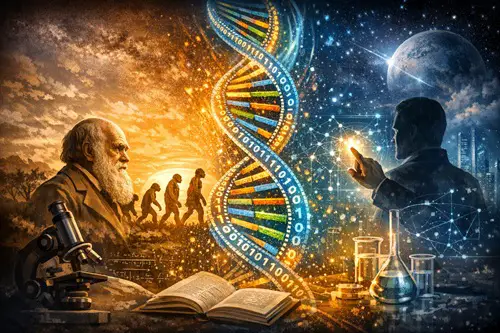 Few topics generate as much heat at the science-religion interface as the claim that DNA is “too information-rich” to have arisen by natural means. The intuitive force of the argument is obvious: if DNA resembles a language or computer code, and codes come from minds, then perhaps biology points beyond nature. This essay dissects that inference with conceptual and empirical precision. 1. What Does It Mean to Say DNA Contains “Information”?The structure of DNA, elucidated by James Watson and Francis Crick in 1953, revealed a polymer composed of four nucleotide bases arranged in sequences. These sequences encode proteins via the genetic code. But “information” is a multivalent concept. At least three distinct notions are relevant: • Shannon information - statistical unpredictability in a sequence. • Algorithmic information - compressibility or minimal description length. • Functional (biological) information - sequences that achieve a specified biochemical function. Confusion arises when these are conflated. A random string has high Shannon information but no function. A highly repetitive string has low Shannon information but also little function. Functional biological information occupies a narrow region: sequences that are both specific and operational within cellular machinery. 2. The Design Argument from InformationProponents of intelligent design, such as William Dembski and Stephen Meyer, argue that functional information in DNA is “specified complexity” that cannot arise from undirected processes. Since minds produce code, and DNA resembles code, the inference to a designing intelligence appears warranted. Meyer, in particular, emphasizes that DNA stores digitally encoded information analogous to software. Because natural laws generate regularity and chance generates randomness, neither, he argues, can produce specified sequences required for life. The force of this argument depends on two assumptions: • That natural processes cannot generate new functional information. • That analogy to human language or code licenses inference to a mind. Both assumptions are contentious. 3. Natural Mechanisms That Generate Genetic InformationMainstream evolutionary biology, grounded in the framework of Charles Darwin, proposes a non-teleological explanation: variation plus selection over vast timescales can produce the appearance of design. Key mechanisms include: MutationRandom changes in nucleotide sequences introduce novelty. Gene DuplicationEntire genes are copied. One copy maintains original function; the other is free to accumulate mutations and potentially acquire new function. This is a powerful source of increased genomic complexity. Recombination and Horizontal Gene TransferEspecially in prokaryotes, genetic material can be exchanged, rapidly spreading functional innovations. Natural SelectionSelection is not random. It systematically retains variants that enhance replication within a given environment. In information-theoretic terms, mutation introduces variation (entropy), while selection acts as a filter, increasing functional information relative to environmental constraints. The process is cumulative and non-random in its retention phase. 4. Does Natural Selection Create Information?A persistent objection claims that natural selection can only “select” existing information, not create it. However, this presupposes a static informational landscape. Consider a simple model: if a random mutation slightly improves enzyme efficiency, selection amplifies that variant. The genome now contains a configuration that was statistically improbable prior to selection. Functional information relative to environmental demands has increased. In Shannon terms, the genome may not drastically increase in raw entropy. But in functional terms—defined relative to survival constraints—it absolutely can. Evolutionary biologists such as Richard Dawkins have emphasized cumulative selection as the key to escaping pure randomness. A single-step assembly of a complex protein is astronomically unlikely. But stepwise selection across intermediate functional states dramatically alters the probability landscape. 5. The Origin of the First InformationThe harder problem is abiogenesis: how did the first self-replicating informational molecules arise before Darwinian evolution? Research into an RNA world—where RNA molecules both store information and catalyze reactions—suggests plausible pathways. Catalytic ribozymes demonstrate that functional sequences can emerge from random RNA pools under selective laboratory conditions. Prebiotic chemistry does not require foresight. It requires: • Chemical diversity. • Energy gradients. • Cycles of concentration and selection (e.g., wet-dry cycles, hydrothermal systems). Here, selection operates at a chemical level prior to biology. Certain molecular configurations persist because they are more stable or autocatalytic. Complexity can accumulate without intentional agency. This research area remains incomplete, but “not yet fully explained” does not entail “in principle inexplicable.” 6. The Analogy to Human Codes: Misleading or Insightful?DNA is often compared to computer code. Yet this analogy can mislead. Computer code presupposes: • An external programmer. • A predefined architecture. • Symbolic conventions independent of physics. DNA, by contrast: • Is chemically instantiated. • Emerges from self-replicating systems. • Has no external interpreter; the cellular machinery co-evolved with the code. The “genetic code” itself likely evolved gradually, rather than being imposed fully formed. The analogy to software is heuristic, not ontological. 7. Probability and Deep TimeObjections often rely on astronomical improbability calculations. However, such calculations typically assume: • A single-step assembly. • Uniform random sampling. • No intermediate selection. Evolution violates these assumptions. It is a path-dependent search through adjacent possibilities, guided by selection constraints and historical contingencies. Over billions of years, cumulative processes can traverse highly improbable regions of configuration space. The age of Earth (~4.5 billion years) and the scale of microbial populations dramatically amplify search capacity. 8. Philosophical UndercurrentsThe debate is not purely scientific; it is metaphysical. Methodological naturalism restricts explanation to natural causes. Theistic or teleological views interpret biological information as evidence of purpose. Some philosophers argue that information is inherently mental, thus pointing beyond physics. Others maintain that information is relational—arising whenever physical states correlate reliably with environmental states. Whether one sees DNA as evidence of divine intelligence or emergent complexity often reflects prior commitments about mind, matter, and causation. Conclusion: Is DNA Too Informational for Nature?DNA is indeed staggeringly information-rich. But evolutionary theory provides mechanisms—mutation, duplication, recombination, and selection—that can, in principle and in observed practice, increase functional information over time. The design inference depends on extending an analogy between biological and human codes beyond its evidential warrant. While the origin of life remains an open scientific frontier, no established principle in physics or information theory forbids the natural emergence of biological information. The deeper question is not whether DNA contains information—it does—but whether information necessarily implies intention. Current evolutionary biology answers: no. The debate persists not because science has failed, but because information straddles biology, philosophy, and theology in ways that guarantee enduring controversy.
Widget is loading comments...
|