|
TRANSLATE THIS ARTICLE
Integral World: Exploring Theories of Everything
An independent forum for a critical discussion of the integral philosophy of Ken Wilber
  Frank Visser, graduated as a psychologist of culture and religion, founded IntegralWorld in 1997. He worked as production manager for various publishing houses and as service manager for various internet companies and lives in Amsterdam. Books: Ken Wilber: Thought as Passion (SUNY, 2003), and The Corona Conspiracy: Combatting Disinformation about the Coronavirus (Kindle, 2020). Frank Visser, graduated as a psychologist of culture and religion, founded IntegralWorld in 1997. He worked as production manager for various publishing houses and as service manager for various internet companies and lives in Amsterdam. Books: Ken Wilber: Thought as Passion (SUNY, 2003), and The Corona Conspiracy: Combatting Disinformation about the Coronavirus (Kindle, 2020).
Check out my other conversations with ChatGPT Transcendent NaturalismA Conceptual Hybrid Under StrainFrank Visser / ChatGPT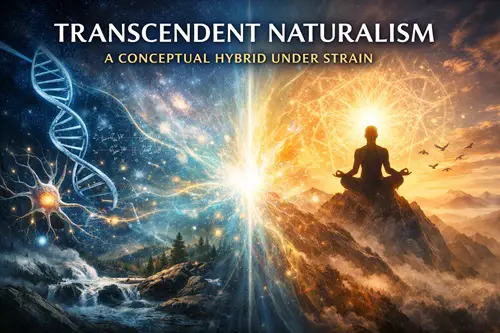 In integral-adjacent discourse—especially in the wake of debates around post-materialism, panpsychism, and evolutionary spirituality—the phrase “transcendent naturalism” appears with increasing frequency. It functions rhetorically as a bridge: an attempt to affirm scientific credibility (“naturalism”) while preserving spiritual depth (“transcendence”). Yet on inspection, the term carries an internal tension that demands careful analysis. Is it a sophisticated synthesis—or a category mistake dressed in conciliatory language? This essay clarifies what “transcendent naturalism” can mean, distinguishes its variants, and assesses whether the concept is coherent or merely strategic. I. What Is Naturalism?In philosophy, naturalism typically denotes the thesis that reality consists exclusively of natural processes and entities. There are several forms: • Methodological naturalism – Science limits itself to natural causes. • Metaphysical (ontological) naturalism – Only natural entities exist. • Scientific naturalism – Reality is exhaustively describable in terms of physics, chemistry, and biology (sometimes reductively). Classical defenders include figures such as W.V.O. Quine and Daniel Dennett, who reject appeals to supernatural causes while allowing for emergent complexity within nature. Crucially, traditional naturalism denies supernatural transcendence—no divine realm, no ontologically separate spiritual domain. II. What Is Transcendence?“Transcendence” can mean several things: • Epistemic transcendence – Limits of current knowledge. • Emergent transcendence – Higher-order properties arising from lower-level processes. • Metaphysical transcendence – A realm or principle beyond nature. • Experiential transcendence – Mystical or altered states of consciousness. When integral thinkers use “transcendent,” they rarely mean supernaturalism in a crude theological sense. Instead, they often refer to evolutionary self-surpassing—complexification, interior depth, or spiritual realization. Yet the ambiguity is decisive: if transcendence means “beyond nature,” the phrase contradicts naturalism. If it means “beyond previous levels within nature,” the contradiction evaporates. III. Three Versions of “Transcendent Naturalism”The phrase functions differently depending on which of the above senses are intended. 1. Emergentist Naturalism (Coherent Version)Here, transcendence means emergence. Mind transcends matter in organizational complexity but not in substance. Example: Terrence Deacon describes life and mind as emergent properties arising from thermodynamic constraints. Stuart Kauffman speaks of self-organization and adjacent possible states without invoking supernatural agency. In this interpretation, transcendence is internal to nature—complexity rising from simplicity. There is no ontological breach. This is entirely compatible with naturalism. But note: here “transcendent naturalism” reduces to non-reductive naturalism. The term adds rhetorical uplift, not new ontology. 2. Immanent Spiritual Naturalism (Borderline Case)Some thinkers—e.g., Ursula Goodenough or Philip Clayton—retain naturalism while interpreting nature itself as sacred. The divine is not outside nature but synonymous with its creative depth. This resembles Spinozist monism (though without strict geometric metaphysics). “Transcendence” becomes a poetic term for the inexhaustibility of natural process. Here, the tension softens because transcendence is redefined as immanent depth. Nature is “more than” mechanistic description, but nothing exists beyond it. Still, critics may argue that the language of transcendence smuggles metaphysical surplus into an otherwise naturalistic framework. 3. Evolutionary Eros (Contradictory Version)In integral spirituality, especially in the work of Ken Wilber and popularizers like Bobby Azarian, transcendence sometimes implies a directional drive in evolution—an intrinsic telos toward complexity, consciousness, or Spirit. If this “Eros” functions as: • A lawful tendency reducible to thermodynamics and selection ? still naturalism. • A quasi-intentional cosmic force guiding evolution ? metaphysical transcendence. The latter crosses the boundary. Once a purposive principle irreducible to physical causation is posited, naturalism is no longer intact. This is where critics detect equivocation: the language oscillates between scientific emergence and metaphysical teleology. IV. The Logical TensionThe contradiction depends on definitions: • If “transcendent” = beyond the natural order ? incompatible with naturalism. • If “transcendent” = emergent within the natural order ? redundant with non-reductive naturalism. Thus, “transcendent naturalism” often performs a rhetorical maneuver: It signals distance from reductionism without admitting supernaturalism. The phrase reassures both camps: • To scientists: “We remain naturalists.” • To spiritual audiences: “There is more than flat materialism.” Whether this is philosophical precision or diplomatic ambiguity is the key question. V. Why the Term Appeals to Integral CirclesIntegral discourse seeks synthesis. It rejects: • Flat reductionism (“nothing but atoms”). • Traditional supernatural dualism. “Transcendent naturalism” promises a third way: evolution as self-surpassing, consciousness as intrinsic to cosmos, Spirit as emergent rather than imposed. It fits well with: • Developmental stage models. • Complexity science. • Narrative accounts of cosmic unfolding. But the conceptual risk is inflation. When “transcendence” becomes a metaphysical placeholder for what science has not yet explained, it begins to resemble a secularized vitalism. VI. A Diagnostic FrameworkTo evaluate any claim of transcendent naturalism, ask: Ontological Question Does it posit entities or forces irreducible to natural causation? Teleological Question Is evolution described as directionally necessary or statistically contingent? Explanatory Sufficiency Could the same phenomena be explained using existing scientific frameworks without metaphysical supplementation? If the answer to (1) is yes, naturalism has been abandoned. If no, the transcendence is metaphorical or emergent. VII. Conclusion: Synthesis or Semantic Strategy?“Transcendent naturalism” is not inherently incoherent—but it is unstable. • In its strongest metaphysical sense, it contradicts naturalism. • In its weakest emergent sense, it adds little beyond complexity theory. • In its rhetorical middle ground, it functions as a boundary concept—gesturing toward spiritual depth without committing to supernatural ontology. The burden lies on its proponents to specify: Is transcendence a poetic description of emergent complexity? Or an ontologically distinct principle? Until that is clarified, the term remains suspended between precision and persuasion—a hybrid under philosophical strain.
Widget is loading comments...
|