|
TRANSLATE THIS ARTICLE
Integral World: Exploring Theories of Everything
An independent forum for a critical discussion of the integral philosophy of Ken Wilber
  Frank Visser, graduated as a psychologist of culture and religion, founded IntegralWorld in 1997. He worked as production manager for various publishing houses and as service manager for various internet companies and lives in Amsterdam. Books: Ken Wilber: Thought as Passion (SUNY, 2003), and The Corona Conspiracy: Combatting Disinformation about the Coronavirus (Kindle, 2020). Frank Visser, graduated as a psychologist of culture and religion, founded IntegralWorld in 1997. He worked as production manager for various publishing houses and as service manager for various internet companies and lives in Amsterdam. Books: Ken Wilber: Thought as Passion (SUNY, 2003), and The Corona Conspiracy: Combatting Disinformation about the Coronavirus (Kindle, 2020).
Check out my other conversations with ChatGPT The Narcissism of Cosmic PurposeWhy the Universe Owes Us NothingFrank Visser / ChatGPT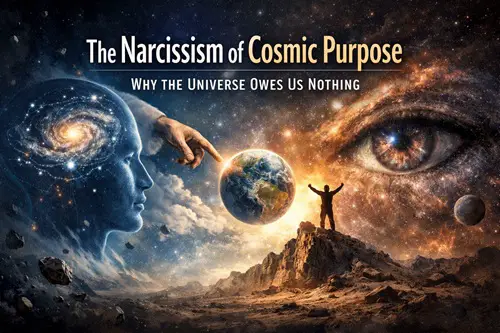 There is a peculiar arrogance hiding in some of our loftiest metaphysical systems. It is the quiet assumption that the universe has been building toward us. That evolution was not merely a blind, contingent process, but a meaningful ascent. That consciousness is not an accident, but the point. Whether dressed in biblical language, process theology, panpsychism, or the more esoteric metaphysics of Ken Wilber, the narrative is strikingly similar: the cosmos is going somewhere. Matter becomes life, life becomes mind, mind becomes spirit. The universe awakens to itself. We are the leading edge of that awakening. This story flatters us. And that is precisely why we should distrust it. From Genesis to Eros: Same Plot, New VocabularyIn traditional theism, the universe unfolds according to divine design. In process philosophy, it is lured by a divine aim. In Integral metaphysics, it is animated by Eros—an intrinsic drive toward greater complexity and consciousness. Different terminology, same teleological spine. The old creationist narrative said: God made man in His image. The updated spiritual-evolutionary narrative says: The cosmos evolves into self-awareness. Either way, we end up at center stage. The language has changed. The narcissism remains. The Smuggling of “Higher” and “Lower”Evolutionary biology, strictly speaking, has no concept of “higher.” There is adaptation, mutation, selection, drift. Bacteria are not “less evolved” than humans; they are exquisitely adapted survivors. In fact, they will likely outlive us. Yet spiritual interpreters quietly reinsert vertical value. Complexity becomes superiority. Consciousness becomes depth. Human self-reflection becomes a cosmic achievement. The move is subtle but decisive: descriptive complexity is transmuted into normative ascent. But complexity is not destiny. It is just one branch on a sprawling phylogenetic bush. The vast majority of life has remained simple for billions of years. If there is a “direction” in evolution, it is toward whatever survives—nothing more. Wilber and Azarian: Teleology in Two RegistersThe contemporary spiritual-evolutionary scene offers two influential variations on the cosmic-purpose theme: the grand metaphysical architecture of Ken Wilber and the narrative-driven evolutionary optimism of Bobby Azarian. Wilber's position is explicit. Evolution is propelled by Eros—Spirit-in-action—pressing matter toward life, life toward mind, mind toward supermind. He rejects crude creationism, but he refuses reductionism with equal force. For him, the emergence of increasing depth cannot be explained by chance and selection alone; it reflects an intrinsic Kosmic drive. Teleology is not abandoned; it is interiorized and spiritualized. Azarian operates in a more cultural and psychological register. In works like The Romance of Reality, evolution is framed as a meaningful epic. Humanity stands at a threshold: self-aware evolution. The cosmos has given birth to beings who can consciously participate in its unfolding. The language is less metaphysically technical than Wilber's, but the narrative arc is unmistakable—direction, deepening, awakening. The difference is stylistic. The common denominator is purposive ascent. Both accounts pivot on a crucial interpretive leap: from the fact of increasing complexity in certain lineages to the claim of intrinsic directionality. From emergence to intention. From pattern to plan. But nothing in evolutionary biology requires that leap. Natural selection plus thermodynamics plus time is sufficient to explain why complexity sometimes increases in open systems. Once replication with variation exists, cumulative selection can generate staggering intricacy without foresight. To infer cosmic intention from emergent order is to repackage awe as ontology. Wilber embeds purpose in the fabric of the Kosmos. Azarian embeds it in the story we tell about evolution. In both cases, humanity becomes evolution's self-conscious vanguard. The universe, once again, seems to have been heading somewhere—and that somewhere looks suspiciously like us. The Psychological Engine Beneath the MetaphysicsWhy, then, does the idea of cosmic purpose grip us so tightly? Because contingency is terrifying. A universe that produced us accidentally can erase us accidentally. A purposeless cosmos offers no guarantees, no moral arc, no metaphysical applause. We want the story to culminate in us. We want the universe to care. The longing for cosmic purpose is not evidence of its existence. It is evidence of existential anxiety. The metaphysical system becomes a coping mechanism. The Anthropocentric InflationStrip away the metaphysical ornamentation and what remains? The assumption that consciousness—specifically human consciousness—is cosmically significant. But the universe is 13.8 billion years old. Homo sapiens have existed for roughly 300,000 years. On the cosmic calendar, we arrived in the last seconds before midnight. And we presume the entire story was building toward this? Most of the universe is hostile to life. Most of its history was lifeless. Most of its future will likely be lifeless again. If a gamma-ray burst had sterilized Earth a billion years ago, the cosmos would not have noticed. The universe does not lean toward us. We are a local fluctuation in a vast thermodynamic field. The Narcissism ThesisTo insist that evolution has intrinsic purpose is to universalize a human perspective. It is to mistake our internal sense of meaning for an ontological property of reality. We feel purpose. Therefore, the cosmos must contain it. This is projection on a cosmic scale. The religious believer once said, “God created the universe for us.” The spiritual evolutionist now says, “The universe is evolving into us.” Both positions place humanity at the center of the metaphysical drama. Both betray the same underlying conceit. Flatland Without DespairTo abandon cosmic purpose is not to embrace nihilism. It is to relocate meaning where it actually resides: in biological organisms capable of valuation. Meaning is real. But it is local. It arises in nervous systems, cultures, languages, relationships. It is enacted, not embedded in quarks. It is constructed, not woven into spacetime. This does not diminish it. It clarifies it. • A child's laughter does not need cosmic endorsement to matter. • A moral act does not require universal teleology to have weight. • A work of art does not need to advance the destiny of the Kosmos to be profound. Meaning is precious precisely because it is fragile. A Cosmos Without ApplauseThe mature stance is not spiritual inflation but intellectual humility. The universe owes us nothing. • It does not promise progress. • It does not guarantee awakening. • It does not arc toward justice. It produces stars, black holes, bacteria, and occasionally self-reflective primates who write metaphysical systems to reassure themselves. The temptation to read destiny into evolution is understandable. It is emotionally satisfying. It dignifies our brief appearance. But the more radical—and more honest—position is this: We are not the culmination of a cosmic plan. We are a temporary experiment in complexity. And the universe, vast and indifferent, will continue without commentary. To accept this is not to diminish humanity. It is to finally let the cosmos be what it is— and to take responsibility for meaning ourselves.
Comment Form is loading comments...
|