|
TRANSLATE THIS ARTICLE
Integral World: Exploring Theories of Everything
An independent forum for a critical discussion of the integral philosophy of Ken Wilber
  Frank Visser, graduated as a psychologist of culture and religion, founded IntegralWorld in 1997. He worked as production manager for various publishing houses and as service manager for various internet companies and lives in Amsterdam. Books: Ken Wilber: Thought as Passion (SUNY, 2003), and The Corona Conspiracy: Combatting Disinformation about the Coronavirus (Kindle, 2020). Frank Visser, graduated as a psychologist of culture and religion, founded IntegralWorld in 1997. He worked as production manager for various publishing houses and as service manager for various internet companies and lives in Amsterdam. Books: Ken Wilber: Thought as Passion (SUNY, 2003), and The Corona Conspiracy: Combatting Disinformation about the Coronavirus (Kindle, 2020).
Check out my other conversations with ChatGPT Trump's Strike on IranLiberation, Deterrence, or Imperial Overreach?Frank Visser / ChatGPT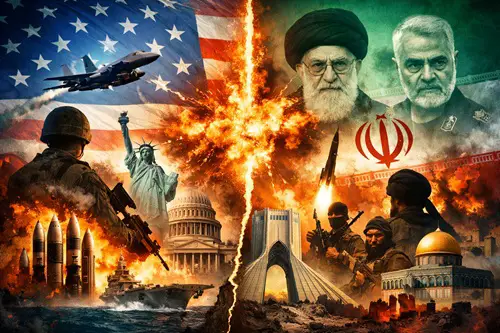 When Donald Trump authorized a major military strike against Iran, the decision reignited one of the oldest debates in American foreign policy: when, if ever, is force justified against a hostile regime? Iran is not a neutral actor. For more than four decades, the Islamic Republic has combined internal repression with regional militancy. Yet the United States is itself the most powerful military state on Earth, with a long record of intervention. The case for—and against—the strike turns on how one weighs these competing realities. 1. A Regime Built on RepressionSince the 1979 revolution led by Ruhollah Khomeini, the Islamic Republic has operated as a theocratic-authoritarian system. Political dissent is suppressed; journalists, activists, and opposition figures face imprisonment or worse; women's rights remain heavily constrained; religious minorities encounter structural discrimination. Protest movements—most recently the “Woman, Life, Freedom” uprising—have been met with force. This is not a regime in democratic transition. It is a consolidated clerical state whose unelected institutions—especially the Supreme Leader and the Revolutionary Guard—dominate the political order. For supporters of Trump's strike, this matters morally and strategically. A government that oppresses its own population while projecting violence outward cannot be treated as a normal sovereign actor. 2. Iran's Regional Network of Armed ProxiesIran's influence does not stop at its borders. Through the Islamic Revolutionary Guard Corps and its Quds Force, Tehran finances, trains, and arms a web of non-state actors across the Middle East. These include: • Hezbollah in Lebanon • Hamas in Gaza • Houthis in Yemen • Shiite militias in Iraq and Syria These groups have attacked Israeli and Gulf targets, disrupted Red Sea shipping, prolonged civil wars, and contributed to chronic regional instability. Iran's support for Russia—including drone transfers during the Ukraine war—further complicates its international posture. From the perspective of U.S. and Israeli security planners, degrading Iran's military infrastructure is not symbolic punishment but strategic disruption: weaken Tehran, and you weaken its proxy network. 3. Nuclear and Missile ConcernsThe nuclear question remains central. Since the U.S. withdrawal from the Joint Comprehensive Plan of Action under Trump in 2018, tensions have escalated over uranium enrichment and inspection access. Iran maintains its program is peaceful. Its adversaries argue that its enrichment levels, missile development, and concealment patterns suggest breakout capability ambitions. The strategic logic behind preventive strikes is straightforward: once a hostile regime acquires nuclear weapons, deterrence becomes exponentially more dangerous and coercive leverage increases. Whether one views the strike as reckless escalation or necessary prevention depends largely on how imminent one judges that nuclear threshold to be. 4. The Hypocrisy Problem: America's Own RecordYet any moral clarity about Iran collides with a stark counterargument: the United States is hardly an innocent referee. The U.S. maintains the largest military budget in the world, a global base network, a nuclear triad, and a history of intervention from Vietnam to Iraq. Drone campaigns, sanctions regimes, covert operations, and regime-change efforts have produced civilian casualties and long-term destabilization. To many observers, Washington condemns destabilizing behavior in others while practicing power politics at scale. The hypocrisy critique has several layers: • The U.S. insists Iran must not obtain nuclear weapons while retaining thousands of its own. • Washington labels Iranian-backed militias as terrorists while supporting armed groups when strategically convenient. • American interventions are framed as “security” or “liberation,” while adversaries' interventions are branded aggression. From this angle, the global system is unsafe not primarily because of Iran alone, but because great powers—especially the United States—enforce order selectively. Moral language often masks geopolitical interest. Defenders of American policy respond that there is a structural distinction: the U.S., for all its failures, remains a constitutional democracy subject to electoral correction and public scrutiny; Iran is an entrenched theocracy with minimal internal accountability. Moreover, American power underwrites global trade routes, alliance systems, and nuclear deterrence frameworks that prevent large-scale war. But the credibility gap remains. When a superpower invokes norms it does not consistently apply to itself, legitimacy erodes. 5. Liberation or Destabilization?Some proponents argue that striking Iran could catalyze internal transformation. Iran has experienced repeated protest waves, generational dissatisfaction, and economic crisis. External pressure, they claim, may weaken hardliners and embolden reformist or revolutionary forces. History, however, offers caution. External military action often consolidates nationalist sentiment around embattled regimes. Iraq and Libya demonstrate that removing or weakening authoritarian structures does not automatically yield stable democracy. Power vacuums can produce fragmentation, civil war, or extremist resurgence. Thus the liberation argument is aspirational, not guaranteed. Conclusion: Between Realism and Moral AmbiguityThere is indeed something to be said in defense of Trump's strike on Iran. Iran is a repressive regime with a long record of proxy warfare, regional destabilization, and strategic hostility. Weakening its capacity to arm militant groups or advance toward nuclear breakout has a coherent deterrence rationale. For Israel and Gulf states, Iranian power is not abstract—it is immediate and existential. At the same time, the United States occupies no morally pristine ground. It is the most powerful military actor in the international system, with its own legacy of intervention and coercion. To condemn destabilization while wielding overwhelming force invites charges of double standards. The central tension is this: • If the world is unsafe because authoritarian regional powers spread militant influence, then confronting Iran appears justified. • If the world is unsafe because dominant powers enforce order selectively and militarize geopolitics, then American strikes risk perpetuating the cycle. Foreign policy rarely offers clean moral binaries. It is conducted in a realm where deterrence, power, legitimacy, and ethics intersect imperfectly. Trump's strike on Iran can be defended as strategic containment of a malign regime—and criticized as another episode in an already over-militarized global order. Both propositions can be true at once. The real question is not simply whether Iran is dangerous. It is whether force reduces danger in the long term—or merely redistributes it.
Widget is loading comments...
|