|
TRANSLATE THIS ARTICLE
Integral World: Exploring Theories of Everything
An independent forum for a critical discussion of the integral philosophy of Ken Wilber
  Frank Visser, graduated as a psychologist of culture and religion, founded IntegralWorld in 1997. He worked as production manager for various publishing houses and as service manager for various internet companies and lives in Amsterdam. Books: Ken Wilber: Thought as Passion (SUNY, 2003), and The Corona Conspiracy: Combatting Disinformation about the Coronavirus (Kindle, 2020). Frank Visser, graduated as a psychologist of culture and religion, founded IntegralWorld in 1997. He worked as production manager for various publishing houses and as service manager for various internet companies and lives in Amsterdam. Books: Ken Wilber: Thought as Passion (SUNY, 2003), and The Corona Conspiracy: Combatting Disinformation about the Coronavirus (Kindle, 2020).
Check out my other conversations with ChatGPT The Inflation of PrefixesPost-, Meta-, Neo- in the Integral MilieuFrank Visser / ChatGPT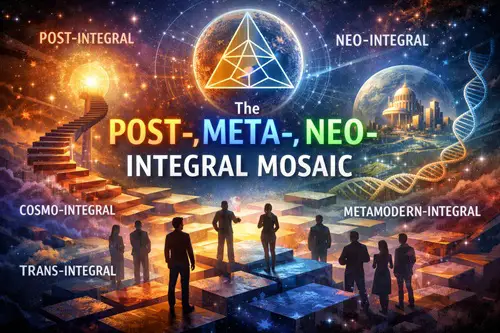 Postmodernism, post-postmodernism, meta-modernism, neo-perennialism, meta-perennialism, meta-naturalism, meta-integral... In recent years, the broader integral ecosystem—once relatively centered on the work of Ken Wilber—has undergone a marked semantic proliferation. We now encounter post-integral, meta-integral, neo-integral, trans-integral, cosmo-integral, metamodern-integral, and other such hybridizations. This is not merely stylistic exuberance. It reflects structural tensions within a maturing intellectual movement. What is happening here? 1. The Exhaustion of a Grand NarrativeIntegral Theory originally presented itself as a synthetic metaframework: AQAL, quadrants, levels, lines, states, types—an architectonic system claiming unprecedented scope. As long as that architecture retained charismatic authority and theoretical momentum, dissent remained marginal. But large-scale metanarratives face an inherent problem: once canonized, they harden. The system becomes scholastic. Innovation increasingly takes the form of commentary rather than discovery. Prefixes such as post- and meta- function as distancing devices. They signal: • “We honor the original impulse but move beyond it.” • “We operate at a level that contextualizes the framework itself.” • “We correct perceived blind spots without abandoning integrality.” This is a classic second-generation dynamic. The original synthesis becomes an object of reflection. 2. Branding in a Crowded Conceptual MarketplaceThere is also a sociological explanation. Integral discourse has diffused across coaching, spirituality, developmental psychology, metamodern philosophy, systems thinking, and cultural theory. As the center weakens, peripheral entrepreneurs differentiate themselves. In academic and para-academic ecosystems, novelty signaling is essential. A new prefix performs three functions: • Differentiation – Establishes intellectual territory. • Continuity signaling – Retains legitimacy by referencing the parent framework. • Implicit critique – Suggests insufficiency in prior formulations. The phenomenon resembles the fragmentation of Marxism into neo-Marxism, post-Marxism, analytical Marxism, etc.—a symptom of internal theoretical strain rather than vitality alone. 3. The “Meta” Escalation ProblemIntegral Theory already claimed to be meta-theoretical. To go “meta” beyond a meta-theory introduces a regress problem: • If Integral was already second-order, • then meta-integral implies third-order reflexivity, • which invites meta-meta positioning, and so on. This vertical inflation is structurally unstable. Eventually, “meta” ceases to designate epistemic advance and becomes rhetorical altitude. One might call this transcendence fatigue—a recursive reenactment of the very verticality the theory celebrates. 4. A Crisis of Authority After WilberMuch of the integral landscape was once gravitationally organized around Wilber himself. As his influence plateaued and controversies accumulated, centrifugal forces increased. Former insiders, sympathetic critics, and adjacent thinkers began asking: • Is AQAL sufficient? • Does it overreach scientifically? • Does it smuggle metaphysics under developmental language? • Is its spiritual teleology defensible? Rather than rejecting integrality outright, many chose modification over rupture. Hence: neo-integral, post-integral, integral 2.0, etc. This resembles post-structuralism's relationship to structuralism: not total rejection, but critical reconfiguration. 5. Metamodern ContaminationThe rise of metamodern discourse—associated with figures such as Han van der Meer and especially Daniel Görtz—has influenced integral circles. Metamodernism oscillates between irony and sincerity, modernity and postmodernity. Integral theorists seeking renewed cultural relevance have imported this language. The result is hybrid constructs like “metamodern-integral,” which attempt to preserve developmental depth while acknowledging postmodern skepticism. This cross-pollination reflects adaptive pressure: integral thought must compete with other large-scale sensemaking frameworks. 6. The Psychological Dimension: Status and DifferentiationDevelopmental models often attract individuals oriented toward vertical self-understanding. In such milieus, differentiation is not merely intellectual—it is existential. To declare oneself “post-integral” subtly implies developmental advance beyond first-generation integralism. The prefix becomes a stage marker. In this sense, the proliferation may enact the very developmental competition the framework describes. 7. The Productive InterpretationNot all prefix inflation is decadence. There are legitimate reasons for second-generation work: • Correcting scientific overreach (e.g., entropy, evolution, cosmology). • Clarifying epistemic domains (phenomenology vs. ontology). • Distinguishing spirituality from metaphysical literalism. • Integrating critiques from analytic philosophy and cognitive science. A movement that cannot generate internal critique stagnates. The presence of post- and meta- strands indicates ongoing dynamism. The real question is whether these derivatives: • deepen empirical rigor, • clarify conceptual boundaries, • or merely repackage spiritual metaphysics under new labels. 8. Is This Fragmentation or Maturation?We may be witnessing one of three possibilities: • Scholastic fragmentation – a medieval multiplication of sub-schools. • Paradigm transition – integral dissolving into broader post-postmodern frameworks. • Normalization – integral becoming one influence among many rather than a master narrative. Historically, most grand syntheses follow this arc. 9. A Diagnostic SummaryThe proliferation of prefixes signals: • Declining central authority. • Increased reflexivity. • Competitive branding. • Theoretical strain. • Cultural adaptation pressures. • Psychological differentiation dynamics. In short: the integral movement is no longer unified by a single gravitational center. It is pluralizing. Whether this is decay or evolution depends on whether the new formulations solve problems the original could not. If they merely add altitude without adding explanatory power, the inflation will collapse under its own semantic weight. If they clarify, delimit, and empirically ground integrality, the prefixes may mark genuine maturation. Conclusion: Beyond the Prefix GameThe deeper issue is not whether we are post-, meta-, or neo-. It is whether integral discourse can: • specify its epistemic limits, • disentangle spirituality from cosmological claims, • engage science without metaphysical overreach, • and tolerate internal critique without defensive closure. If that occurs, the movement may stabilize at a second-generation equilibrium. If not, the prefix cascade will continue—until integrality dissolves into the broader ecosystem of contemporary sensemaking frameworks, where it becomes one historical chapter rather than a living synthesis. Epilogue: The Protestantization of Integral: A Structural AnalogyA useful historical parallel can be drawn with the fragmentation of Western Christianity following the dominance of the Catholic Church. For centuries, Catholicism functioned as a universal synthesis—doctrinally comprehensive, sacramentally integrated, and institutionally centralized. Yet the 16th-century Reformation, initiated by figures such as Martin Luther and John Calvin, fractured that unity. Each Protestant movement identified real or perceived deficiencies: • Luther emphasized justification by faith. • Calvin stressed divine sovereignty. • Anabaptists foregrounded radical discipleship. • Later evangelical strands prioritized personal conversion. • Pentecostalism highlighted charismatic experience. Each correction addressed a dimension some believed the Catholic synthesis had muted or distorted. Yet in doing so, these movements often forfeited the universality they criticized. What was gained in focus was lost in comprehensiveness. The analogy to integral fragmentation is instructive: • Integral Theory originally presented itself as a universal synthesis. • Post-/meta-/neo- derivatives identify blind spots—scientific overreach, metaphysical inflation, cultural naïveté, insufficient political realism. Each reformulation sharpens a dimension. But each risks narrowing the scope that made integrality compelling. Just as Protestant sects proliferated—each claiming fidelity to the core while correcting distortions—integral derivatives multiply, each preserving “the spirit” while revising the structure. The structural dynamic is similar: Correction → differentiation → pluralization → loss of unified center. This does not imply that the corrections are unjustified. Many Protestant critiques of late medieval Catholicism were substantial. The question is whether fragmentation produces cumulative improvement or centrifugal dissipation.
Widget is loading comments...
|