|
TRANSLATE THIS ARTICLE
Integral World: Exploring Theories of Everything
An independent forum for a critical discussion of the integral philosophy of Ken Wilber
  Frank Visser, graduated as a psychologist of culture and religion, founded IntegralWorld in 1997. He worked as production manager for various publishing houses and as service manager for various internet companies and lives in Amsterdam. Books: Ken Wilber: Thought as Passion (SUNY, 2003), and The Corona Conspiracy: Combatting Disinformation about the Coronavirus (Kindle, 2020). Frank Visser, graduated as a psychologist of culture and religion, founded IntegralWorld in 1997. He worked as production manager for various publishing houses and as service manager for various internet companies and lives in Amsterdam. Books: Ken Wilber: Thought as Passion (SUNY, 2003), and The Corona Conspiracy: Combatting Disinformation about the Coronavirus (Kindle, 2020).
Check out my other conversations with ChatGPT Eros Against Entropy?Ken Wilber, the Second Law of Thermodynamics, and the Evolution of ComplexityFrank Visser / ChatGPT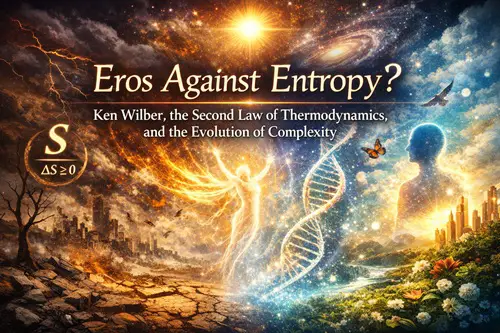 Introduction: The Entropy ProblemFew issues in the science-spirituality dialogue are as persistently misunderstood as the role of the Second Law of Thermodynamics in evolution. Critics of Ken Wilber have long argued that his notion of Eros—a cosmic drive toward greater complexity and consciousness—implicitly functions as an extra-physical principle that counteracts entropy. According to these critics, Wilber frames biological and cultural evolution as so improbably “uphill” that only a spiritual force can explain it. The problem is not that Wilber affirms spirituality. The problem is conceptual: does evolution actually defy the Second Law? And if not, does invoking Eros misrepresent thermodynamics as an obstacle to emergence that needs metaphysical rescue? To answer this, we must disentangle thermodynamics, evolutionary theory, and Wilber's metaphysical overlay with precision. 1. What the Second Law Actually SaysThe Second Law of Thermodynamics states that in a closed system, entropy (roughly, energy dispersal or disorder) tends to increase over time. It does not say that: • Local order cannot increase. • Complex structures cannot form. • Life violates physics. The Earth is not a closed system. It receives a continuous influx of low-entropy energy from the Sun and radiates higher-entropy energy into space. This energy gradient enables local decreases in entropy—such as the formation of hurricanes, crystals, living cells, and ecosystems—while the total entropy of the larger system (Earth + Sun + space) still increases. This is standard non-equilibrium thermodynamics, not a loophole in physics. In other words, the emergence of order does not contradict the Second Law. It depends on it. 2. Emergence Without ErosModern evolutionary biology explains increasing biological complexity through well-established mechanisms: • Variation (mutation, recombination) • Selection (differential survival and reproduction) • Self-organization (chemical and physical pattern formation) • Developmental constraints • Ecological feedback loops No appeal to a cosmic drive toward complexity is required. Complexity increases when it confers adaptive advantage in particular environments. It also often plateaus, regresses, or simplifies. Many organisms evolve toward less complexity if it suits ecological niches (parasites are classic examples). Evolution has no intrinsic direction toward higher consciousness. It produces what works. Similarly, in physics and chemistry, complex structures arise spontaneously under far-from-equilibrium conditions. Dissipative structures (as studied by Ilya Prigogine) show how order can arise precisely because systems are dissipating energy gradients. Again: no metaphysical supplement is required. 3. Wilber's Framing of the “Improbability” of ComplexityWilber often presents evolution as an astronomically improbable ascent from matter to mind, suggesting that chance plus selection cannot plausibly account for such coordinated increases in complexity and consciousness. From this improbability, he infers the operation of Eros—a self-organizing, self-transcending drive intrinsic to the Kosmos. Here the thermodynamic issue becomes rhetorically powerful. If one assumes that the universe naturally “runs down” into disorder, then the rise of life and consciousness appears anomalous—an uphill climb against entropy. In that framing, Eros becomes the countervailing principle that explains why order intensifies rather than decays. But this framing subtly mischaracterizes thermodynamics. Entropy increase at the cosmic level is fully compatible with local complexity formation. Indeed, complexity often accelerates entropy production globally. Living systems are entropy exporters. Thus evolution is not a rebellion against the Second Law. It is one expression of it. 4. The Conceptual Slippage: From Description to MetaphysicsThe deeper issue is not physics but explanatory economy. When Wilber describes evolution as exhibiting self-transcendence and increasing depth, he is making a phenomenological observation about patterns in biological and cultural history. But when he reifies that pattern into an ontological force—Eros as a quasi-law of the cosmos—he shifts from description to metaphysical hypothesis. Science already accounts for: • Increasing structural complexity • Information accumulation • Emergent properties • The evolution of nervous systems and consciousness These are modeled through dynamical systems theory, evolutionary biology, and neuroscience. Adding Eros does not generate new predictions, constraints, or empirical leverage. It redescribes emergence in spiritualized language. This is where critics argue that Wilber introduces an unnecessary ontological multiplier. 5. Directionality Without TeleologyOne might object: doesn't evolution show a general trend toward increasing complexity? The answer is nuanced. The maximum level of complexity has increased over evolutionary time. The average organism remains simple (e.g., bacteria dominate biomass). Complexity is contingent, not inevitable. Stephen Jay Gould described evolution as a “drunkard's walk” away from minimal complexity. Once life begins at a minimal threshold, diversification allows some lineages to explore greater complexity—but there is no built-in cosmic striving. This model explains directionality without teleology. Wilber, however, interprets directionality as evidence of intrinsic telos. That is a philosophical move, not a thermodynamic necessity. 6. The Real Stakes: Is Eros Explanatory or Symbolic?At its strongest, Wilber's concept of Eros functions poetically—a mythic-symbolic way of honoring the astonishing creativity of the universe. At its weakest, it risks implying: • That entropy fundamentally resists complexity. • That natural processes are insufficient. • That spiritual force is required to overcome decay. If framed as literal cosmological supplementation, Eros becomes scientifically redundant. If framed as metaphorical reverence for emergent order, it becomes harmless but explanatorily empty. The confusion arises when metaphor is presented as ontological necessity. 7. Why Science Does Not Need an Extra LawScience explains emergence through: • Energy gradients • Non-equilibrium thermodynamics • Evolutionary dynamics • Information theory • Complex systems modeling None of these frameworks encounter a thermodynamic wall that requires transcendental assistance. The Second Law is not the enemy of life. It is the background condition that makes life's energy flows intelligible. Invoking Eros as an additional “Law” contravening decay presupposes a problem that physics does not recognize. Conclusion: Entropy and EnchantmentThe universe does not need to violate entropy to produce consciousness. It produces consciousness while entropy increases. The appearance of ascent—from quarks to culture—can inspire metaphysical wonder. But explanatory rigor requires distinguishing: • Physical law • Biological mechanism • Philosophical interpretation • Spiritual metaphor When these levels blur, thermodynamics is miscast as an adversary, and Eros is elevated to a necessity it does not scientifically warrant. Evolution does not defy the Second Law. It exemplifies it.
Widget is loading comments...
|