|
TRANSLATE THIS ARTICLE
Integral World: Exploring Theories of Everything
An independent forum for a critical discussion of the integral philosophy of Ken Wilber
  Frank Visser, graduated as a psychologist of culture and religion, founded IntegralWorld in 1997. He worked as production manager for various publishing houses and as service manager for various internet companies and lives in Amsterdam. Books: Ken Wilber: Thought as Passion (SUNY, 2003), and The Corona Conspiracy: Combatting Disinformation about the Coronavirus (Kindle, 2020). Frank Visser, graduated as a psychologist of culture and religion, founded IntegralWorld in 1997. He worked as production manager for various publishing houses and as service manager for various internet companies and lives in Amsterdam. Books: Ken Wilber: Thought as Passion (SUNY, 2003), and The Corona Conspiracy: Combatting Disinformation about the Coronavirus (Kindle, 2020).
Check out my other conversations with ChatGPT Reading the Hadean Earth in the GenomeGeology and the LUCA ProblemFrank Visser / ChatGPT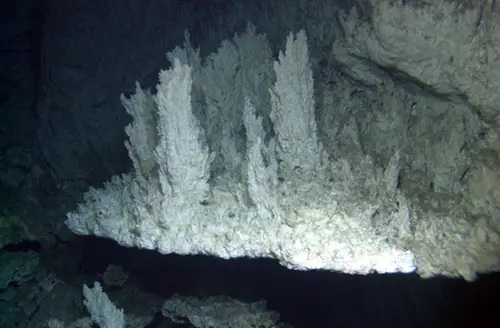
Lost City Hydrothermal Vent Field (Wikipedia)
The origin of life is not only a biochemical question but a geological one. Life did not emerge in abstraction; it emerged on a specific planet, under specific thermodynamic and geochemical constraints. The concept of the Last Universal Common Ancestor (LUCA)—the population from which modern Bacteria and Archaea descend—therefore invites a methodological reversal: instead of asking only what early Earth geology enabled, we may ask what extant genomes reveal about that geology. This essay explores whether early Earth conditions can be inferred from comparative genomics of Bacteria and Archaea, and how far such inferences can legitimately go. The Geological Theater: The Hadean and Early Archean EarthDuring the Hadean (4.6-4.0 Ga) and early Archean (4.0-3.5 Ga), Earth was dynamically unstable: • Extensive volcanism and high geothermal flux • A largely anoxic atmosphere • Heavy meteorite bombardment • Widespread hydrothermal systems • Oceans likely present by ~4.3 Ga Evidence from ancient zircons and isotopic signatures suggests liquid water existed surprisingly early. Tectonic activity—whether in proto-plate form or stagnant lid regimes—generated hydrothermal gradients at the ocean crust. These gradients are central. They represent sustained free-energy differentials, the kind life requires. Modern hydrothermal systems, such as those at the Lost City Hydrothermal Field, provide alkaline, hydrogen-rich fluids interacting with CO2-rich seawater. Many researchers propose that similar systems on early Earth offered the geochemical scaffolding for metabolism-first scenarios. LUCA: Not the First Life, But a SurvivorLUCA was not the first living system. It was the last common ancestor of all current cellular life, already possessing: • A DNA genome • The universal genetic code • Ribosomes • Core metabolic pathways Comparative genomics attempts to reconstruct LUCA by identifying genes shared between modern Bacteria and Archaea. A landmark 2016 study by Weiss et al. identified a core set of ~355 genes plausibly traceable to LUCA. These genes strongly suggest: • An anaerobic metabolism • Dependence on hydrogen (H2) • CO2 fixation via the Wood-Ljungdahl pathway • Transition metal cofactors (Fe, Ni, Mo) • Sensitivity to oxygen This metabolic profile is strikingly congruent with hydrothermal vent chemistry. Metabolic Pathways as Geological FossilsIf genomes are archives, what exactly do they archive? 1. Hydrogen MetabolismLUCA likely possessed hydrogenases—enzymes catalyzing the reversible oxidation of H2. These enzymes depend on iron-sulfur clusters, structurally similar to minerals formed in hydrothermal systems. Hydrogen abundance implies: • A reducing environment • Water-rock interactions such as serpentinization • Active crustal geochemistry • Serpentinization—where ultramafic rocks react with water—produces hydrogen and alkaline conditions. The persistence of hydrogenase systems in deep-branching microbes suggests adaptation to precisely these conditions. 2. The Wood-Ljungdahl PathwayThe acetyl-CoA (Wood-Ljungdahl) pathway is one of the most ancient carbon fixation pathways. It: • Reduces CO2 using H2 • Is linear (not cyclic) • Requires metal cofactors Its geochemical plausibility is notable: laboratory simulations show partial abiotic analogues under hydrothermal conditions. The genome here reflects an economy of energy—this pathway is among the most thermodynamically efficient carbon fixation systems known. In short, the genome suggests that early metabolism was geochemically continuous with its environment. 3. Iron-Sulfur ProteinsIron-sulfur clusters are ubiquitous in ancient enzymes. Their inorganic analogues form naturally in hydrothermal mineral matrices (e.g., greigite, mackinawite). This continuity between inorganic catalysis and biological catalysis suggests that early metabolism may have been scaffolded by mineral surfaces before becoming genetically encoded. The geological inference is clear: life's earliest enzymatic machinery mirrors mineral chemistry available in hydrothermal contexts. Limits of Genomic PaleogeologyHowever, caution is essential. There are at least four major limitations to “reading” geology in genomes: Horizontal Gene Transfer (HGT)Early evolution was likely characterized by rampant horizontal gene transfer. This blurs phylogenetic reconstruction. Some genes inferred to be ancient may reflect later exchange rather than inheritance from LUCA. LUCA Was Already ComplexLUCA possessed ribosomes and DNA replication machinery. These systems require prior evolutionary history. Thus, LUCA is downstream of the origin of life proper. Genomes do not directly record pre-genetic stages. Survivorship BiasOnly lineages adapted to specific conditions survived. If early Earth hosted multiple ecological niches, the LUCA lineage may represent just one successful branch, not a universal environmental snapshot. Convergent AdaptationHydrogen metabolism might not reflect origin conditions but early adaptation to dominant niches. Geological conditions may have been diverse; genomes preserve what proved durable, not necessarily primordial. Deep Time and ThermodynamicsDespite these caveats, a consistent pattern emerges: • Anaerobic metabolism • Hydrogen utilization • CO2 fixation • Metal-rich enzymology • Thermophilic tendencies in deep-branching lineages These features align with models placing life's early evolution in hydrothermal vent systems—either alkaline vents like Lost City or black smoker systems along mid-ocean ridges. The thermodynamic argument is compelling. Early Earth offered abundant redox gradients at hydrothermal interfaces. Modern cells still exploit proton gradients across membranes. The universality of chemiosmosis suggests that life's core bioenergetics originated in environments where natural proton gradients existed. In other words: cell membranes may have internalized geochemical gradients that first existed externally. Can We Read the Geology Directly?Not directly, but inferentially. Genomes do not contain sedimentary layers. They contain metabolic constraints. When those constraints match plausible geochemical regimes, a consilience emerges between molecular biology and planetary science. The genome is not a fossil in the paleontological sense; it is a functional relic. It preserves solutions to thermodynamic problems. By reconstructing those problems, we approximate the environmental context in which those solutions first stabilized. The strongest geological signals in the genome are therefore: • Dependence on hydrogen • Metal-sulfur enzymology • CO2-based carbon fixation • Anaerobic metabolism Together, these point toward a reducing, hydrothermally active, metal-rich early Earth. The Philosophical EdgeThis approach also reframes the origin-of-life debate. Rather than asking how “information” suddenly appeared, one asks how metabolic continuity emerged from geochemical continuity. The genome does not whisper metaphysics. It encodes adaptation to gradients, redox chemistry, and mineral availability. The transition from geology to biology appears less like a miracle and more like a phase transition in planetary chemistry. Whether this suffices to explain abiogenesis remains open. But it shows that early Earth geology is not merely background scenery—it is partially inscribed in the architecture of life itself. ConclusionWe cannot read the Hadean Earth like a stratigraphic column within bacterial DNA. Yet comparative genomics strongly suggests that LUCA inhabited a hydrogen-rich, anaerobic, metal-dense world consistent with hydrothermal systems on early Earth. The genome, in this sense, is a thermodynamic memory. It does not preserve rocks. It preserves constraints. And through those constraints, the deep Earth still speaks.
Widget is loading comments...
|