|
TRANSLATE THIS ARTICLE
Integral World: Exploring Theories of Everything
An independent forum for a critical discussion of the integral philosophy of Ken Wilber
  Frank Visser, graduated as a psychologist of culture and religion, founded IntegralWorld in 1997. He worked as production manager for various publishing houses and as service manager for various internet companies and lives in Amsterdam. Books: Ken Wilber: Thought as Passion (SUNY, 2003), and The Corona Conspiracy: Combatting Disinformation about the Coronavirus (Kindle, 2020). Frank Visser, graduated as a psychologist of culture and religion, founded IntegralWorld in 1997. He worked as production manager for various publishing houses and as service manager for various internet companies and lives in Amsterdam. Books: Ken Wilber: Thought as Passion (SUNY, 2003), and The Corona Conspiracy: Combatting Disinformation about the Coronavirus (Kindle, 2020).
Check out my other conversations with ChatGPT The Follies of U.S. Foreign PolicyRegime Change in Iran, American Hubris, and the Lessons of IraqFrank Visser / ChatGPT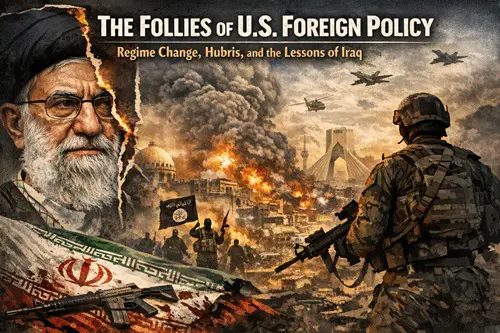 The United States has long presented itself as a defender of global order, democracy, and stability. Yet some of its most consequential foreign policy decisions have produced outcomes strikingly at odds with those goals. The recurring pattern is familiar: a perceived threat emerges, Washington decides that removing a hostile leader will solve the problem, and military force is deployed to engineer political transformation abroad. The result, more often than not, is chaos, unintended consequences, and long-term instability. Recent developments surrounding the reported killing of Ali Khamenei and calls in Washington for regime change in Iran evoke uncomfortable historical parallels. The echoes of the 2003 invasion of Iraq are unmistakable. Once again, the assumption appears to be that removing a hostile regime will weaken extremism and open the door to a more cooperative political order. Yet the experience of the past two decades suggests precisely the opposite. The Iraq PrecedentWhen the United States invaded Iraq in 2003, the stated objective was to eliminate weapons of mass destruction allegedly possessed by the regime of Saddam Hussein and to neutralize a supposed nexus between Iraq and global terrorism. Neither justification survived scrutiny. No stockpiles of weapons of mass destruction were found, and the alleged links to groups such as Al-Qaeda proved tenuous or nonexistent. What did emerge from the invasion was a profound political vacuum. The dismantling of Iraq's state institutions—including the army and civil administration—destroyed the framework that had maintained order, however authoritarian that order may have been. Sectarian tensions, long suppressed under Hussein's rule, erupted into open conflict between Sunni and Shiite factions. Militias proliferated, and the country descended into years of violence and instability. Out of this turmoil arose one of the most brutal jihadist movements of the modern era: Islamic State, commonly known as ISIS. The group capitalized on disaffected Sunni populations, porous borders, and collapsing governance structures. At its height, ISIS controlled large portions of Iraq and neighboring Syria, declaring a so-called caliphate and inspiring terrorist attacks across the globe. In short, the war designed to defeat terrorism ended up incubating a far more virulent form of it. The Illusion of DecapitationThe belief that eliminating a hostile leader will solve deeper geopolitical problems is one of the most persistent illusions in modern statecraft. In reality, political systems rarely depend entirely on a single individual. Authoritarian regimes, in particular, tend to rest on networks of military, intelligence, and ideological institutions that can survive the removal of a leader. In Iran's case, the political structure is deeply embedded in the institutions created after the Iranian Revolution of 1979. Central among these is the powerful Islamic Revolutionary Guard Corps (IRGC), which functions simultaneously as a military force, political actor, and economic powerhouse. The IRGC's influence extends across Iranian politics and into allied movements throughout the Middle East. Removing a supreme leader—even one as influential as Khamenei—would not dismantle this network. On the contrary, it might strengthen hardline elements within it. In times of external threat, regimes often consolidate power rather than collapse. Nationalism and resistance to foreign intervention can unify factions that might otherwise be divided. History suggests that external attempts to topple regimes frequently produce the opposite of their intended effect: they radicalize domestic politics and empower the most militant actors. The Martyrdom EffectTargeted assassinations carry another predictable consequence: the transformation of political leaders into martyrs. In societies already suspicious of foreign intervention, the killing of a national leader by an external power can become a rallying symbol. This dynamic was evident after the 2020 assassination of Qasem Soleimani, a senior Iranian military commander widely regarded within Iran as a national hero. Far from weakening the Iranian state, his death triggered massive funeral processions and intensified anti-American sentiment. The killing of a figure like Khamenei could amplify this effect on an even larger scale. The narrative of resistance against foreign aggression is deeply embedded in Iran's political identity, shaped by historical experiences such as the 1953 Iranian coup d'état, when the United States and Britain helped overthrow Iran's elected prime minister Mohammad Mosaddegh. That episode remains a powerful symbol of Western interference in Iranian affairs. Against that historical backdrop, the assassination of Iran's supreme leader would almost certainly be interpreted not as liberation but as another chapter in a long history of foreign domination. The Regional Domino EffectBeyond Iran itself, regime change could destabilize the broader Middle East. Iran is not an isolated state; it sits at the center of a complex web of alliances, rivalries, and proxy conflicts stretching from the Persian Gulf to the Mediterranean. Groups aligned with Iran—including Hezbollah in Lebanon and various militias in Iraq and Syria—would likely respond to a U.S.-backed overthrow of the Iranian leadership. Escalation could spread across multiple fronts, drawing in regional actors and potentially triggering a wider war. Even within Iran itself, the collapse of central authority could unleash ethnic and regional tensions. Iran is home to diverse communities—Persians, Azeris, Kurds, Arabs, and others—whose relations with the central government are not always harmonious. In a power vacuum, separatist movements or armed factions might emerge, producing a fragmented landscape reminiscent of post-invasion Iraq or civil-war-torn Syria. The irony is stark: a policy intended to neutralize threats could end up multiplying them. The Myth of Exported DemocracyUnderlying many regime-change policies is a moral narrative: the belief that removing authoritarian leaders will naturally lead to democracy. This assumption has proven repeatedly flawed. Democratic institutions cannot simply be installed from outside. They depend on complex social foundations—legal systems, political culture, economic stability, and public trust—that take decades or centuries to develop. When regimes collapse suddenly under foreign pressure, these foundations are rarely in place. The experience of Afghanistan illustrates this problem vividly. After the U.S. invasion following the September 11 attacks, the United States spent two decades attempting to build democratic institutions in the country. Yet when American forces withdrew in 2021, the government collapsed almost immediately, and the Taliban returned to power. The lesson is clear: political systems imposed through military occupation rarely endure once the occupying power departs. Strategic MyopiaOne reason these mistakes recur is the dominance of short-term strategic thinking in Washington. Military action offers immediate, visible results—the destruction of targets, the elimination of leaders, the projection of power. Diplomacy, by contrast, is slow, uncertain, and often politically unpopular. Yet the long-term consequences of military intervention often outweigh the short-term gains. Wars reshape societies, economies, and political identities in ways that are impossible to control from afar. Once a regime collapses, the forces unleashed by that collapse rarely follow the script envisioned by policymakers. Moreover, the United States frequently underestimates the power of nationalism. Populations that might resent their own governments can nonetheless rally around them when confronted with foreign aggression. External pressure can transform domestic grievances into patriotic resistance. The Persistence of American HubrisDespite repeated failures, the regime-change mindset persists. Part of the reason lies in American exceptionalism—the belief that U.S. power and intentions are fundamentally benevolent and therefore capable of reshaping the world for the better. This conviction can lead policymakers to discount historical evidence. The disastrous aftermath of interventions in Vietnam, Iraq, and Afghanistan has not fully erased the assumption that the next intervention will succeed where others failed. Yet history suggests a different conclusion. Great powers often overestimate their ability to control distant political landscapes. The complexity of local dynamics, cultural contexts, and historical grievances frequently overwhelms even the most sophisticated strategic plans. Toward a More Realistic Foreign PolicyIf there is a lesson to be drawn from the last half-century of U.S. interventions, it is that military force is a blunt instrument for solving political problems. Removing leaders rarely eliminates the underlying forces that produced them. In many cases, those forces grow stronger amid the chaos that follows. A more realistic approach would emphasize diplomacy, regional cooperation, and a deeper understanding of local political structures. It would recognize that stability often depends not on the sudden overthrow of regimes but on gradual internal evolution. Such an approach requires patience and humility—qualities not always abundant in the realm of great-power politics. Yet without them, the cycle of intervention and unintended consequences is likely to continue. ConclusionThe temptation to reshape the world through force has been a recurring feature of American foreign policy. Time and again, however, the results have revealed the limits of that ambition. The experience of Iraq, the rise of ISIS, and the long turmoil that followed should serve as cautionary tales. If the United States pursues regime change in Iran under the assumption that removing a leader will solve complex geopolitical tensions, it risks repeating the very mistakes that produced so much instability over the past two decades. History rarely repeats itself in exactly the same form. But it often rhymes—and in the case of regime change in the Middle East, the rhyme has become all too familiar.
Widget is loading comments...
|