|
TRANSLATE THIS ARTICLE
Integral World: Exploring Theories of Everything
An independent forum for a critical discussion of the integral philosophy of Ken Wilber
  Frank Visser, graduated as a psychologist of culture and religion, founded IntegralWorld in 1997. He worked as production manager for various publishing houses and as service manager for various internet companies and lives in Amsterdam. Books: Ken Wilber: Thought as Passion (SUNY, 2003), and The Corona Conspiracy: Combatting Disinformation about the Coronavirus (Kindle, 2020). Frank Visser, graduated as a psychologist of culture and religion, founded IntegralWorld in 1997. He worked as production manager for various publishing houses and as service manager for various internet companies and lives in Amsterdam. Books: Ken Wilber: Thought as Passion (SUNY, 2003), and The Corona Conspiracy: Combatting Disinformation about the Coronavirus (Kindle, 2020).
Check out my other conversations with ChatGPT 'God, the Science, the Evidence'A Critical ReviewFrank Visser / ChatGPT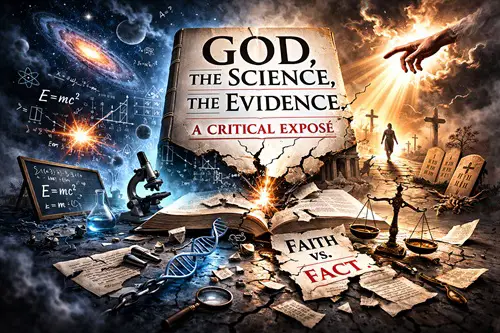 God, the Science, the Evidence has achieved the rare feat of becoming a bestseller while simultaneously embodying nearly every logical and epistemological flaw that can afflict a purportedly “scientific” defense of religion. Despite its bold title and hefty page count, what the book actually offers is a sophisticated form of the age-old God-of-the-gaps fallacy repackaged in a palatable narrative for modern readers—an approach that deserves not admiration but razor-sharp critique. 1. Mislabeling Apologetics as “Science”The most immediate deception of Bolloré and Bonnassies is the title itself. By framing their argument as science and evidence, they conflate two very different domains: empirical methodology and philosophical inference. Science, properly understood, is a method for generating testable hypotheses about the natural world. It does not confer proof of metaphysical entities. Yet the authors repeatedly imply that cosmological and biological phenomena scientifically indicate a creator, even though none of the scientific theories they deploy — from the Big Bang to fine-tuning — entail a deity. This is not a minor error, it's a category mistake. The argument that “absence of disproof” equates to evidence is a basic logical fallacy. You can't prove Zeus doesn't exist by science—but nor does the inability to disprove Zeus constitute evidence for him. The burden of proof lies squarely with the claimant, and the authors consistently fail to meet it. Science doesn't affirm supernatural causes; it models observable phenomena. Cosmology, quantum physics, and evolutionary biology do not offer empirical support for a divine creator any more than they do for unicorns or fairies—only different narratives attempt to interpret the gaps. The authors' rhetorical move—framing materialism as an irrational belief while claiming scientific support for theism—reveals not intellectual rigor but a rhetorical sleight-of-hand. 2. Circular Reasoning and Selective LogicPerhaps the most egregious philosophical flaw in God, the Science, the Evidence is its reliance on circular logic: “Since theism and atheism are mutually exclusive, disproving one would validate the other.” This is a clear misunderstanding of both logic and the actual spectrum of metaphysical stances. There are more than two possibilities—agnosticism, pantheism, non-personal deism, and other naturalistic or dualistic frameworks sit outside the stark theism/vs. atheism dichotomy the authors insist upon. Treating atheism as the sole rival to their preferred conclusion is a narrowing of the epistemic map that artificially inflates the weight of their arguments. Even worse, this reductionist framing enables them to claim that discrediting materialism automatically lends support to a divine creator, a non sequitur that would embarrass any undergraduate in logic. 3. The “Evidence” Isn't EvidenceThe heart of the book's purported case rests on phenomena such as: • The Big Bang (claimed to imply a cause) • Fine-tuning arguments • Complexity of life (especially DNA) • Quoted authority figures But none of these constitute empirical evidence for a theistic deity: The Big Bang describes the evolution of the universe from a hot dense state; it does not point to a supernatural cause or intentional agency. Modern cosmology includes models (e.g., quantum cosmogenesis) that don't require a transcendent cause at all. Fine-tuning arguments depend on assumptions about probability in a single realized universe—something science does not quantify. There is no scientific consensus that fine-tuning logically implies design rather than deeper natural law or multiverse scenarios. Quoting scientists or Nobel laureates doesn't transform opinion into data. Experts can speculate; their authority does not substitute for empirical demonstration. This betrays a fundamental misunderstanding: science offers models and explanations, not metaphysical proofs. Claiming otherwise simply deputizes “science” to do what it can't. Critics have rightly labeled this approach as old apologetics dressed in new clothes—a retread of familiar arguments with fresh packaging. 4. The God-of-the-Gaps and Confirmation BiasThe book is essentially an updated “God-of-the-gaps” argument. Wherever there is currently incomplete scientific explanation—be it origins, complexity, or cosmological beginnings—the authors insert a divine placeholder. This is not evidence, it's argument from ignorance: “We don't yet know how X occurred; therefore God did it.” This strategy has a historical track record of collapse: every gap previously filled with divine causation—lightning, disease, eclipses—was eventually explained by natural processes. Yet Bolloré and Bonnassies rely on this very logic as their chief mechanism of inference. That's not discovery, it's induction from ignorance. 5. Rhetoric Over ObjectivityPerhaps tellingly, reviews and discussions of the book outside evangelical circles point out that its scientific and logical claims are unsupported and sometimes superficial. Readers on forums like Goodreads call it broad but shallow, with logical slips and unsubstantiated claims. One French critique even notes the preface by Nobel laureate Robert Wilson was secured on partial information, suggesting that the scientific authority invoked might not fully endorse the book's broader metaphysical thesis. Conclusion: A Bestseller, Not a BreakthroughIn truth, God, the Science, the Evidence succeeds not because it breaks new ground in science or philosophy, but because it packages familiar apologetics in a compelling narrative designed to resonate with believers and the scientifically curious alike. Its rhetorical flair and encyclopedic citations obscure fundamental flaws: • Conflation of metaphysics with science • Logical fallacies and circular reasoning • “Evidence” that is not evidence • Appeals to authority rather than empirical proof For those seeking genuine epistemic rigor, this book offers comfort, not clarity. Its real achievement is convincing readers that they now have “scientific proof” when all they have is philosophically dressed fideism. Rather than advancing dialogue between science and religion, it obfuscates the true boundary between what science can explain and what faith can affirm. In the end, an agenda dressed in scientific language is still an agenda, not a conclusion. The real revolution would be to acknowledge that science and faith occupy different but complementary domains—neither of which is served by pretending that a metaphysical claim has been scientifically verified.
Comment Form is loading comments...
|