|
TRANSLATE THIS ARTICLE
Integral World: Exploring Theories of Everything
An independent forum for a critical discussion of the integral philosophy of Ken Wilber
  Frank Visser, graduated as a psychologist of culture and religion, founded IntegralWorld in 1997. He worked as production manager for various publishing houses and as service manager for various internet companies and lives in Amsterdam. Books: Ken Wilber: Thought as Passion (SUNY, 2003), and The Corona Conspiracy: Combatting Disinformation about the Coronavirus (Kindle, 2020). Frank Visser, graduated as a psychologist of culture and religion, founded IntegralWorld in 1997. He worked as production manager for various publishing houses and as service manager for various internet companies and lives in Amsterdam. Books: Ken Wilber: Thought as Passion (SUNY, 2003), and The Corona Conspiracy: Combatting Disinformation about the Coronavirus (Kindle, 2020).
Check out my other conversations with ChatGPT Death of God, Death of Science?Why Jordan Peterson's Metaphysical Rescue Mission FailsFrank Visser / ChatGPT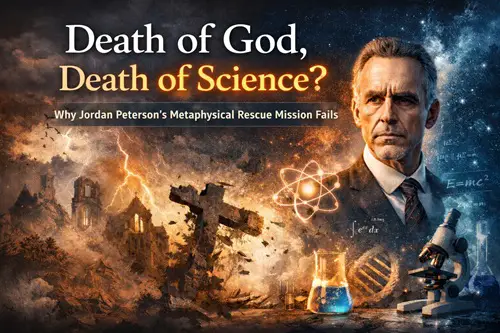 Jordan Peterson has a talent for framing cultural anxieties as philosophical revelations. When he suggests that “with the death of God… science dies too,” he casts atheism not merely as a spiritual loss but as an epistemic catastrophe. The claim is dramatic: remove God, and the rational enterprise of science supposedly collapses under its own metaphysical emptiness. It is a powerful line. It is also philosophically shallow. Metaphysics Is Not TheologyPeterson's argument begins with a seemingly innocuous observation: science rests on unprovable assumptions. Truth exists. Truth is intelligible. Understanding truth is good. The Good itself is real. Since these are not scientific findings, he implies they must be religious inheritances. But this conflates metaphysics with theology. To affirm that truth exists is to adopt epistemic realism, not Christianity. Long before Christian doctrine systematized its theology, philosophers such as Aristotle defended robust accounts of logic, causation, and intelligibility. One can believe that propositions correspond to reality without invoking a personal deity. Secular philosophy is not parasitic on faith. Science presupposes certain ontological and epistemological commitments. That does not make them religious. The Seduction of LogosPeterson often strengthens his case by invoking Logos, drawing on the prologue of the Gospel of John: “In the beginning was the Logos.” Logos becomes, in his rhetoric, the rational structure of reality itself. If the universe is intelligible, it participates in Logos. If Logos is real, then Mind underwrites being. The inference sounds profound but lacks necessity. Intelligibility does not entail intention. A snowflake exhibits symmetry. A crystal forms a lattice. Physical laws display mathematical elegance. None of these imply a cosmic planner. They indicate regularity, not personality. Science describes structure; it does not attribute motives to it. To move from “order” to “mind” is to add a metaphysical layer that the data themselves do not demand. Information Without an AuthorThe argument grows more sophisticated when “information” enters the scene. DNA is described as a “code.” The universe is “written in mathematics.” Because information in ordinary language implies communication, the temptation is to infer a communicator. Yet in the technical sense defined by Claude Shannon, information is simply the reduction of uncertainty. It is statistical structure. It does not imply meaning, intention, or authorship. To slide from Shannon's formal definition to theological semantics is an equivocation. The universe may contain structured complexity. That does not make it a message. Teleology Reintroduced by StealthA similar maneuver appears in appeals to purpose. If reality exhibits increasing complexity, perhaps it is striving toward consciousness or divinization. The ancient language of teleology quietly returns. But since Charles Darwin, biology has shown that apparent design can arise without foresight. Natural selection produces adaptive complexity without intending it. Teleonomy—the appearance of purpose—does not require metaphysical teleology. The leap from “organized” to “intended” is philosophical embroidery, not scientific inference. The Mystery of MathematicsEven the “unreasonable effectiveness of mathematics,” noted by Eugene Wigner, does not compel a theistic conclusion. That mathematics maps onto physical reality so effectively is indeed remarkable. But invoking God merely relocates the puzzle. One must then explain why the divine mind itself is structured, rational, and mathematically coherent. The explanatory gap is displaced, not resolved. Mystery does not automatically validate theology. Does the Good Require God?Peterson's most existential move is moral. If science presupposes that truth-seeking is good, and if goodness collapses without God, then science cannot survive atheism. But this ignores the range of secular moral philosophy. One may defend moral realism without theism, ground normativity in human flourishing, or adopt constructivist accounts of value. Scientists do not require metaphysical certainty about ultimate goodness to prefer accurate theories over inaccurate ones. They require norms of coherence, predictive success, and empirical accountability. Science functions because it works. Airplanes fly. Vaccines prevent disease. Satellites orbit predictably. The iterative success of the method justifies its continued use. The commitment to truth is not a liturgical act. It is a practical necessity. The Psychological AppealPeterson's reasoning derives its force from psychological resonance rather than logical compulsion. Human beings naturally long for a universe in which truth, goodness, and ultimate reality converge. The idea that the cosmos is morally aligned with our highest values is comforting. But existential comfort is not philosophical proof. To label science as “faith-based” because it assumes intelligibility is to stretch the word faith beyond recognition. Science rests on provisional trust in stable regularities—trust continually tested and refined by empirical engagement. Should those regularities fail, science would fail with them, irrespective of how fervently one believed in God. Conclusion: Order Without SermonThe death of God, if it occurs culturally, does not entail the death of science. What it threatens is a particular theological interpretation of why science works. Science itself remains methodologically intact. It requires structured reality, not sacred ontology. Peterson narrows the distance between belief in the Good and belief in God until they become rhetorically indistinguishable. But this is a semantic maneuver, not a logical inevitability. One can affirm truth, intelligibility, and the value of understanding without positing a transcendent lawgiver. Science rests on the stubborn fact that the world exhibits patterns—and that disciplined inquiry can uncover them. That achievement is sufficiently remarkable without transforming it into theology by another name.
Widget is loading comments...
|