|
TRANSLATE THIS ARTICLE
Integral World: Exploring Theories of Everything
An independent forum for a critical discussion of the integral philosophy of Ken Wilber
  Frank Visser, graduated as a psychologist of culture and religion, founded IntegralWorld in 1997. He worked as production manager for various publishing houses and as service manager for various internet companies and lives in Amsterdam. Books: Ken Wilber: Thought as Passion (SUNY, 2003), and The Corona Conspiracy: Combatting Disinformation about the Coronavirus (Kindle, 2020). Frank Visser, graduated as a psychologist of culture and religion, founded IntegralWorld in 1997. He worked as production manager for various publishing houses and as service manager for various internet companies and lives in Amsterdam. Books: Ken Wilber: Thought as Passion (SUNY, 2003), and The Corona Conspiracy: Combatting Disinformation about the Coronavirus (Kindle, 2020).
Check out my other conversations with ChatGPT All the Living DiesA Meditation on 'Everlasting Life'Frank Visser / ChatGPT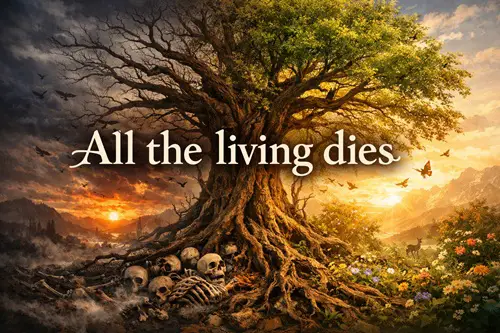 I have studied the afterlife as others study maps of distant continents—charting heavens, purgatories, astral planes, bardos, subtle bodies, resurrections, reincarnations. I have walked the visionary cosmologies of Emanuel Swedenborg, traced the Tibetan cartography of the Bardo Thodol, pondered the resurrectional certainties of Paul the Apostle, and perhaps even the modern clinical mysticism of Raymond Moody. Each system promises continuity. Each refuses the finality of the grave. Each insists that the story bends upward. And yet. There stands before us a simpler testament, older than scripture and more empirical than theology: the Tree of Life. Not the mythic tree in Book of Genesis, guarded by cherubim and a flaming sword, but the evolutionary tree—branching, bifurcating, exploding with form across four billion years. A diagram at once austere and extravagant. Every twig an experiment. Every leaf a lineage. Every branch terminating. The Tree of Life is not crowned by immortality. It is crowned by extinction. From trilobites to tyrannosaurs, from ammonites to mammoths, entire empires of flesh have vanished. The earth has hosted cathedrals of bone and forests of fern taller than houses, and swept them away without malice. Life does not negotiate permanence. It proliferates and relinquishes. Death is not an error in the system. It is the system. Cells are born and die in your body at this moment. Apoptosis—programmed cell death—is not pathology but necessity. Without it, development collapses into chaos. The sculpting of a hand in the womb requires the death of tissue between the fingers. Form emerges through subtraction. Life shapes itself by letting go. Species, too, are temporary sentences written in genetic ink. Natural selection does not preserve forever; it preserves for now. The “survival of the fittest” is only survival relative to an environment that itself will change. Climate shifts. Continents drift. Asteroids fall. What thrives today becomes maladaptive tomorrow. Extinction is not a cosmic tragedy—it is evolutionary punctuation. The Tree grows by shedding. We humans, uniquely self-conscious branches of this Tree, recoil from that logic. We construct eschatologies as counter-arguments. We imagine that consciousness, because it illuminates the world, cannot itself be extinguished. We erect ontologies of soul-substance and subtle planes. We populate invisible realms with justice, reunion, compensation. It is understandable. Awareness of death is a wound that thinks. But the Tree is unsentimental. It tells a different poetry. Not of eternal continuance, but of ceaseless transformation. The atoms that compose your body were forged in ancient stars. They have been ocean and limestone, fern and fish. They will be soil again, and perhaps rose, perhaps bird. Matter circulates. Energy flows. Patterns arise and dissolve. Nothing personal survives in the way we prefer. And yet nothing is wasted. There is grandeur in this view—not despite its sobriety, but because of it. To be alive at all, in this brief configuration, is statistically miraculous. Out of billions of possible genetic permutations, you are this one. Out of the aeons of cosmic time, you occupy this narrow band of decades. The improbability is staggering. Precisely because it ends. If organisms did not die, evolution would stall. If generations did not turn over, adaptation would freeze. Death is the price of novelty. Mortality is the engine of diversity. The riot of forms catalogued by Charles Darwin in On the Origin of Species is inseparable from the graveyard beneath it. The Tree of Life is rooted in extinction. And perhaps this is the deeper consolation: not that we continue unchanged, but that we belong to a process vastly larger than our fear. We are not exiles from immortality; we are expressions of impermanence. The same law that brought us forth will carry us away. The deal is not cruel. It is consistent. All the living dies. Stars exhaust their fuel. Galaxies collide. Even protons may not be eternal. Why should primates be exempt? To accept death as integral to life is not nihilism. It is alignment with reality. It is the relinquishment of metaphysical inflation. It is the courage to say: this is enough. The Tree does not promise us heaven. It offers participation. For a while, sap rises through our branch. Leaves unfurl. We flower, perhaps bear fruit. Then autumn. The nutrients return to the soil from which new shoots emerge. The Tree continues—not as personal survival, but as continuity of life itself. We are not here to escape the Tree. We are here as one of its seasons.
Comment Form is loading comments...
|