|
TRANSLATE THIS ARTICLE
Integral World: Exploring Theories of Everything
An independent forum for a critical discussion of the integral philosophy of Ken Wilber
  Frank Visser, graduated as a psychologist of culture and religion, founded IntegralWorld in 1997. He worked as production manager for various publishing houses and as service manager for various internet companies and lives in Amsterdam. Books: Ken Wilber: Thought as Passion (SUNY, 2003), and The Corona Conspiracy: Combatting Disinformation about the Coronavirus (Kindle, 2020). Frank Visser, graduated as a psychologist of culture and religion, founded IntegralWorld in 1997. He worked as production manager for various publishing houses and as service manager for various internet companies and lives in Amsterdam. Books: Ken Wilber: Thought as Passion (SUNY, 2003), and The Corona Conspiracy: Combatting Disinformation about the Coronavirus (Kindle, 2020).
Check out my other conversations with ChatGPT No Holy ConsensusHow the World's Religions View the Ukraine WarFrank Visser / ChatGPT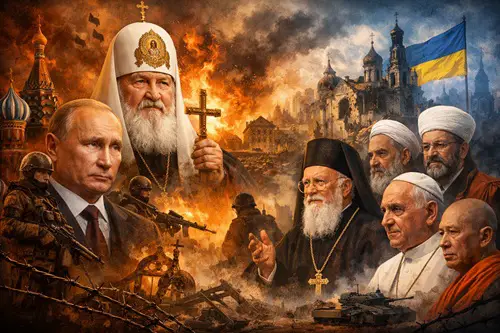 When Russian President Vladimir Putin and Patriarch Kirill cast the invasion of Ukraine in sacred terms, they did more than justify a military campaign—they theologized it. By invoking the defense of “Holy Russia,” spiritual unity, and civilizational struggle against a decadent West, they elevated a geopolitical conflict into a metaphysical drama. Yet this sacralization of war is far from universally accepted within Eastern Orthodoxy, let alone among the world's religions. Across patriarchates, churches, and interfaith bodies, sharply divergent interpretations have emerged—ranging from explicit endorsement, to uneasy ambivalence, to unequivocal condemnation. The result is not a unified religious front, but a fractured spiritual landscape in which theology, nationalism, and moral reasoning collide. 1. The Orthodox Landscape: Fragmented ResponsesA. Russian Orthodox Church and the “Holy War” NarrativeAmong Eastern-Orthodox communities, the most prominent religious articulation of the war comes from the Russian Orthodox Church (Moscow Patriarchate) under Patriarch Kirill. The church has increasingly aligned with the Russian state's narrative: Patriarch Kirill and Moscow Patriarchate authorities have provided religious legitimation of the invasion, framing Russia's military actions as a defensive “Holy War” against perceived Western moral decay and geopolitical threat. They describe the conflict as protecting a unified spiritual entity (“Holy Russia”) and resisting globalism and Western secularism, even suggesting that Russia's role in the conflict is part of a cosmic struggle. The declaration states Russia is defending a “single spiritual space” and portrays the war as spiritually righteous. This framing has extended to liturgical practice: Kirill has issued victory prayers and tied military sacrifice to spiritual reward. Refusal to endorse these prayers or war blessings has led to punitive measures—including defrocking priests who refuse to support official war prayers. Kirill's position has been widely criticized as blending nationalism with ecclesiology and misusing religious language to justify political violence. B. Opposition Within OrthodoxyDespite the dominant Moscow narrative, there are significant Orthodox voices that reject or critique this religious framing: The Ecumenical Patriarchate (based in Constantinople/Istanbul), which is recognised as “first among equals” in Orthodoxy, has denounced the Moscow Patriarch's support for the invasion, emphasizing that war cannot be sanctified. Its spiritual leader, Ecumenical Patriarch Bartholomew, has publicly criticized the Russian church's endorsement of violence and reaffirmed support for an independent Ukrainian Orthodox Church free from Moscow control. Conversely aligned Orthodox jurisdictions have taken a strong peace line: theologians and clergy across Greece, Ukraine, Romania, and beyond issued the Volos Declaration, condemning the ideology driving the invasion and labeling it heretical—explicitly rejecting the Russkii mir (Russian World) teaching. Within the Russian Orthodox Church itself, there have been grassroots calls from individual priests and monks calling for reconciliation and an immediate ceasefire, pleading with Kirill to act for peace. Local Orthodox leaders in Europe and the Baltics—for example in Lithuania—have openly stated they do not share the geopolitical and theological interpretation endorsed by Moscow and have moved to structures aligned with Constantinople. Thus, there is no monolithic “Orthodox Christian” position on the war—there are deep fractures shaped by national and ecclesiastical loyalties, geopolitical contexts, and theological convictions. 2. Broader Christian Reactions (Non-Orthodox)Roman Catholic ChurchThe response from the Catholic Church has been far more oriented toward peace and humanitarian concern than holy war rhetoric: The Pope (currently Pope Leo XIV, successor to Francis) has repeatedly condemned the conflict's human toll and insisted that war must end and peace negotiated without delay. He has explicitly framed war as a tragic failure of humanity incompatible with Christian teaching. Previous statements from Pope Francis emphasized that “God is peace… not the guide toward war,” implicitly critiquing the church-state alliance in the Russian context. The Holy See has consistently engaged in interfaith and diplomatic initiatives aimed at peacebuilding, urging religious communities to reject violence and to advocate for dialogue. Catholic leaders, including figures from the Ukrainian Greek Catholic Church, have also condemned the Russian narrative and emphasized justice and defense of the persecuted as central Christian duties. Protestant, Evangelical, and Other Christian VoicesLeaders from various Protestant traditions—especially within Ukraine—have united in calling for peace and condemning Russian aggression; many explicitly reject any theology that sanctifies violence or justifies invasion. Their message generally emphasizes love for neighbor, national self-defense framed as protection of innocents, and solidarity with victims. 3. Interfaith and World Religions' PerspectivesInterfaith OrganizationsEntities like Religions for Peace—an interreligious network including Buddhists, Christians, Muslims, Hindus, and others—have issued collective statements rejecting all forms of violence and calling for a peaceful resolution. These statements specifically reject invoking religion to justify war. Conferences of world religious leaders (e.g., in Astana) have condemned violence in both Gaza and Ukraine and stressed the need for mutual respect, understanding, and dialogue—highlighting that religion should be a bridge for peace, not a tool for division. Islamic PerspectivesIslamic responses have varied by region and institution: Major Muslim organizations and leaders have condemned war and violence generally, urging peace and humanitarian responses. In Russia, however, the head of the Buddhist Traditional Sangha voiced support for the invasion—representing how some religious authorities aligned with state narratives. Other Buddhist leaders, including the Dalai Lama, have publicly expressed deep anguish over the suffering and called for a swift return to peace, underscoring the shared religious ethic that war is outdated. Other world religions (e.g., Hindu, Sikh, Bahá'í, Jain) represented in interfaith peace statements have consistently upheld non-violence and the rejection of religious justification for war. JudaismJewish leaders at interfaith forums have stressed that the Ukraine conflict is not a religious war and affirmed the importance of respecting all faiths, while lamenting the suffering caused by political violence. 4. Synthesis: Religion, War, and Competing NarrativesOverall, the religious landscape surrounding the Ukraine war reveals competing visions: In Moscow, state-aligned religious rhetoric has been deployed to sanctify geopolitical aims, blending national identity with ecclesiastical authority. Within Orthodoxy and across other Christian traditions, there is a strong counter-narrative asserting that true religious teaching cannot justify violence and must promote peace, compassion, and reconciliation. Interfaith initiatives have emphasized shared ethical commitments across religions—especially the rejection of violence and exploitation of faith for political agendas—calling for cooperative peace efforts. These patterns show that religious interpretations of the war are not monolithic. They are shaped by institutional alliances, historical memory, theological principles, and geopolitical contexts. While some leaders use religious language to rally believers around national causes, others insist that religion's core teachings fundamentally oppose war as a sacred enterprise. In the broader religious imagination, then, the conflict in Ukraine is less a sanctioned “holy war” than a profound moral crisis—one that challenges religious communities to articulate and live out principles of peace, justice, and human dignity amid violent struggle.
Widget is loading comments...
|