|
TRANSLATE THIS ARTICLE
Integral World: Exploring Theories of Everything
An independent forum for a critical discussion of the integral philosophy of Ken Wilber
  Frank Visser, graduated as a psychologist of culture and religion, founded IntegralWorld in 1997. He worked as production manager for various publishing houses and as service manager for various internet companies and lives in Amsterdam. Books: Ken Wilber: Thought as Passion (SUNY, 2003), and The Corona Conspiracy: Combatting Disinformation about the Coronavirus (Kindle, 2020). Frank Visser, graduated as a psychologist of culture and religion, founded IntegralWorld in 1997. He worked as production manager for various publishing houses and as service manager for various internet companies and lives in Amsterdam. Books: Ken Wilber: Thought as Passion (SUNY, 2003), and The Corona Conspiracy: Combatting Disinformation about the Coronavirus (Kindle, 2020).
Check out my other conversations with ChatGPT Preemption as Imperial StrategyVladimir Putin and the War Against UkraineFrank Visser / ChatGPT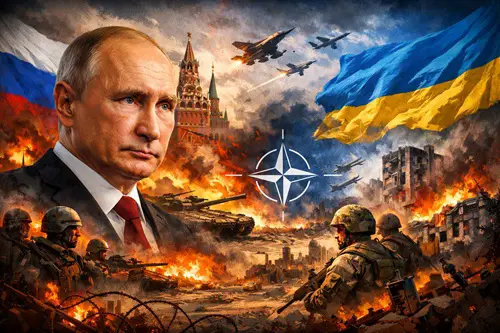 When Russia launched its full-scale invasion of Ukraine on 24 February 2022, the Kremlin framed it not as aggression but as necessity: a forced, pre-emptive act to prevent an existential threat. Four years later, after hundreds of thousands of casualties, devastated cities, and a permanently altered European security landscape, that framing remains central to Moscow's justification. Understanding the war requires taking this rationale seriously—not as a valid claim, but as the core ideological construct that made the invasion conceivable and sustainable. This is a war born not of immediate military danger, but of geopolitical loss aversion. Ukraine's Westward DriftFrom Moscow's perspective, Ukraine's gradual integration with Western institutions was the real casus belli. Key milestones: • The 2004 Orange Revolution signaled resistance to Kremlin-backed political control. • The 2014 Maidan uprising ousted the pro-Russian president and set Kyiv firmly on a pro-European course. • The EU Association Agreement formalized economic and political alignment with Europe. • NATO cooperation deepened, even without formal membership. To Western policymakers, this reflected Ukrainian sovereignty. To the Kremlin, it represented encroachment into what it considers its historical sphere of influence. For Putin, Ukraine is not simply a neighboring state. It is, in his published essays and speeches, part of a “historical Russia”—a civilizational unity artificially divided. An independent Ukraine leaning West is therefore not merely geopolitically inconvenient; it is ideologically intolerable. The Logic of “Preemption”The invasion was publicly justified as a defensive necessity: to stop NATO expansion, to prevent Ukraine from becoming a Western military platform, and to protect Russian speakers in Donbas. This mirrors a broader doctrine articulated in Russian strategic thought: threats must be neutralized before they fully materialize. The preemption argument rested on three premises: • NATO would eventually admit Ukraine. • Western weapons systems would permanently alter the strategic balance. • A culturally Westernized Ukraine would become a permanent ideological reproach to Russian authoritarian governance. The third premise may have been the most decisive. A successful, democratic, EU-integrated Ukraine on Russia's border undermines the Kremlin narrative that Slavic societies require centralized, vertical power structures. It would demonstrate that an alternative post-Soviet trajectory is viable. Thus, the invasion functioned as a preventive war—not against tanks poised at the border, but against political drift. The Imperial FramePutin's July 2021 essay “On the Historical Unity of Russians and Ukrainians” made clear that he does not regard Ukraine as fully sovereign in the Western sense. This historical narrative frames modern Ukrainian nationalism as artificial and externally manipulated. Within that worldview: • Ukrainian Westernization equals civilizational betrayal. • NATO expansion equals strategic encirclement. • Color revolutions equal regime-change operations orchestrated by Washington. Preemption, then, becomes not optional but necessary. Rationalizing Four Years of DestructionFour years into the war, the original expectation of a swift collapse of Kyiv has long evaporated. Instead, Russia has absorbed massive military losses, sweeping sanctions, economic isolation from much of Europe, and long-term strategic damage. How is this sustained rhetorically? 1. Existential FramingThe war is now described as a struggle against the “collective West,” not merely Ukraine. By elevating the conflict to civilizational scale, any cost becomes defensible. Sacrifice signals seriousness. 2. Escalation CommitmentPsychologically and politically, retreat would invalidate the initial preemption narrative. If the war was necessary to prevent catastrophe, abandoning it implies the catastrophe was exaggerated—or imaginary. Thus, continuation becomes self-justifying. 3. Territorial FormalizationBy annexing occupied regions and incorporating them constitutionally, Moscow reframed the war as defense of Russian territory. This shifts the rhetorical terrain from expansion to protection. 4. Information ControlDomestic media ecosystems minimize losses and amplify narratives of Western aggression. The war is presented as forced upon Russia by NATO provocation and Ukrainian extremism. Strategic Reality vs. Narrative ContinuityFrom a realist perspective, the invasion produced the very outcome it sought to prevent: • NATO expanded further. • Ukraine's Western identity consolidated. • Europe rearmed at scale. • Russian influence in Europe contracted dramatically. Preemption became self-fulfilling encirclement. Yet internally, the narrative remains stable because it does not depend on empirical success. It depends on historical grievance, civilizational mythology, and regime survival logic. The Core ContradictionIf Ukraine was drifting West by choice, then the invasion was not defensive but coercive. It sought to deny Ukraine strategic agency. Putin's preemption argument ultimately rests on rejecting Ukraine's right to choose its alignments. The tragedy of the war lies in this refusal. What Moscow defined as existential threat was, in fact, a neighboring society exercising sovereign preference. ConclusionThe invasion of Ukraine can be understood as a preventive war against geopolitical and ideological loss. It was not triggered by imminent attack but by the intolerable prospect of permanent Western integration. Four years later, the rationalization endures because it has expanded: from preventing NATO membership to defending Russian civilization itself. The costs—human, economic, moral—are immense. But within the Kremlin's framework, they are framed as the unavoidable price of resisting historical diminishment. Preemption, once invoked, has no natural endpoint. It becomes identity.
Widget is loading comments...
|