|
TRANSLATE THIS ARTICLE
Integral World: Exploring Theories of Everything
An independent forum for a critical discussion of the integral philosophy of Ken Wilber
  Frank Visser, graduated as a psychologist of culture and religion, founded IntegralWorld in 1997. He worked as production manager for various publishing houses and as service manager for various internet companies and lives in Amsterdam. Books: Ken Wilber: Thought as Passion (SUNY, 2003), and The Corona Conspiracy: Combatting Disinformation about the Coronavirus (Kindle, 2020). Frank Visser, graduated as a psychologist of culture and religion, founded IntegralWorld in 1997. He worked as production manager for various publishing houses and as service manager for various internet companies and lives in Amsterdam. Books: Ken Wilber: Thought as Passion (SUNY, 2003), and The Corona Conspiracy: Combatting Disinformation about the Coronavirus (Kindle, 2020).
Check out my other conversations with ChatGPT Who's Winning the Ukraine War?Definitions, Metrics, and MythsFrank Visser / ChatGPT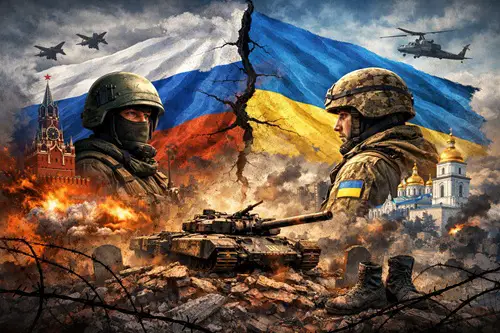 Public argument about the war between Russia and Ukraine has fractured into incompatible interpretive camps. Some observers describe Russia as the victim of Western encroachment and even as strategically “winning.” Others maintain that Russia launched an aggressive war and has failed to achieve its stated objectives. The purpose of this essay is not polemic but clarification. Disagreement persists largely because participants are using different definitions, timelines, and evaluative criteria. Once those are made explicit, the debate becomes more tractable. I. The Baseline Fact PatternIn February 2022, Russian forces crossed internationally recognized Ukrainian borders in a large-scale invasion. This is not a matter of Western spin but of documented military movement. Whatever the geopolitical prehistory, the initiating act of cross-border force was Russian. This does not automatically resolve the moral or strategic debate. But it establishes agency. Any argument portraying Russia purely as a passive victim must shift the frame from the event itself to earlier causes. II. Expanding the Timeline: The “Provocation” ArgumentThe most common justification for Russia-as-victim reframes the conflict as a reaction to: • NATO expansion eastward, • The possibility of Ukrainian NATO membership, • The status of Russian-speaking populations in Donbas, • Western influence following the Maidan revolution. In this longer causal chain, the invasion is interpreted as a preemptive defensive measure rather than aggression. This is a serious geopolitical argument. However, two clarifications are essential: • Strategic grievance does not eliminate agency. States may perceive threats, but preventive war remains a policy choice. • International law does not recognize anticipated alignment as casus belli. Feeling strategically encircled is not equivalent to being attacked. Thus, the victim narrative depends on redefining defensive war to include preemptive expansion. III. What Does “Winning” Actually Mean?The term “winning” is frequently invoked without specification. It can mean at least four different things: 1. Territorial GainHas Russia increased its control relative to pre-invasion lines? In some areas, yes. Has it achieved rapid regime change, full Donbas control, or political subjugation of Kyiv? No. 2. Strategic ObjectivesIf early aims included: • “Demilitarizing” Ukraine, • Blocking NATO expansion, • Reasserting regional dominance, then outcomes are mixed. Ukraine is now more heavily armed than before. NATO has expanded (Finland and Sweden joined). Western cohesion initially strengthened. 3. Attritional EnduranceIn a war of attrition, “winning” may mean outlasting the opponent economically and demographically. Some analysts argue Russia's larger resource base allows it to absorb losses longer than Ukraine. But attritional survival is not identical with strategic success. It can result in immense self-inflicted cost. 4. Narrative or Ideological VictoryIf the war is framed as resistance against Western hegemony, then merely preventing Western “defeat” of Russia may count symbolically as victory. In this paradigm, endurance equals success. Each definition yields different conclusions. Without clarifying which metric is being used, the term “winning” becomes rhetorical rather than analytical. IV. The Human LedgerAfter years of war: • Massive casualties on both sides. • Large-scale infrastructure destruction. • Displacement of millions. • No decisive breakthrough. If the initiating party sought a short war and rapid political transformation, that objective failed. Calling the outcome a success requires either lowering the bar of success or redefining the original aims. V. The “You're Indoctrinated” Reflex — Projection and PropagandaA recurring move in debate is the accusation that critics of Russia are “indoctrinated by the West,” “CIA-influenced,” or merely repeating NATO talking points. This rhetorical strategy deserves scrutiny. First, it functions as preemptive delegitimization. Instead of engaging substantive claims (e.g., who crossed the border, what objectives were stated, what outcomes occurred), it attacks the epistemic integrity of the interlocutor. Second, it often mirrors the very phenomenon it claims to expose. Many of the arguments advanced in defense of Russia—such as: • Ukraine being run by “Nazis,” • The war being purely defensive against NATO aggression, • The West orchestrating a global conspiracy to destroy Russia, closely track official narratives disseminated through Russian state media and affiliated outlets. In other words, the accusation of Western indoctrination frequently coexists with uncritical repetition of Russian state framing. This is a classic case of projection in information warfare: attributing propaganda susceptibility to one's opponent while internalizing a different propaganda stream. Third, the CIA/NATO accusation simplifies a pluralistic media environment into a monolith. Western discourse contains intense internal disagreement—across governments, think tanks, academics, and journalists. To describe all criticism of Russia as CIA scripting collapses this complexity into caricature. Serious analysis requires symmetrical skepticism: • Western governments produce propaganda. • Russian governments produce propaganda. The task is not to switch allegiance from one narrative apparatus to another, but to apply consistent standards of evidence. VI. Why Intellectual Camps DivergeThe disagreement is not only empirical; it is philosophical. Some commentators operate within: • Geopolitical realism: Great powers enforce spheres of influence. • Multipolar enthusiasm: Weakening U.S. dominance is intrinsically positive. • Anti-Western critique: Western hypocrisy justifies counter-hegemonic force. • Civilizational framing: Russia as defender of tradition against liberal modernity. Others prioritize: • Sovereignty norms, • Non-aggression principles, • Measurable strategic outcomes, • Human cost. These frameworks rest on different axioms. If one sees international order primarily as a contest among great powers, Russian action appears structurally predictable. If one centers sovereignty and non-aggression, it appears as unlawful expansion. Different axioms produce different verdicts. VII. Conclusion: Conceptual Discipline Over Tribal ReflexIf we are to debate responsibly, three distinctions must be maintained: Causation vs. justification Explaining why Russia acted does not automatically justify the action. Endurance vs. success Surviving a conflict is not identical to achieving original objectives. Critique of the West vs. absolution of Russia Western policy errors do not dissolve Russian agency. Finally, accusations of indoctrination should not substitute for argument. The presence of propaganda on one side does not validate propaganda on the other. If Russia initiated the large-scale assault and has not achieved its maximal aims after years of war and enormous losses, describing that as an unequivocal success requires rigorous defense—not rhetorical inversion. Clarity is not naivety. It is the prerequisite for serious discourse.
Widget is loading comments...
|