|
TRANSLATE THIS ARTICLE
Integral World: Exploring Theories of Everything
An independent forum for a critical discussion of the integral philosophy of Ken Wilber
  Frank Visser, graduated as a psychologist of culture and religion, founded IntegralWorld in 1997. He worked as production manager for various publishing houses and as service manager for various internet companies and lives in Amsterdam. Books: Ken Wilber: Thought as Passion (SUNY, 2003), and The Corona Conspiracy: Combatting Disinformation about the Coronavirus (Kindle, 2020). Frank Visser, graduated as a psychologist of culture and religion, founded IntegralWorld in 1997. He worked as production manager for various publishing houses and as service manager for various internet companies and lives in Amsterdam. Books: Ken Wilber: Thought as Passion (SUNY, 2003), and The Corona Conspiracy: Combatting Disinformation about the Coronavirus (Kindle, 2020).
Check out my other conversations with ChatGPT The Career of a ConceptMemes from Evolutionary Theory to Digital CultureFrank Visser / ChatGPT
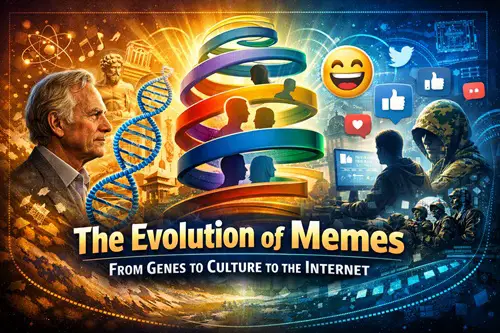 Few ideas have traveled as widely—and mutated as freely—as the concept of the “meme.” Coined in 1976 by Richard Dawkins in The Selfish Gene, the meme began as a theoretical construct within evolutionary biology. Today it is shorthand for viral internet jokes, ideological contagion, political manipulation, developmental worldviews, and even civilizational dynamics. This essay traces the major uses of the meme concept, examines its critics, and evaluates its contemporary relevance. 1. The Original Formulation: Cultural ReplicatorsDawkins introduced the meme as a cultural analogue to the gene. Just as genes propagate through biological reproduction, memes propagate through imitation. Examples included tunes, catchphrases, religious beliefs, architectural styles, and scientific theories. Three properties defined a meme in this framework: • Fidelity (accuracy of copying) • Fecundity (rate of spread) • Longevity (persistence over time) The meme was intended as a Darwinian unit of cultural selection. Cultural forms compete for cognitive bandwidth. Successful memes are those that replicate efficiently—not necessarily those that are true or socially beneficial. Contemporary relevance: This model helps explain why misinformation and conspiracy narratives can outcompete sober analysis in high-velocity information ecosystems. 2. Memetics as a Proposed ScienceIn the 1990s, thinkers such as Susan Blackmore (The Meme Machine) attempted to establish memetics as a formal scientific discipline. Culture was reinterpreted as a second replicator system layered atop genetics. Human cognition itself was seen as shaped by memetic competition. Blackmore later proposed “temes” (technological memes), anticipating algorithmic and machine-mediated replication. Despite initial enthusiasm, memetics failed to consolidate as a robust research program. Contemporary relevance: While memetics as a standalone science receded, evolutionary models of culture remain influential in network theory, behavioral economics, and computational social science. 3. Spiral Dynamics and vMEMEsThe meme concept was reinterpreted in developmental terms by Don Beck and Chris Cowan in Spiral Dynamics. Here, memes—specifically “vMEMEs”—represent structured value systems rather than isolated cultural units. In this framework: • A vMEME is a coherent worldview. • It organizes cognition, identity, and moral judgment. • It emerges in response to life conditions. • Development proceeds through successive vMEMEs. Unlike Dawkinsian memes, vMEMEs are macro-structures. They resemble developmental stages more than replicators. The term “meme” here functions metaphorically rather than biologically. Contemporary relevance: Spiral Dynamics has influenced leadership theory, political analysis, and integral philosophy. Its use of “meme” illustrates conceptual expansion—but also terminological drift. The risk is conflating viral transmission with psychological development. 4. Internet Memes: Vernacular UsageIn digital culture, “meme” now refers to viral images, videos, or catchphrases circulating on platforms such as Reddit, X, and TikTok. Digital memes display: • Rapid replication • High mutation rates • Short selection cycles • Measurable diffusion patterns Here, the meme behaves more closely to Dawkins' original replicator model. Copying is literal and traceable. Contemporary relevance: Internet memes compress ideology into emotionally charged signals. They are instruments of identity formation and polarization. 5. Memes as Strategic InstrumentsThe meme concept has entered the vocabulary of information warfare. Political actors deploy meme campaigns to influence public perception, amplify outrage, and destabilize consensus. Algorithmic amplification creates selection pressures favoring: • Emotional intensity • Tribal signaling • Simplification • Moral absolutism In this environment, memetic fitness often overrides epistemic validity. Contemporary relevance: Memetic awareness is now part of media literacy. Citizens operate inside replication networks whether they recognize it or not. 6. Critics of the Meme ConceptThe meme concept has attracted sustained criticism across disciplines. 6.1 Conceptual VaguenessAnthropologist Dan Sperber argued that cultural transmission is reconstructive rather than replicative. Ideas are reinterpreted by cognitive systems rather than copied like genes. The “unit” of transmission is therefore unstable. Similarly, evolutionary biologist Stephen Jay Gould criticized gene-centric reductionism more broadly, warning against overly simplistic Darwinian extensions into culture. 6.2 Lack of Empirical PrecisionCritics note: • No clear operational definition of a meme • No identifiable cultural equivalent of DNA • No agreed measurement of memetic fitness Without clear units and mechanisms, memetics risks becoming metaphorical rather than scientific. 6.3 ReductionismSome social theorists argue that memetics reduces complex socio-historical phenomena to blind replication dynamics. Institutions, power structures, and material conditions cannot be adequately explained by imitation alone. 6.4 ReificationWhen memes are described as if they “want” to replicate, explanatory agency subtly shifts from human actors to abstract entities. This can obscure responsibility and intentionality. 7. Cognitive Epidemiology: A RevisionIn response to such critiques, cultural epidemiology reframes the issue. Instead of asking “What is the meme?” it asks “Why are certain representations more likely to spread?” This approach studies: • Cognitive biases • Emotional salience • Social identity mechanisms The mind becomes the selective environment; transmission becomes probabilistic rather than particulate. Contemporary relevance: This model is empirically more tractable and better aligned with findings in cognitive psychology. 8. Artificial Intelligence and Synthetic MemeticsAI systems now generate and optimize memetic content at scale. Algorithmic curation intensifies selection pressures in real time. Machine-generated content accelerates mutation cycles beyond human tempo. We are witnessing: • Automation of cultural replication • Feedback loops between engagement metrics and content generation • Hybrid human-machine memetic ecosystems Contemporary relevance: Memetic evolution is no longer purely human-driven. The ecology has become techno-cultural. Conclusion: A Concept Worth Retaining—With CautionThe meme began as a Darwinian thought experiment. It expanded into developmental psychology, internet culture, and geopolitical strategy. It has also been criticized for vagueness, reductionism, and metaphorical overreach. Three disciplined takeaways remain valuable: • Ideas compete for attention. • Transmission dynamics shape belief landscapes. • Fitness and truth are independent variables. The meme concept remains analytically useful when treated as a heuristic rather than an ontological claim. Its greatest value today lies not in founding a new science, but in sharpening our awareness of how ideas propagate, mutate, and entrench themselves in an increasingly accelerated informational environment.
Widget is loading comments...
|