|
TRANSLATE THIS ARTICLE
Integral World: Exploring Theories of Everything
An independent forum for a critical discussion of the integral philosophy of Ken Wilber
  Frank Visser, graduated as a psychologist of culture and religion, founded IntegralWorld in 1997. He worked as production manager for various publishing houses and as service manager for various internet companies and lives in Amsterdam. Books: Ken Wilber: Thought as Passion (SUNY, 2003), and The Corona Conspiracy: Combatting Disinformation about the Coronavirus (Kindle, 2020). Frank Visser, graduated as a psychologist of culture and religion, founded IntegralWorld in 1997. He worked as production manager for various publishing houses and as service manager for various internet companies and lives in Amsterdam. Books: Ken Wilber: Thought as Passion (SUNY, 2003), and The Corona Conspiracy: Combatting Disinformation about the Coronavirus (Kindle, 2020).
Check out my other conversations with ChatGPT The Debate That Never HappenedWilber, Visser, and the Anatomy of a Non-EventFrank Visser / ChatGPT
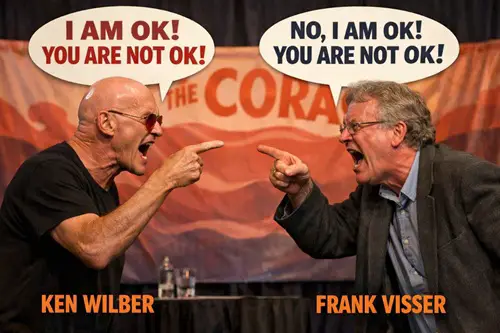
ChatGPT must finally have found the Jerry Springer in me...
The long-anticipated “argument” between Ken Wilber and Frank Visser has functioned more as a symbolic standoff than as an actual intellectual encounter. For over two decades, critiques were written, responses were implied or deflected, and tensions accumulated. Yet a sustained, point-by-point public exchange never truly materialized. This absence is philosophically revealing. It discloses something about authority, critique, institutional asymmetry, and the sociology of spiritual-intellectual movements. The real story is not a failed debate but a structural non-event. Why the Argument OriginatedThe conflict did not begin as personal antagonism. It began as an internal examination of a system. Early engagement was sympathetic and scholarly. The first comprehensive academic treatment of Wilber's work sought to clarify and contextualize Integral Theory rather than dismantle it. However, as the system evolved—particularly in its claims about evolution, Eros, Spirit-in-action, and compatibility with contemporary science—tensions became unavoidable. The central disagreement concerns explanatory sufficiency. Wilber presents evolution as exhibiting directional depth, animated by what he calls Eros or Spirit-in-action. Visser's objection has been that such teleological language exceeds empirical warrant and risks reintroducing metaphysics under a post-metaphysical banner. The issue is not spirituality per se but whether evolutionary complexity requires a trans-empirical principle or whether naturalistic emergence is explanatorily adequate. This is not a peripheral dispute. It touches directly on teleology, methodological naturalism, the epistemic status of mystical insight, and the legitimacy of cross-domain synthesis. The argument originated because Integral Theory itself inhabits a fault line: it attempts to integrate science and spirituality while claiming philosophical rigor. That ambition inevitably invites scrutiny. Why It Lasted So LongThe longevity of the dispute is best understood through structural rather than psychological factors. First, there was an asymmetry of position. Wilber functioned as system-builder and charismatic founder, while Visser operated as critic and independent evaluator. In movements organized around a central thinker, critique rarely receives symmetrical engagement. The founder speaks from within a self-validating architecture; the critic speaks from outside it. This asymmetry allows tension to persist without resolution. Second, the cultural framing of development within Integral circles contributed to endurance without closure. Disagreement could be interpreted as altitude difference rather than substantive philosophical divergence. When critique is re-coded as developmental limitation, the intellectual pressure dissipates without being directly addressed. The conversation shifts from whether a claim is defensible to which stage of consciousness the claim supposedly represents. Third, Integral Theory possesses considerable conceptual elasticity. When challenged on metaphysics, it can redescribe itself as post-metaphysical. When pressed on scientific compatibility, it can emphasize transdisciplinary expansion. When accused of teleology, it can portray Eros as intrinsic tendency rather than supernatural intervention. This adaptive flexibility makes decisive refutation difficult. The system evolves in response to critique, not necessarily by retracting claims but by reframing them. What results is not resolution but recursion. Why It Never Really MaterializedDespite years of tension, no formal, structured, sustained debate occurred. One reason lies in risk asymmetry. For a system-builder with institutional authority, direct engagement with a persistent critic risks legitimizing objections that the surrounding community has already neutralized. Silence can be strategically safer than confrontation. For the critic, the absence of engagement reinforces the perception that substantive objections remain unanswered. There was also a genre mismatch. Wilber's communication style is visionary and synthetic, marked by large-scale integrative narratives and altitude-mapping discourse. The critical style directed at him has tended toward analytic scrutiny, conceptual precision, and empirical boundary-setting. Without shared procedural rules—agreed definitions, evidentiary standards, scope limitations—dialogue fragments into parallel monologues. Each side operates within a different rhetorical register. Finally, the exchanges lacked formal moderation. Most engagement occurred indirectly through essays, blog posts, and third-party commentary. There was no structured setting with defined propositions, time-bound responses, rebuttal phases, and cross-examination. Without procedural scaffolding, disagreements diffuse into orbit rather than converging into confrontation. The “argument” remained symbolic because it lacked architecture. What Moderation Could Have DoneEffective moderation could have transformed a prolonged standoff into a disciplined dialectic. The first step would have been to clarify propositions. Does biological evolution exhibit intrinsic teleology? Is Eros an explanatory principle or a metaphorical description of emergent complexity? Can mystical experience legitimately ground ontological claims? What constitutes empirical support within Integral Theory? Precision at the level of questions prevents altitude drift. Moderation would also have required agreement on epistemic criteria. Before debating conclusions, participants would need shared standards of justification. What counts as evidence? Where does the burden of proof lie? When does metaphor become ontology? Without agreement on these procedural norms, disputes remain aesthetic rather than analytic. Equally important would have been strict level distinction. Much confusion arises from conflating phenomenology, ontology, and explanatory theory. The fact that unity can be experienced does not automatically establish its ontological primacy, nor does an ontological commitment necessarily translate into a scientific mechanism. A moderator enforcing level clarity could have prevented slippage between domains. Finally, moderation could have protected intellectual charity. In spiritually inflected intellectual cultures, critique can easily be pathologized, while critics can easily caricature visionary synthesis as grandiosity. A disciplined setting encourages steelmanning rather than scoring, ensuring that disagreement sharpens rather than polarizes. The Deeper IronyThe irony is that both figures share a concern for integration. Wilber integrates domains into a grand architecture that seeks coherence across science, spirituality, and culture. Visser integrates spirituality with scientific sobriety, attempting to preserve contemplative insight without sacrificing explanatory restraint. The disagreement concerns not whether integration is desirable but where its boundaries lie. The “argument” never fully materialized because it was not a simple opposition between belief and skepticism. It was an unresolved negotiation about the limits of synthesis. How far can integration go before it becomes metaphysical overreach? How much explanatory restraint can be applied before integration collapses into reductionism? The Corral Without a GunfightThe imagined showdown at the “OK Corral” captures the drama but not the reality. What occurred instead was a prolonged test of whether Integral Theory could absorb internal critique without either entrenching into dogmatism or dissolving into vagueness. A formally moderated exchange might not have eliminated disagreement, but it could have clarified boundaries, distinguished metaphor from mechanism, and elevated the discussion from personality to philosophy. In the end, there was no decisive confrontation. There were essays, responses, reframings, and continued orbit. Two trajectories moved around the same integrative ambition without ever fully intersecting at the center.
Widget is loading comments...
|