|
TRANSLATE THIS ARTICLE
Integral World: Exploring Theories of Everything
An independent forum for a critical discussion of the integral philosophy of Ken Wilber
  Frank Visser, graduated as a psychologist of culture and religion, founded IntegralWorld in 1997. He worked as production manager for various publishing houses and as service manager for various internet companies and lives in Amsterdam. Books: Ken Wilber: Thought as Passion (SUNY, 2003), and The Corona Conspiracy: Combatting Disinformation about the Coronavirus (Kindle, 2020). Frank Visser, graduated as a psychologist of culture and religion, founded IntegralWorld in 1997. He worked as production manager for various publishing houses and as service manager for various internet companies and lives in Amsterdam. Books: Ken Wilber: Thought as Passion (SUNY, 2003), and The Corona Conspiracy: Combatting Disinformation about the Coronavirus (Kindle, 2020).
Check out my other conversations with ChatGPT Parsimony and the Limits of Epistemic AuthorityExamining the Assumption at the Heart of Critiques of Integral TeleologyFrank Visser / ChatGPT
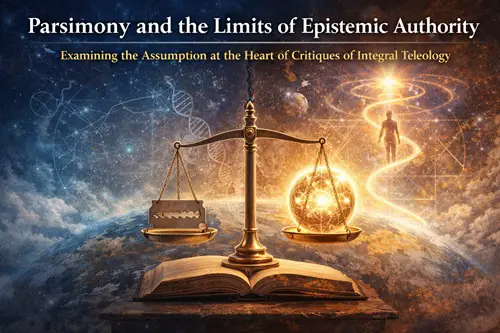 In any critique of Ken Wilber, the most compelling challenge arises not from Wilber himself, nor from the inspiring metaphysical claims of integral evolution. The real pressure point lies within the critique: the implicit reliance on parsimony, or Ockham's Razor, as an epistemic norm sufficient to adjudicate metaphysical claims. Parsimony is seductive. It promises clarity, restraint, and defensibility. It instructs us to avoid multiplying entities or principles beyond necessity. In the context of integral theory, it offers an immediate advantage: teleology, Eros, and spiritualized developmental hierarchies are “unnecessary” to explain the observable phenomena of biological and cultural evolution. At first glance, this seems decisive. Why posit intrinsic cosmic purpose when empirical trends can be accounted for by self-organization, natural selection, and emergent complexity? Yet this very reliance contains a hidden vulnerability. Parsimony is a heuristic, not a metaphysical law. It guides explanatory strategy but does not dictate ontological reality. To say that teleology is unnecessary is not to say that it does not exist; it is to say that it is not required for an explanation at a given epistemic level. In other words, parsimony cannot falsify the metaphysical claim. It can recommend restraint in theorizing, but it cannot definitively arbitrate between competing visions of the cosmos. I. Parsimony as Heuristic, Not ArbiterThe principle of parsimony is most compelling within science because science seeks predictive, testable explanations. Within that framework, unnecessary assumptions complicate models without improving explanatory or predictive power. But when the domain shifts from mechanism to ultimate structure—from biology to metaphysics—parsimony's authority diminishes. The universe is not obliged to obey our epistemic economy. A complex or teleological reality is not “false” merely because it is not required by our models. Wilber's integral teleology does not operate solely at the level of efficient causation. It encompasses formal and final causes, drawing from phenomenology, cosmology, and developmental psychology. Its explanatory reach is not intended to reduce the phenomena of evolution to mechanism alone, but to articulate a structural orientation implicit in being. Parsimony can question the necessity of positing Eros, but it cannot definitively rule out its existence. This is the first fracture in the critique. II. Explanatory Sufficiency vs. Ontological CompletenessA related issue arises in distinguishing explanatory sufficiency from ontological completeness. Observing that emergent complexity, self-organization, and evolutionary pressures can account for biological patterns suffices to describe them. But sufficiency at the level of description does not automatically entail metaphysical closure. Reality may contain structural tendencies or constraints beyond those immediately detectable—trends that are empirical only in the broadest statistical sense or revealed through developmental phenomenology. Parsimony assumes that sufficiency at one explanatory level translates into ontological parsimony. Yet this is a philosophical leap. Without additional justification, it risks smuggling a metaphysical preference—a naturalist bias—under the guise of epistemic discipline. The critique becomes internally vulnerable: it claims neutrality while silently imposing a constraint on what kinds of entities or principles may “exist.” III. Parsimony and Structural TeleologyA deeper challenge emerges when considering the nature of structural teleology. Even if we suspend beliefs about Eros as conscious or purposive, certain patterns in reality suggest directionality or constraint. Evolutionary convergence, increasing complexity in certain lineages, and attractor states in complex systems hint at non-random tendencies. Wilber's teleology interprets these patterns as intrinsic orientation. From a purely empirical standpoint, one could argue that invoking intrinsic purpose is unnecessary: the patterns emerge from contingent dynamics. But the move from “unnecessary for explanation” to “unreal” is not logically required. Parsimony cannot adjudicate whether reality itself favors one metaphysical framing over another; it can only guide human theorizing. IV. Epistemic Modesty as a ResponseRecognizing this limitation does not weaken critique; it sharpens it. The proper stance is epistemic modesty: • Teleology is not required for explanatory adequacy. • Claims of intrinsic directionality exceed what can be empirically demonstrated. • The adoption of teleological principles involves philosophical, not purely scientific, commitment. By emphasizing the distinction between methodological restraint and metaphysical judgment, the critique becomes structurally rigorous. It no longer overreaches by claiming falsification; it situates its power in evaluation of evidence and necessity. V. Conclusion: The Contours of the Weakest AssumptionThe weakest assumption in critiques of integral teleology is the unexamined authority of parsimony. While parsimonious reasoning is a powerful guide in epistemology and scientific modeling, it cannot, on its own, decide the metaphysical status of teleology. The universe may be more structurally or teleologically intricate than our explanations require. The critique is strongest when it acknowledges this boundary: Wilber's Eros may be unnecessary for explanation, but that is different from proving it nonexistent. Recognizing this nuance strengthens the philosophical rigor of the argument while avoiding the pitfalls of hidden naturalism or dogmatic reductionism. In sum, parsimony is a guide, not a verdict. Its role is to highlight unnecessary assumptions, not to settle metaphysical truth. Understanding this distinction allows a critique of integral teleology to remain sharp, disciplined, and defensible—even in the face of ambitious metaphysical claims.
Comment Form is loading comments...
|