|
TRANSLATE THIS ARTICLE
Integral World: Exploring Theories of Everything
An independent forum for a critical discussion of the integral philosophy of Ken Wilber
  Frank Visser, graduated as a psychologist of culture and religion, founded IntegralWorld in 1997. He worked as production manager for various publishing houses and as service manager for various internet companies and lives in Amsterdam. Books: Ken Wilber: Thought as Passion (SUNY, 2003), and The Corona Conspiracy: Combatting Disinformation about the Coronavirus (Kindle, 2020). Frank Visser, graduated as a psychologist of culture and religion, founded IntegralWorld in 1997. He worked as production manager for various publishing houses and as service manager for various internet companies and lives in Amsterdam. Books: Ken Wilber: Thought as Passion (SUNY, 2003), and The Corona Conspiracy: Combatting Disinformation about the Coronavirus (Kindle, 2020).
Check out my other conversations with ChatGPT The Internal Strain of Integral TeleologyWhy Wilber's Eros Oscillates Between Metaphor and MetaphysicsFrank Visser / ChatGPT
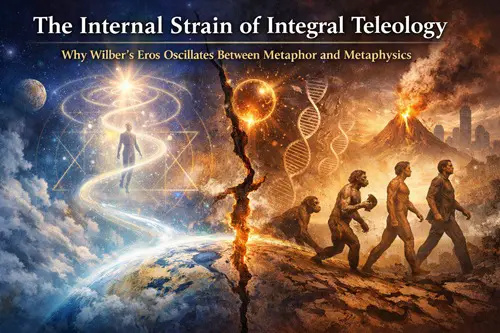 The debate over teleology in contemporary spiritual philosophy is often framed as science versus spirituality, mechanism versus meaning, reductionism versus depth. That framing is misleading. The real issue is internal coherence. In the work of Ken Wilber, teleology appears not as crude supernatural intervention but as an intrinsic developmental orientation of reality itself. Evolution is not merely a contingent process; it is the Kosmos awakening to itself. “Eros” names the immanent drive toward increasing depth, complexity, and consciousness. The claim is ambitious, elegant, and existentially powerful. The question is not whether this narrative is inspiring. It is whether it stabilizes conceptually when examined on its own terms. I. What Integral Teleology Actually AssertsStripped to essentials, the position contains five linked claims: • Reality unfolds developmentally. • Evolution trends toward increasing depth and consciousness. • This trend is intrinsic rather than accidental. • The intrinsic orientation is sometimes named Eros. • Higher developmental stages disclose reality more adequately. This is not young-earth creationism. It does not posit episodic divine intervention. It posits structural directionality embedded within being itself. Teleology here is not external design but immanent unfolding. The issue is whether this unfolding remains descriptively modest or becomes ontologically inflated. II. Probability or Necessity?A central ambiguity runs through the system: does evolution tend toward greater complexity, or is it driven toward it? These are not equivalent. If development is statistical, then extinction events, regressions, and dead ends are fully natural outcomes of contingent processes. The trend is real but not guaranteed. Teleology becomes a description of long-term pattern, not an intrinsic mandate. If development is intrinsic or necessary, then regress and catastrophe must be reinterpreted as phases within an inevitable arc. But this creates a different difficulty: any possible outcome can be retroactively incorporated into the unfolding of Spirit. Collapse, barbarism, and stagnation become moments within a larger logic. When a principle can accommodate every outcome, it risks losing discriminative power. Teleology begins to resemble retrospective pattern recognition rather than forward constraint. The tension here is structural: either teleology is probabilistic and therefore weak, or it is intrinsic and therefore insulated from falsification. III. Description Slipping into NormativityIntegral theory presents developmental hierarchy as descriptive. Matter gives rise to life; life to mind; mind to Spirit. Each level is “more inclusive,” “deeper,” or “more adequate.” Yet the language of depth and inclusion quietly imports value. Later stages are not merely more complex; they are portrayed as more real, more true, more comprehensive. The developmental ladder becomes a ladder of adequacy. This produces a conflation: complexity becomes ontological superiority. Evolutionary biology, however, does not select for metaphysical adequacy. It selects for viability under environmental constraint. Bacteria remain the most successful life form on the planet. Simplicity often outperforms complexity. If higher equals more real, then value has been inserted into ontology. If higher merely means more complex, then teleology loses its spiritual force. Integral teleology depends on this ambiguity. Remove the evaluative surplus, and Eros becomes descriptive trend. Retain it, and ontology absorbs normativity. IV. Explanation or Redescription?A decisive question can be asked with clinical simplicity: What does Eros explain that evolutionary theory does not? If Eros predicts specific outcomes, constrains possible futures, or accounts for anomalies, then it functions as an explanatory principle. If it merely redescribes observed increases in complexity using spiritually resonant language, then it is narrative overlay. An explanatory principle must distinguish between possible and impossible trajectories. Yet integral teleology appears compatible with virtually any evolutionary scenario. Progress, stagnation, collapse, extinction—all are interpreted as moments within Spirit's unfolding. When a principle explains everything, it risks explaining nothing. The instability arises not because teleology is spiritual, but because it lacks discriminative boundaries. V. Developmental Epistemology and CircularityIntegral theory introduces a powerful epistemic claim: higher stages of consciousness disclose more of reality. This move appears generous—different worldviews reflect different developmental altitudes. But it introduces reflexive tension. If teleology is seen primarily from higher developmental stages, then disagreement with teleology can be interpreted as evidence of developmental limitation. Critics are not wrong; they are earlier. This creates a subtle circularity: Teleology is validated because advanced stages perceive it. Advanced stages are validated because they perceive teleology. Such a structure risks epistemic closure. The theory becomes self-sealing. Dissent is reclassified as altitude difference rather than argumentative challenge. A philosophical system that immunizes itself from critique by developmental stratification invites suspicion of conceptual insulation. VI. Involution and Evolution: A Metaphysical ForkIntegral cosmology includes both involution (Spirit descending into matter) and evolution (Spirit rediscovering itself). The symmetry is elegant and mythopoetically satisfying. Yet it generates a metaphysical dilemma. If Spirit fully contains all potentials at the moment of involution, then evolution adds nothing genuinely new. The drama becomes pre-scripted; novelty is apparent rather than real. If evolution introduces genuine novelty, then Spirit was not fully actual at the outset. In that case, the ground of being is incomplete and developing. Either the process is predetermined and redundant, or the Absolute is unfinished. This is not a rhetorical objection. It is a structural fork embedded within the metaphysics itself. VII. The Oscillation Between Metaphor and OntologyThe deepest instability may lie here. When challenged, teleology can retreat into metaphor: Eros is poetic shorthand for complexity and integration. When affirmed, teleology advances into ontology: Eros is intrinsic to the fabric of reality. This oscillation allows flexibility but undermines clarity. If Eros is metaphorical, it cannot ground cosmology. If it is ontological, it requires criteria distinguishing genuine direction from retrospective storytelling. Without such criteria, teleology hovers between inspiration and assertion. VIII. Where the Collapse OccursThe internal strain of integral teleology culminates in one question: Does Eros constrain reality, or does it narrate reality after the fact? If it constrains, then it should render certain trajectories impossible or improbable in principle. If it narrates, it functions as interpretive lens rather than ontological engine. The difficulty is that integral teleology appears compatible with every evolutionary scenario. It predicts growth and accommodates decay. It affirms progress and absorbs catastrophe. Such universality weakens its explanatory traction. The collapse, then, is not dramatic. It is conceptual. Teleology oscillates between statistical trend, normative valuation, and metaphysical claim without stabilizing decisively as any one of them. IX. The Deeper IssueNone of this proves that reality is indifferent. It does not demonstrate that development is purely accidental. It does not refute spiritual interpretations of evolution. It shows something narrower and more precise: Wilber's teleology lacks internal criteria distinguishing ontological structure from retrospective narrative. When a system cannot clearly separate description from valuation, probability from necessity, metaphor from metaphysics, it becomes difficult to determine what exactly is being claimed. That ambiguity is the fault line. Integral teleology does not collapse because science disproves it. It strains because its conceptual components pull in different directions. It promises structural necessity while operating as expansive narrative. It asserts intrinsic direction while accommodating every outcome. The tension is internal, not external. And that is where the philosophical pressure remains.
Comment Form is loading comments...
|