|
TRANSLATE THIS ARTICLE
Integral World: Exploring Theories of Everything
An independent forum for a critical discussion of the integral philosophy of Ken Wilber
  Frank Visser, graduated as a psychologist of culture and religion, founded IntegralWorld in 1997. He worked as production manager for various publishing houses and as service manager for various internet companies and lives in Amsterdam. Books: Ken Wilber: Thought as Passion (SUNY, 2003), and The Corona Conspiracy: Combatting Disinformation about the Coronavirus (Kindle, 2020). Frank Visser, graduated as a psychologist of culture and religion, founded IntegralWorld in 1997. He worked as production manager for various publishing houses and as service manager for various internet companies and lives in Amsterdam. Books: Ken Wilber: Thought as Passion (SUNY, 2003), and The Corona Conspiracy: Combatting Disinformation about the Coronavirus (Kindle, 2020).
Check out my other conversations with ChatGPT
THE LONG DISPUTE OVER EVOLUTION
Creationists and Spiritualists Misuse Evolution The Integral Appropriation of Evolutionary Dissent “You're Still Trapped in Flatland” “Darwinism Can't Explain Shit—Deal with It” Why Spiritual Theories Keep Underestimating Evolution A Manifesto for Taking Evolution Seriously “Male in Siberia, Female in Mexico” - Wilber's Rhetoric in Context “He's a Meta-Theorist—Give Him a Break” Dismissing an “extremely conventional” scientist Where Wilber Finally Draws the Line “His Forte Is Psychology and Culture”—So No TOE? What This Debate Looks Like from the Outside Why Spiritual Theories Keep Underestimating EvolutionA Meta-Analysis of the Recurring Anti-Darwinian TemptationTHE LONG DISPUTE OVER EVOLUTION, Part 5Frank Visser / ChatGPT
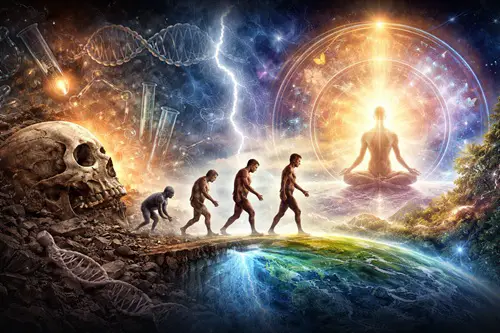
IntroductionAgain and again, spiritually inclined thinkers announce that Darwinism is in trouble. The names and vocabularies change—creationism, intelligent design, integral theory, evolutionary spirituality—but the pattern remains remarkably stable. Scientific minority views are elevated into existential threats, explanatory gaps are treated as failures of principle, and metaphysical narratives rush in to fill the space. This essay asks a deeper question: why does this keep happening? Why do spiritual frameworks, even sophisticated ones like Integral Theory, repeatedly underestimate the resilience, adaptability, and explanatory power of evolutionary biology? The answer lies less in science than in psychology, metaphysics, and rhetoric. 1. The Intolerability of Meaningless SuccessEvolutionary theory delivers an uncomfortable message: it works extraordinarily well without meaning, purpose, or direction. For many spiritual thinkers, this is the core problem. A cosmos in which complexity, intelligence, and consciousness arise through contingent natural processes feels existentially thin—no matter how elegant the science. Thus, evolutionary success itself becomes suspicious. If evolution can explain so much without invoking depth, then depth must be smuggled back in. Spiritual theories therefore look not for failures of evolution, but for excuses to supplement it. 2. Confusing Explanatory Modesty with Ontological FailureScience is structurally modest. It advances by: • acknowledging uncertainty • refining mechanisms • leaving questions open Spiritual systems, by contrast, tend to be architectonic: they promise coherence, wholeness, and final integration. The mistake occurs when scientific humility is misread as metaphysical inadequacy. Unsolved problems in evolutionary biology are interpreted not as research frontiers, but as signs that naturalism cannot, even in principle, account for reality. This category error fuels the perpetual sense that Darwinism is “almost finished.” 3. The Misuse of Dissent as LeverageScientific dissent is normal, localized, and method-bound. Spiritual theorists treat it differently: as leverage. Minority views—punctuated equilibrium, evo-devo, epigenetics, EES—are removed from their disciplinary context and repurposed as philosophical crowbars. Their function is not to improve science, but to destabilize it just enough to justify metaphysical intervention. This explains the paradoxical admiration for dissenting scientists paired with indifference to their conclusions. 4. Teleology EnvyAt bottom lies what might be called teleology envy. Evolutionary biology explains outcomes without goals. Spiritual theories, however, are organized around ascent narratives: growth, depth, realization, awakening. When evolution refuses to cooperate, it must be reinterpreted. Wilber's Eros is exemplary here: a cosmic tendency toward complexity that looks, feels, and functions like purpose—while claiming not to be one. This rhetorical maneuver allows spiritual thinkers to preserve teleology while denying they've imported it. 5. The Asymmetry of BurdenA striking feature of spiritual critiques of evolution is the asymmetry of standards: • Evolution must explain everything mechanistically • Spirit need explain nothing operationally Evolution is interrogated down to the last gene; Spirit floats free of causal specification. Any explanatory gap in science counts against naturalism, but none count against metaphysics. This asymmetry guarantees a perpetual verdict: science is always insufficient; Spirit is always vindicated. 6. Why Wilber Is Not an ExceptionKen Wilber is often defended as uniquely sophisticated. But in this respect, he is typical. His rhetoric—“Darwinism can't explain shit,” “holes large enough to drive Hummers through”—belongs to a long lineage of spiritual polemic. What differs is not structure, but vocabulary. God becomes Eros; design becomes depth; creation becomes self-transcendence. The intellectual move remains unchanged. 7. The Cost of Underestimating EvolutionBy persistently framing evolution as deficient, spiritual theories incur a cost: • They miseducate their audiences about science • They immunize themselves against correction • They turn integration into appropriation Most importantly, they miss what is genuinely radical about evolution: not that it needs spiritual completion, but that it doesn't. ConclusionSpiritual theories keep underestimating evolution because evolution threatens something they hold dear: guaranteed meaning. As long as meaning is treated as something the universe must owe us, Darwinism will always seem inadequate. But this is a demand placed on reality, not a conclusion drawn from evidence. Evolution does not point beyond itself. It points to a world in which complexity arises without promise, intelligence without intention, and depth without design. For many, that is unbearable. For science, it is simply the way things are.
Widget is loading comments...
|