|
TRANSLATE THIS ARTICLE
Integral World: Exploring Theories of Everything
An independent forum for a critical discussion of the integral philosophy of Ken Wilber
  Frank Visser, graduated as a psychologist of culture and religion, founded IntegralWorld in 1997. He worked as production manager for various publishing houses and as service manager for various internet companies and lives in Amsterdam. Books: Ken Wilber: Thought as Passion (SUNY, 2003), and The Corona Conspiracy: Combatting Disinformation about the Coronavirus (Kindle, 2020). Frank Visser, graduated as a psychologist of culture and religion, founded IntegralWorld in 1997. He worked as production manager for various publishing houses and as service manager for various internet companies and lives in Amsterdam. Books: Ken Wilber: Thought as Passion (SUNY, 2003), and The Corona Conspiracy: Combatting Disinformation about the Coronavirus (Kindle, 2020).
Check out my other conversations with ChatGPT
THE LONG DISPUTE OVER EVOLUTION
Creationists and Spiritualists Misuse Evolution The Integral Appropriation of Evolutionary Dissent “You're Still Trapped in Flatland” “Darwinism Can't Explain Shit—Deal with It” Why Spiritual Theories Keep Underestimating Evolution A Manifesto for Taking Evolution Seriously “Male in Siberia, Female in Mexico” - Wilber's Rhetoric in Context “He's a Meta-Theorist—Give Him a Break” Dismissing an “extremely conventional” scientist Where Wilber Finally Draws the Line “His Forte Is Psychology and Culture”—So No TOE? What This Debate Looks Like from the Outside 'You're Still Trapped in Flatland'A Rebuttal of Integral Defenses of Spiritual EvolutionTHE LONG DISPUTE OVER EVOLUTION, Part 3Frank Visser / ChatGPT
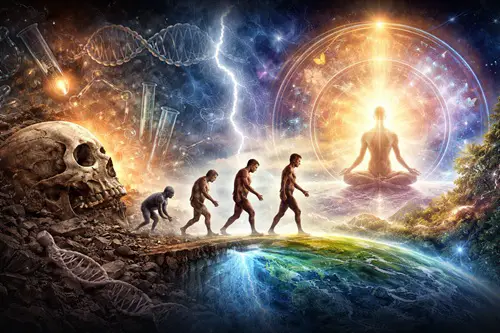 IntroductionWhenever Integral Theory is criticized for smuggling metaphysics into evolutionary biology, the response is strikingly predictable. The critic is accused of misunderstanding Wilber, clinging to reductionism, or confusing “levels” with “lines.” What is rarely addressed is the substance of the critique itself: the systematic misuse of scientific dissent to justify spiritual claims about evolution. This essay responds directly to the most common Integral rebuttals, showing that they function less as clarifications than as rhetorical immunizations against criticism. 1. “You Have a Very Restricted View of Evolution”If “restricted” means I limit evolution to methodological naturalism, then yes—that is deliberate. My view includes contemporary developments such as multilevel selection, developmental systems theory, niche construction, epigenetics, and the Extended Evolutionary Synthesis. What it does not include is intrinsic spiritual teleology. Integral theory expands evolution not by adding new biological mechanisms, but by adding metaphysical direction (Eros). That is an ontological move, not a scientific one. The disagreement is therefore not about how complex evolution is. It is about whether explanatory gaps justify spiritual causation. That is where we part ways. 2. “Integral Says 'Both/And,' Not 'Either/Or'”Another common response is that Integral Theory does not reject Darwinism but merely transcends and includes it. This sounds conciliatory, but functionally it does something else: • it downgrades evolutionary explanation to a partial truth, while elevating Spirit to a deeper causal level. In practice, this means: • evolution explains how changes occur • Spirit explains why they occur But this division of labor is never operationalized. Spirit does no explanatory work beyond affirming directionality, depth, or meaning—qualities evolution allegedly lacks. “Both/and” thus becomes a one-way hierarchy: science supplies facts; metaphysics supplies significance, without constraint or accountability. 3. “You Don't Understand Levels, Lines, and Quadrants”Integral defenders often retreat into framework complexity. If you object to spiritual evolution, you are told you've confused: • interior with exterior • levels with lines • quadrants with domains Yet this technical apparatus does not solve the central problem. It merely redescribes it. The question is simple: Does evolution itself—biological, cultural, or cosmic—exhibit intrinsic spiritual directionality? Integral Theory answers yes, but the evidence offered is invariably interpretive, not empirical. Scientific minority views are cited only to destabilize naturalism, after which metaphysical conclusions are inserted from outside the data. No amount of quadrant mapping turns that maneuver into science. 4. “Science Can't Explain Consciousness or Novelty”This objection has rhetorical force precisely because it exploits open questions. Yes, science does not yet fully explain: • the origin of consciousness • the emergence of complex novelty • the subjective dimension of experience But Integral Theory treats these explanatory gaps as positive evidence for Spirit. This is a classic non sequitur. Lack of a complete explanation does not license the introduction of a metaphysical cause—especially one that is: • undefined • causally unconstrained • empirically inaccessible Calling this move “post-materialist” does not change its structure. It remains a God-of-the-gaps argument, dressed in nondual language. 5. “Eros Is Not a Designer—It's Immanent”Integral defenders often insist that Eros is misunderstood as Intelligent Design. It is not an external planner, they say, but an intrinsic tendency of the cosmos. This distinction is rhetorically clever but explanatorily empty. Whether guidance is: • external or internal • transcendent or immanent the key issue remains: what causal role does it play, and how do we know? Eros explains everything and therefore nothing. It predicts no outcomes, constrains no processes, and can accommodate any evolutionary history whatsoever. That is not integration—it is metaphysical insurance. 6. “You're Reducing Spirit to Science”Integral rhetoric frequently accuses critics of scientism: the demand that all claims be reduced to empirical science. But this flips the critique on its head. The problem is not that Integral Theory posits Spirit. It is that it repeatedly anchors Spirit to science—selectively citing evolutionary debates to legitimize spiritual conclusions. If Spirit is independent of science, then scientific dissent is irrelevant. If Spirit depends on science for credibility, then it must accept scientific standards. Integral Theory wants it both ways. 7. Why These Defenses PersistThese rebuttals endure because they function psychologically and rhetorically, not because they resolve the issue. They: • shift the debate from evidence to interpretation • elevate framework complexity over explanatory rigor • portray critics as spiritually deficient rather than analytically precise Most importantly, they preserve a cherished belief: that evolution is secretly on Spirit's side. ConclusionIntegral Theory presents itself as a bold synthesis, but its defenses of spiritual evolution reveal a familiar pattern. Scientific uncertainty is treated as metaphysical opportunity; minority views are inflated into paradigm threats; and explanatory humility is converted into cosmic meaning. The result is not integration but appropriation—a spiritual narrative riding on the back of scientific dissent. Evolution does not need to be spiritually guided to be profound. And Integral Theory does not become deeper by repeatedly mistaking scientific openness for metaphysical endorsement.
Widget is loading comments...
|